
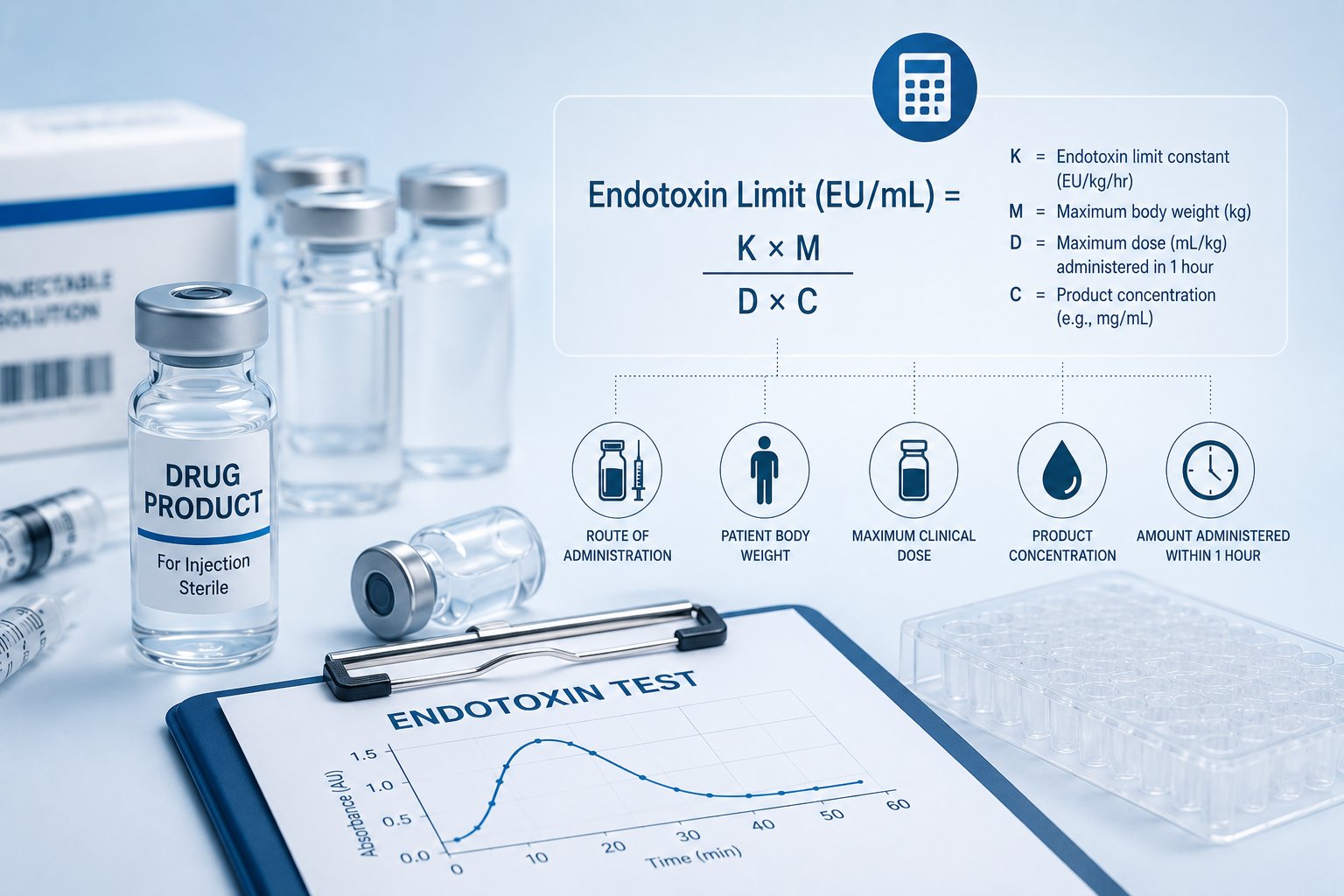
Calculating endotoxin limits is an essential part of developing safe specifications for injectable and parenteral drug products. The calculation establishes the maximum amount of bacterial Endotoxin that may be present in a product based on how much of that product a patient can receive. The correct limit is not a standard number that can be applied to every formulation. It depends on the route of administration, maximum clinical dose, patient body weight, product concentration and the amount administered within one hour. A change in any of these factors can produce a different result. This is why the endotoxin limit should be calculated before the Bacterial Endotoxins Test method development begins. A clear and scientifically justified limit supports Maximum Valid Dilution calculations, method suitability, routine quality control and the final release specification.
What Are Endotoxins?
Endotoxins are components associated with the outer membrane of Gram-negative bacteria. They may remain in a manufacturing environment or material even when the original bacterial cells are no longer viable. When sufficient Endotoxin enters the body through an injectable product, it can cause a pyrogenic response. The possible effects include fever, inflammation and other serious reactions. The level of risk is related to the total endotoxin exposure received by the patient. Because Gram-negative bacteria are widely present in water, raw materials and manufacturing environments, endotoxin control is important throughout pharmaceutical production.
Why Are Endotoxins Important in Pharmaceutical Manufacturing?
Injectable products bypass many of the body’s natural protective barriers. Endotoxin contamination in these products can therefore present a direct patient-safety concern.
A suitable control strategy may include qualified raw materials, controlled water systems, hygienic equipment design, validated cleaning procedures, environmental controls and appropriate testing. The purpose is not simply to obtain a passing laboratory result. Effective endotoxin control helps manufacturers maintain a consistent and safe process from incoming materials through finished-product release.
What Is the Bacterial Endotoxins Test?
The Bacterial Endotoxins Test, commonly called BET, is used to detect or quantify endotoxin activity in a sample. It may be applied to raw materials, water samples, in-process materials and finished drug products, depending on the manufacturing process and applicable requirements.
BET procedures may use gel-clot or photometric approaches. Suitable recombinant reagent-based methods may also be considered where supported by the applicable compendial or regulatory pathway. The method selected for routine testing must be suitable for the product. This is important because formulation ingredients can enhance or inhibit the test response.
What Does the BET Measure?
BET measures endotoxin activity in Endotoxin Units, usually abbreviated as EU. The measured result is compared with the acceptance criterion established for the product. A test result and an endotoxin limit are therefore not the same thing. The limit is the maximum acceptable value, while the test result is the amount detected in the tested sample. Validated sample preparation, suitable controls and product-interference assessment are required to ensure that the result is reliable.
What Is an Endotoxin Limit?
An endotoxin limit is the maximum acceptable endotoxin level for a particular product. For parenteral drugs, it is generally established according to the maximum dose that can be administered to a patient within one hour. The limit is product-specific because clinical dosing varies between products. A drug administered at a high dose usually requires a lower endotoxin limit per unit of product than a drug administered at a low dose. The route also matters. Intrathecal products require a more restrictive value because they are administered into the space containing cerebrospinal fluid.
Endotoxin Limit vs BET Result
The endotoxin limit is the acceptance criterion used to assess the product. It may be expressed in units such as EU/mg, EU/mL or EU/unit. The BET result represents the endotoxin activity measured in the sample. For the product to comply, the reported result must remain within its approved acceptance criterion.
Formula for Calculating Endotoxin Limits
The general formula used for an Endotoxin Limit Calculation is:
Endotoxin limit = K ÷ M
In this formula:
- K represents the maximum acceptable endotoxin exposure associated with the administration route.
- M represents the maximum dose of the product administered per kilogram of body weight within one hour.
This formula provides the basis for an endotoxin limit calculation for drug products, but the input data must be correct. A calculation based on an assumed dose or an incomplete administration schedule may produce an unsuitable specification.
Endotoxin Limit Calculation Units
The final unit should match the way the product is dosed and tested. Common units include:
- EU/mg
- EU/mL
- EU/unit
- EU/dose
- EU per unit of biological activity
For a product dosed by mass, EU/mg may be practical. For a liquid administered by volume, EU/mL may be more appropriate.
Understanding K in the K/M Formula
What Does K Represent?
K represents the maximum acceptable endotoxin exposure associated with the product’s route of administration.
For most relevant non-intrathecal parenteral routes, the commonly applied value is 5 EU/kg. For intrathecal administration, the value is 0.2 EU/kg.
K is only the numerator in the calculation. It should not be treated as the final product limit without considering M.
K Value for Non-Intrathecal Routes
For applicable intravenous and intramuscular products, K is generally taken as:
K = 5 EU/kg
This value is divided by the maximum dose per kilogram delivered within one hour.
K Value for Intrathecal Administration
For intrathecal products:
K = 0.2 EU/kg
Because this value is significantly lower, the resulting product limit is normally more restrictive.
Special Product Categories
Radiopharmaceuticals and certain other specialized products may require different calculations or values. Veterinary products may require assessment based on the intended animal species and dosing instructions. Such products should be evaluated using the relevant compendial requirements, approved labeling and regulatory expectations rather than a general assumption.
Understanding M in the K/M Formula
What Does M Represent?
M represents the maximum amount of product administered per kilogram of patient body weight within one hour.
Determining M correctly usually requires:
- The maximum clinical dose
- The dosing unit
- Patient body weight
- Route of administration
- Infusion or administration duration
- Product concentration
- Target patient population
The highest clinically permitted exposure should be considered rather than an average dose.
Why Assumptions Should Be Avoided
A dose described only as “50 mg” is incomplete. It may mean 50 mg per person, 50 mg/kg or 50 mg delivered over several hours. These interpretations can produce substantially different Endotoxin Limits. Before calculating M, the analyst should obtain complete and approved dosing information.
How to Convert a Whole-Person Dose to a Dose per Kilogram
When a dose is stated per patient rather than per kilogram, it must first be converted:
Dose per kg = Total dose per person ÷ Patient body weight
Adult Dose Example
Assume the maximum dose is 50 mg per adult, and a justified calculation weight of 70 kg is used:
50 mg ÷ 70 kg = 0.71 mg/kg
For a non-intrathecal route:
Endotoxin limit = 5 EU/kg ÷ 0.71 mg/kg
Endotoxin limit = approximately 7.04 EU/mg
The patient-weight assumption should be appropriate for the intended population and supported by the product’s clinical or regulatory strategy.
Why Patient Weight Matters
A smaller patient receiving the same whole-person dose receives more drug per kilogram.
For example, 35 mg administered to a 20 kg child equals:
35 mg ÷ 20 kg = 1.75 mg/kg
The corresponding non-intrathecal limit is:
5 EU/kg ÷ 1.75 mg/kg = approximately 2.86 EU/mg
This limit is lower than the adult example and is therefore more restrictive.
How Infusion Time Affects Endotoxin Limit Calculation
When a dose is administered over several hours, the amount delivered per hour must be considered:
Dose per kg per hour = Total dose per kg ÷ Administration time
Bolus vs Infusion
A bolus administration is generally evaluated as being delivered within one hour. For a prolonged infusion, the dose may be divided by the infusion duration, provided this reflects the actual maximum amount delivered in any one hour.
Assume a dose of 50 mg/kg is infused uniformly over six hours:
50 mg/kg ÷ 6 hours = 8.33 mg/kg/hour
The limit is:
5 EU/kg ÷ 8.33 mg/kg/hour = approximately 0.60 EU/mg
For variable-rate infusions, the highest quantity that may be delivered during any one-hour interval should be evaluated.
Step-by-Step Endotoxin Limit Calculation for Drug Products
A consistent calculation process helps prevent errors.
Step 1: Confirm the Route and Maximum Dose
Identify whether the product is administered intravenously, intramuscularly, intrathecally or by another route. Confirm the maximum dose and whether it is expressed per person, per kilogram, by volume or by body surface area.
Step 2: Determine the Maximum Hourly Exposure
Convert the dose into the amount administered per kilogram within one hour. Account for patient weight and infusion duration where necessary.
Step 3: Apply K/M and Review Every Scenario
Divide the appropriate K value by M. Repeat the calculation for each approved route, strength, patient group and dosing schedule. Where one product specification must support several uses, the lowest applicable calculated limit is generally the most restrictive.

Worked Endotoxin Limit Examples
Example 1: IV or IM Product Dosed in mg/kg
For a maximum dose of 50 mg/kg delivered within one hour:
5 EU/kg ÷ 50 mg/kg = 0.10 EU/mg
Example 2: Intrathecal Product
For an intrathecal dose of 50 mg/kg:
0.2 EU/kg ÷ 50 mg/kg = 0.004 EU/mg
The lower K value creates a much tighter limit.
Example 3: Adult and Pediatric Dosing
For a 50 mg dose administered to a 70 kg adult:
M = 0.71 mg/kg
Limit = 7.04 EU/mg
For a 35 mg dose administered to a 20 kg child:
M = 1.75 mg/kg
Limit = 2.86 EU/mg
When both populations are included in the intended use, the pediatric result is more restrictive.
Endotoxin Limits for Parenteral Products
Endotoxin limits for parenteral products are tied to maximum patient exposure. Injectable products may be administered by mass, volume or unit of biological activity, so the final acceptance criterion should use a unit appropriate to the product. Intravenous and intramuscular products commonly use the non-intrathecal K value, while intrathecal products use the lower value.
Endotoxin Limit Expressed in EU/mL
When the product is administered by volume, a concentration-based limit may be calculated:
EU/mL limit = Maximum allowable EU per dose ÷ Maximum administered volume
Alternatively, an existing EU/mg value may be converted using the product concentration.
Endotoxin Limit Expressed in EU/mg
EU/mg is useful where the maximum dose is expressed in milligrams of product or active ingredient. The basis used should be clear and consistent with the approved dose and laboratory test procedure.

How Product Concentration Affects the Final Limit
The clinically derived limit may need to be converted into the unit used during laboratory testing.
For a product with a limit of 0.10 EU/mg and a concentration of 20 mg/mL:
0.10 EU/mg × 20 mg/mL = 2.0 EU/mL Reconstituted products, ready-to-use formulations and multiple strengths should each be assessed carefully. The concentration used should reflect the relevant manufactured or administered form.
Maximum Valid Dilution
Maximum Valid Dilution, or MVD, is the greatest dilution at which the method can still detect Endotoxin at the required product limit.
A general expression is:
MVD = Endotoxin limit × Sample concentration ÷ Method sensitivity
Units must remain consistent throughout the calculation.
MVD is not automatically the preferred routine dilution. BET method development should identify a suitable dilution at or below the MVD that overcomes interference while maintaining reliable detection.
BET Method Development
BET method development begins after the endotoxin limit, and MVD has been established.
Information Required Before Method Development
The analyst should know the product concentration, dosage form, route, maximum dose, calculated limit, sample solubility, pH and formulation ingredients. This information helps determine whether dilution, pH adjustment or another validated preparation is needed.
Method Selection and Product Interference
Potential methods include gel-clot and photometric techniques, as well as suitable recombinant reagent-based approaches where applicable. Product ingredients may inhibit or enhance the reaction. Interference can arise from unusual pH, high salt concentration, proteins, preservatives, surfactants, chelating agents, color or turbidity. The selected dilution should remain within the MVD while reducing interference.
Method Suitability and Transfer to QC
Method suitability demonstrates that the product does not prevent reliable endotoxin detection under the selected conditions. Suitable controls, including a positive product control, are used to evaluate recovery. Once the procedure is established, the method transfer to quality control should clearly define sample preparation, dilution, reagents, equipment, controls, acceptance criteria and analyst training. FireGene supports pharmaceutical and laboratory workflows with solutions designed for consistent quality-control applications.
Common Mistakes in Endotoxin Limit Calculation
Treating K as the Final Limit
K must be divided by M. It is not the product acceptance criterion by itself.
Misinterpreting the Dose
Analysts should confirm whether the dose is per person, per kilogram or administered over time.
Ignoring Pediatric or Intrathecal Use
A smaller patient weight or an intrathecal route may produce a significantly lower limit.
Using the Highest Calculated Result
Where one specification covers multiple approved uses, the lowest applicable limit is typically the most protective and restrictive value.
Why One Drug Product May Have Multiple Endotoxin Limits
A product can have several calculated limits because it may have different strengths, routes, indications, populations or infusion schedules.
How to Select the Final Release Specification
All realistic approved dosing combinations should be calculated and compared. The selected release specification should be scientifically justified, documented and aligned with the final package insert and product-control strategy.The calculation record should include dosing information, route, patient-weight basis, hourly dose, concentration, unit conversions, selected limit, MVD and method-suitability data.
Role of Endotoxin Limits in Pharmaceutical Quality Control
A correctly calculated limit supports raw-material assessment, water-system monitoring, process investigations, finished-product release and contamination-control decisions. It also creates a clear link between the product’s clinical use and its laboratory acceptance criterion. This makes the specification both scientifically meaningful and easier to justify during regulatory review.
FAQS:
What is the formula for Calculating Endotoxin Limits?
The general formula is K/M, where K is the maximum acceptable endotoxin exposure, and M is the maximum product dose administered per kilogram within one hour.
What does K mean?
K represents the acceptable endotoxin exposure associated with the route of administration. Common values are 5 EU/kg for applicable non-intrathecal routes and 0.2 EU/kg for intrathecal administration.
What does M mean?
M is the maximum dose of the Drug Product administered per kilogram of body weight within one hour.
What are Endotoxin Limits for parenteral products?
They are product-specific acceptance criteria based on route, maximum dose, patient weight, administration duration and product concentration.
How does infusion time affect the calculation?
The total dose is converted into the maximum amount delivered per kilogram within one hour.
Should pediatric dosing be considered?
Yes. A pediatric dose can produce a more restrictive limit because the patient’s lower body weight may result in a higher dose per kilogram.
What is the BET method development?
BET method development establishes a suitable Bacterial Endotoxins Test procedure, sample preparation and dilution for a specific material or product.
What is Maximum Valid Dilution?
MVD is the greatest dilution at which the selected method can still detect Endotoxin at the required acceptance limit.
What causes BET interference?
Possible causes include pH, proteins, salts, preservatives, surfactants, chelating agents, color and turbidity.
Can a limit be expressed in EU/mL?
Yes. Endotoxin limits may be expressed in EU/mL, EU/mg, EU/unit or another suitable unit based on product dosing and testing.
Conclusion
Calculating Endotoxin Limits requires complete and accurate information about the product’s route, maximum dose, patient population and administration time. The K/M formula provides a clear starting point, but each relevant clinical scenario must be evaluated. Adult and pediatric dosing, bolus and infusion schedules, product concentration and intrathecal use can all change the final result. A well-supported Endotoxin Limit Calculation provides the foundation for MVD determination, BET method development and routine quality control. By selecting the most appropriate and scientifically justified limit, manufacturers can establish a reliable specification that supports both patient safety and consistent product quality.


