
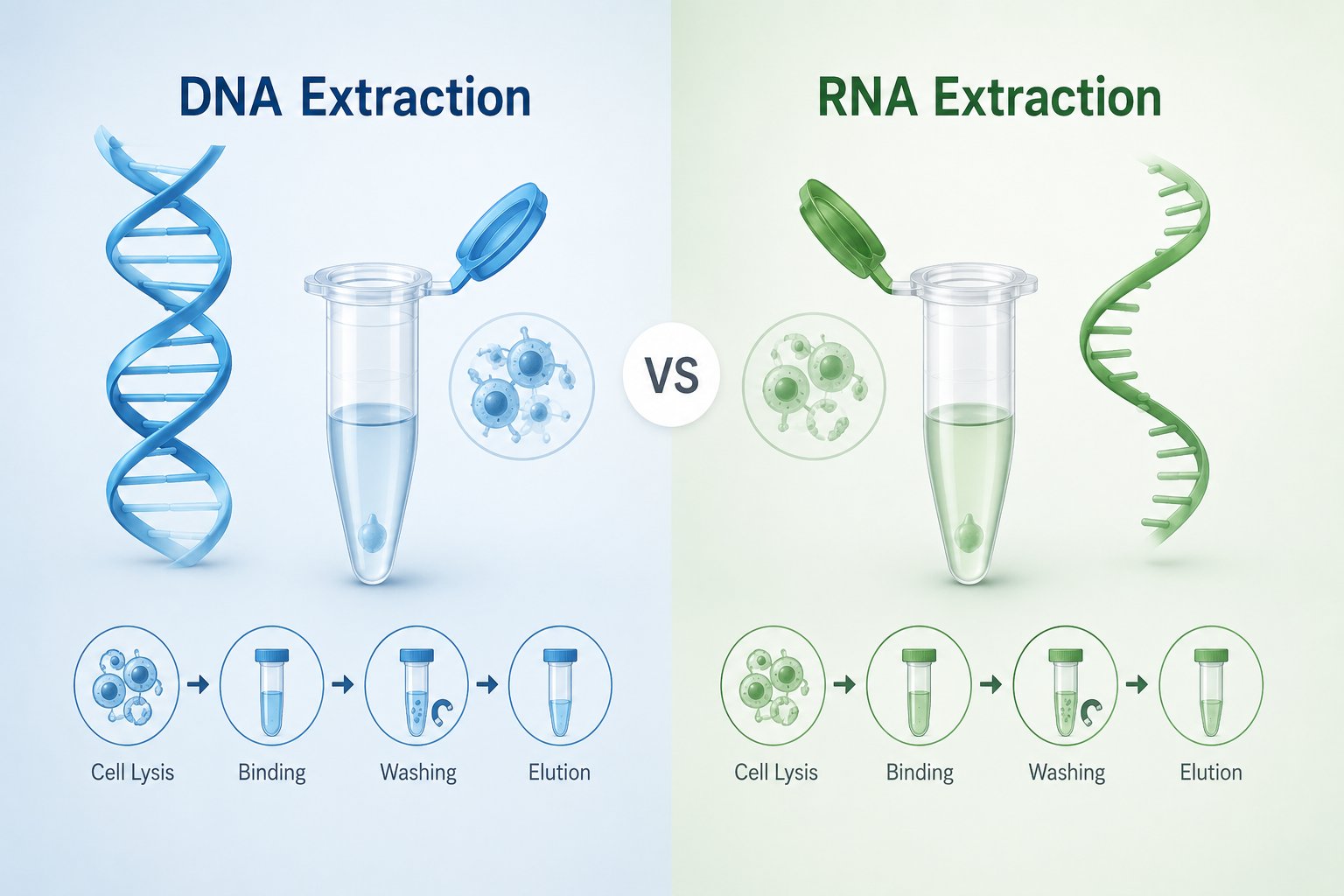
DNA and RNA extraction are two essential techniques in molecular biology, diagnostics, genomics, and life science research. Both methods are used to isolate nucleic acids from biological samples, but they are not the same. DNA extraction focuses on recovering stable genetic material for applications such as PCR, qPCR, cloning, genotyping, and sequencing. RNA extraction, on the other hand, isolates more fragile RNA molecules for RT-PCR, RT-qPCR, RNA-seq, transcriptomics, gene expression analysis, and viral RNA detection. Understanding the difference between DNA and RNA extraction helps researchers choose the right protocol, avoid contamination, protect sample quality, and improve the reliability of downstream results.
What Is DNA Extraction?
DNA extraction is the process of isolating deoxyribonucleic acid from cells, tissues, blood, bacteria, fungi, viruses, FFPE samples, plant material, or other biological sources. The purpose is to obtain clean, high-quality DNA that can be used for molecular analysis. DNA is relatively stable compared with RNA, which makes it easier to handle in many laboratory workflows. Common DNA targets include genomic DNA, plasmid DNA, viral DNA, mitochondrial DNA, and cell-free DNA.
DNA extraction is commonly used in:
- PCR and qPCR
- Genotyping
- Mutation analysis
- Cloning
- Sanger sequencing
- Next-generation sequencing
- Forensic analysis
- Microbial identification
- Molecular diagnostics
A typical DNA extraction workflow includes sample lysis, protein removal, nucleic acid binding or precipitation, washing, and elution. Depending on the sample type and application, researchers may use spin columns, magnetic beads, phenol-chloroform extraction, salting-out methods, CTAB extraction, or automated nucleic acid purification systems.
What Is RNA Extraction?
RNA extraction is the process of isolating ribonucleic acid from biological samples. RNA may include total RNA, messenger RNA, microRNA, small RNA, ribosomal RNA, transfer RNA, or viral RNA. RNA extraction requires more careful handling than DNA extraction because RNA is less stable and easily degraded by RNases. RNases are enzymes found in biological samples, skin, dust, lab surfaces, and many common environments. Even a small amount of RNase contamination can damage RNA quality and affect downstream analysis.
RNA extraction is commonly used in:
- RT-PCR
- RT-qPCR
- RNA sequencing
- Transcriptomics
- Gene expression analysis
- cDNA synthesis
- Viral RNA detection
- Biomarker discovery
- Molecular diagnostic testing
Because RNA quality directly affects experimental accuracy, RNA extraction often requires RNase-free tubes, nuclease-free water, clean workspaces, RNA stabilization reagents, proper storage, and fast sample processing.
DNA vs RNA Extraction:
|
Feature |
DNA Extraction |
RNA Extraction |
|
Target molecule |
DNA |
RNA |
|
Full name |
Deoxyribonucleic acid |
Ribonucleic acid |
|
Common targets |
Genomic DNA, plasmid DNA, viral DNA, cfDNA |
Total RNA, mRNA, miRNA, small RNA, viral RNA |
|
Stability |
More stable |
More fragile |
|
Main concern |
Protein, RNA, salt, or inhibitor contamination |
RNA degradation and genomic DNA contamination |
|
Enzyme commonly used |
RNase A to remove RNA |
DNase I to remove DNA |
|
Handling requirement |
Clean molecular biology technique |
Strict RNase-free technique |
|
Common methods |
Spin column, magnetic bead, phenol-chloroform, salting out |
TRIzol, spin column, magnetic bead, phenol-based extraction |
|
Downstream uses |
PCR, qPCR, sequencing, cloning, genotyping |
RT-PCR, RT-qPCR, RNA-seq, gene expression |
|
Storage |
More forgiving |
Requires careful cold storage |
|
Main challenge |
Purity and inhibitor removal |
Integrity and degradation prevention |
Main Difference Between DNA and RNA Extraction
The main difference between DNA and RNA extraction is the target molecule and the level of care required during purification. DNA extraction isolates DNA, which is more chemically stable and easier to preserve. RNA extraction isolates RNA, which is more sensitive to degradation and requires RNase-free conditions. Another major difference is enzyme treatment. DNA extraction often uses RNase to remove unwanted RNA from DNA samples. RNA extraction often uses DNase to remove contaminating genomic DNA from RNA samples. This is especially important in RT-PCR and RT-qPCR, where genomic DNA contamination can produce misleading amplification results.
In simple terms, DNA extraction is usually focused on preserving genetic information, while RNA extraction is focused on preserving a snapshot of gene activity.

Why RNA Extraction Is More Sensitive Than DNA Extraction
RNA is more difficult to extract because it is naturally less stable than DNA. Its chemical structure makes it more vulnerable to hydrolysis, heat, and nuclease activity. In addition, RNases are highly persistent enzymes that can remain active even under conditions that would inactivate many other proteins. For this reason, RNA extraction protocols often include strong denaturing agents, fast sample lysis, RNase-free consumables, and careful temperature control. Researchers may also use RNA stabilization solutions when samples cannot be processed immediately.
Poor RNA quality can affect gene expression analysis, RNA-seq data, RT-qPCR sensitivity, and viral detection accuracy. That is why RNA integrity, purity, and concentration should be checked before downstream applications.
Shared Steps in DNA and RNA Extraction
Although DNA and RNA extraction differ in important ways, both workflows share several core steps.
1. Sample Collection and Preservation
High-quality extraction begins with proper sample collection. Blood, tissue, swabs, plasma, serum, cultured cells, bacteria, fungi, FFPE samples, and plant material all require different handling conditions. Poor collection or storage can reduce nucleic acid yield and quality.
2. Cell Lysis
Cell lysis breaks open cells or viral particles to release nucleic acids. This may involve chemical lysis buffers, detergents, proteinase K, mechanical disruption, enzymatic digestion, or homogenization.
3. Removal of Proteins and Contaminants
Proteins, lipids, salts, carbohydrates, phenol, ethanol, and PCR inhibitors must be removed. Contaminants can reduce purity and interfere with PCR, qPCR, sequencing, or reverse transcription.
4. Nucleic Acid Binding or Precipitation
DNA or RNA may bind to silica membranes, magnetic beads, glass fiber filters, or precipitate using alcohol-based methods. The choice depends on sample type, workflow speed, throughput, and required purity.
5. Washing
Wash buffers remove salts, proteins, and other impurities. Incomplete washing can leave inhibitors behind, while poor drying may cause ethanol carryover.
6. Elution
The purified DNA or RNA is released into a nuclease-free water or elution buffer. The final eluate should be compatible with downstream molecular biology applications.

Protocol Differences Between DNA and RNA Extraction
pH and Buffer Chemistry
Some extraction methods use different pH conditions to separate DNA and RNA. In acidic phenol-based RNA extraction, RNA remains mainly in the aqueous phase, while DNA and proteins partition into other phases. DNA extraction often uses neutral to slightly alkaline conditions to help preserve DNA structure and improve recovery.
RNase and DNase Control
In DNA extraction, RNase A may be added to remove RNA contamination. In RNA extraction, DNase I may be used to remove genomic DNA contamination. This difference is one of the most important practical distinctions between DNA purification and RNA purification.
Sample Handling
DNA is more forgiving, but it still requires clean technique. RNA requires stricter handling. Gloves, RNase-free tubes, nuclease-free water, clean pipettes, and fast processing are especially important for RNA isolation.
Storage Conditions
Extracted DNA can often be stored at 4°C for short periods and at -20°C for longer storage. RNA is more sensitive and is usually stored at -80°C for long-term preservation. Repeated freeze-thaw cycles should be avoided for both DNA and RNA, but they are especially harmful to RNA.
Common DNA Extraction Methods
Spin Column DNA Extraction
Spin column extraction uses silica membranes to bind DNA in the presence of chaotropic salts. It is popular because it is simple, fast, and produces DNA suitable for PCR, qPCR, and sequencing.
Magnetic Bead DNA Extraction
Magnetic bead purification uses paramagnetic particles to capture DNA. It is useful for automation, high-throughput workflows, and consistent nucleic acid purification.
Phenol-Chloroform DNA Extraction
This traditional method separates DNA from proteins and other contaminants using organic solvents. It can produce high-quality DNA but is more labor-intensive and requires careful handling.
Salting-Out Method
Salting-out uses high salt concentrations to remove proteins while DNA remains available for precipitation. It is cost-effective and commonly used for genomic DNA extraction.
CTAB Extraction
CTAB is often used for plant DNA extraction because plant tissues contain polysaccharides and polyphenols that can interfere with downstream analysis.
Common RNA Extraction Methods
TRIzol or Phenol-Based RNA Extraction
TRIzol and similar reagents use strong denaturants to lyse cells, inactivate RNases, and separate RNA from DNA and proteins. This method is widely used for total RNA isolation.
Spin Column RNA Extraction
Silica column RNA purification is convenient and provides clean RNA for RT-PCR, RT-qPCR, and RNA-seq. Many kits include optional DNase treatment to remove genomic DNA.
Magnetic Bead RNA Extraction
Magnetic bead-based RNA isolation is useful for automation, clinical research, high-throughput testing, and molecular diagnostics.
Small RNA and miRNA Extraction
Specialized RNA extraction kits are used when the goal is to recover microRNA or small RNA. Standard total RNA protocols may not always preserve small RNA efficiently.
Viral RNA Extraction
Viral RNA extraction is used for detecting RNA viruses in swabs, serum, plasma, saliva, or other clinical samples. This workflow is important for RT-PCR-based infectious disease testing.
DNA Contamination vs RNA Contamination
Contamination control is a major part of nucleic acid extraction. In DNA extraction, RNA contamination can affect DNA quantification and downstream performance. RNase treatment helps remove unwanted RNA and improves DNA purity.
In RNA extraction, genomic DNA contamination is a common issue. This is especially problematic in RT-PCR and RT-qPCR because DNA can amplify along with cDNA-derived targets. DNase treatment, careful primer design, and minus-RT controls can help detect and reduce this problem. Other contaminants include proteins, salts, ethanol, phenol, heme, humic acids, and other PCR inhibitors. These impurities can lower yield, reduce enzyme performance, and affect sequencing quality.
Applications of DNA and RNA Extraction
DNA extraction is best when the goal is to study genetic information. It is used to detect mutations, identify organisms, amplify genes, prepare sequencing libraries, and analyze inherited or acquired genomic changes. RNA extraction is best when the goal is to study gene activity or detect RNA-based pathogens. It helps researchers understand which genes are being expressed, how cells respond to disease or treatment, and whether viral RNA is present in a sample.
For example, a DNA extraction kit may be selected for genomic DNA sequencing, while an RNA extraction kit may be selected for RT-qPCR gene expression analysis. In molecular diagnostics, both DNA and RNA extraction can be important depending on whether the target pathogen or biomarker is DNA-based or RNA-based. FireGene supports molecular biology workflows with nucleic acid extraction solutions designed for different sample types and downstream applications, helping laboratories choose suitable tools for DNA, RNA, and viral nucleic acid workflows.
How to Choose the Right DNA or RNA Extraction Kit
The best extraction method depends on the sample, target molecule, and downstream test. Before choosing a DNA or RNA extraction kit, consider the following factors:
Sample Type
Different samples contain different inhibitors. Blood may contain heme, plants may contain polyphenols, stool may contain complex inhibitors, and FFPE samples often contain fragmented nucleic acids. A kit should be optimized for the sample source.
Target Molecule
Choose a DNA extraction kit for genomic DNA, plasmid DNA, viral DNA, or cfDNA. Choose an RNA extraction kit for total RNA, mRNA, miRNA, viral RNA, or small RNA.
Downstream Application
PCR, qPCR, RT-PCR, NGS, RNA-seq, cloning, and transcriptomics may require different purity and integrity levels. RNA-seq usually needs high-quality RNA, while routine PCR may tolerate slightly different requirements.
Yield and Purity
High yield is useful, but purity is equally important. A good extraction workflow should remove proteins, salts, solvents, and inhibitors.
Throughput and Automation
Manual spin columns are suitable for smaller workloads. Magnetic bead-based systems are often preferred for automation and high-throughput molecular testing.
Common Problems and Troubleshooting
Low DNA or RNA Yield
Low yield may result from poor sample quality, incomplete lysis, insufficient starting material, incorrect binding conditions, or inefficient elution. Optimizing lysis time and using the right kit for the sample type can improve recovery.
RNA Degradation
RNA degradation usually occurs because of RNase contamination, delayed processing, poor storage, or repeated freeze-thaw cycles. Use RNase-free consumables, work quickly, and keep samples cold when required.
DNA Contamination in RNA Samples
Genomic DNA contamination can affect RT-PCR and RT-qPCR. DNase treatment and proper controls help reduce false-positive results.
Poor A260/A280 or A260/A230 Ratios
Abnormal purity ratios may indicate protein, salt, phenol, ethanol, or organic compound contamination. Additional washing or improved sample cleanup may be needed.
PCR or RT-PCR Inhibition
Even when DNA or RNA is present, inhibitors can prevent amplification. This is common in complex samples such as blood, stool, soil, and FFPE material. Proper purification and inhibitor removal are essential.
DNA Extraction vs RNA Extraction: Which One Do You Need?
Choose DNA extraction when your goal is to study genetic sequences, mutations, inherited traits, microbial identity, or DNA-based pathogens. Choose RNA extraction when your goal is to study gene expression, transcript abundance, RNA viruses, cellular response, or RNA-based biomarkers.
In some cases, both DNA and RNA are needed from the same sample. Combined DNA/RNA extraction workflows can be useful when sample quantity is limited or when researchers need genomic and transcriptomic information together. FireGene provides molecular biology and nucleic acid extraction products that can support laboratories working across PCR, RT-PCR, qPCR, sequencing, and diagnostic research applications.
FAQs
What is the main difference between DNA and RNA extraction?
DNA extraction isolates DNA for genetic analysis, while RNA extraction isolates RNA for gene expression analysis, RT-PCR, RNA-seq, transcriptomics, and viral RNA detection.
Is RNA extraction harder than DNA extraction?
Yes, RNA extraction is usually more sensitive because RNA is less stable and easily degraded by RNases. It requires RNase-free handling, clean workspaces, and proper storage.
Why is DNase used in RNA extraction?
DNase is used to remove contaminating genomic DNA from RNA samples. This is important for RT-PCR, RT-qPCR, and gene expression analysis.
Why is RNase used in DNA extraction?
RNase is used to remove RNA contamination from DNA samples, improving DNA purity and making the sample more suitable for PCR, qPCR, sequencing, or cloning.
Can DNA and RNA be extracted from the same sample?
Yes, some workflows and kits are designed to extract DNA and RNA from the same sample. This is useful when sample material is limited or when both genomic and transcriptomic analysis are needed.
Which is better: spin column or magnetic bead extraction?
Spin column extraction is simple and widely used for manual workflows. Magnetic bead extraction is better suited for automation, high-throughput processing, and scalable molecular testing.
What are the most common contaminants in DNA and RNA extraction?
Common contaminants include proteins, salts, ethanol, phenol, lipids, carbohydrates, genomic DNA, RNA, RNases, DNases, and PCR inhibitors.
How should extracted DNA and RNA be stored?
DNA is commonly stored at -20°C for long-term use. RNA is more sensitive and is usually stored at -80°C. Both should be protected from contamination and repeated freeze-thaw cycles.
Conclusion
DNA and RNA extraction are closely related nucleic acid purification techniques, but they serve different scientific purposes. DNA extraction is used to isolate stable genetic material for PCR, sequencing, cloning, and genotyping. RNA extraction is used to isolate more fragile RNA molecules for RT-PCR, RNA-seq, gene expression analysis, transcriptomics, and viral RNA detection. The biggest differences involve molecular stability, enzyme treatment, contamination risks, sample handling, storage, and downstream applications. By understanding these differences, researchers can choose the right extraction method, protect sample quality, and generate more reliable molecular biology results.


