
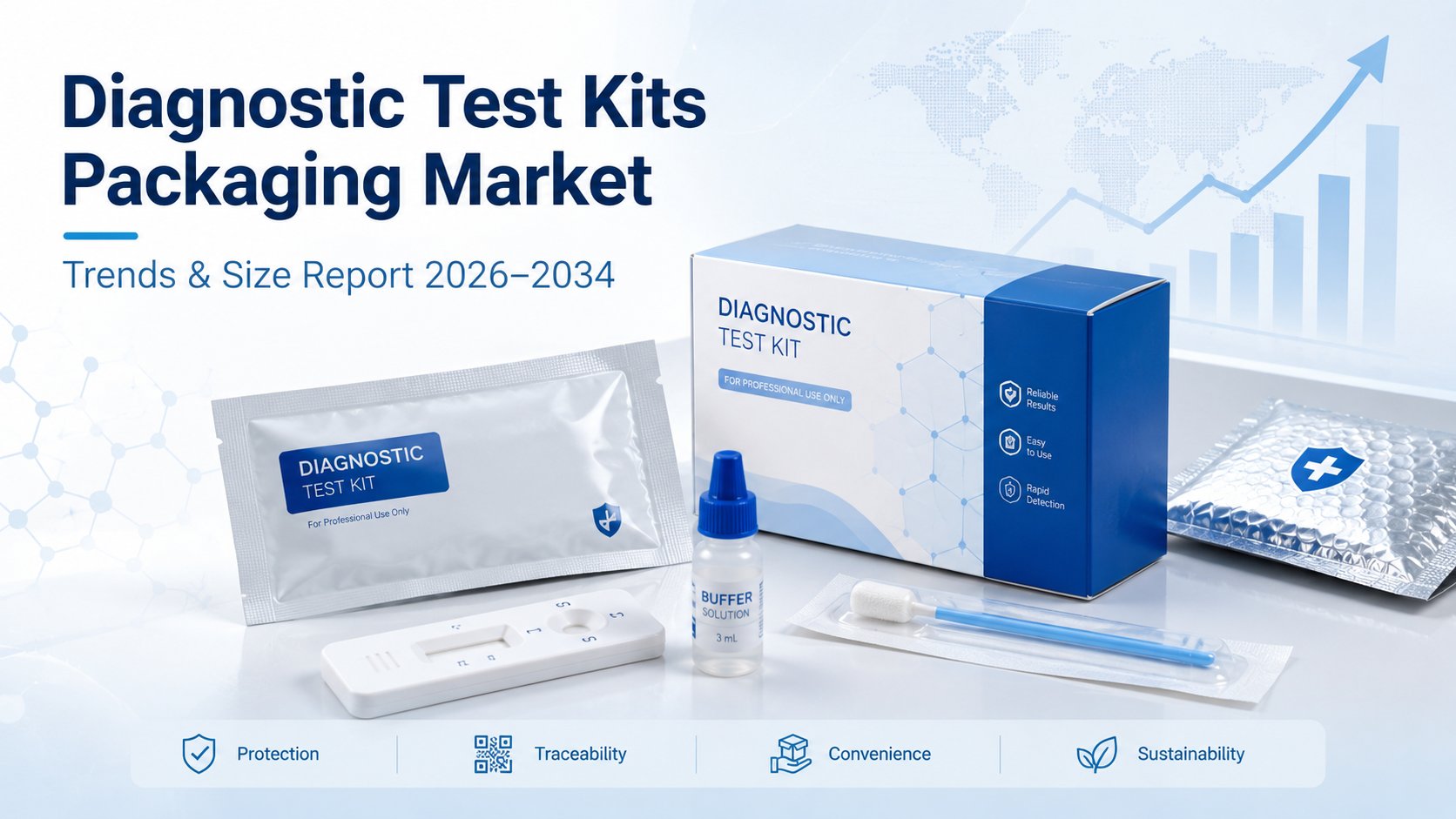
The global Diagnostic Test Kits Packaging Market is growing steadily as healthcare systems increase their use of laboratory testing, point-of-care diagnostics and home-based testing solutions. Diagnostic products often contain sensitive reagents, collection devices, test strips, cassettes and biological materials that require reliable protection throughout storage, transportation and use. Suitable Packaging helps protect Diagnostic Test Kits from moisture, light, contamination, temperature changes and physical damage. It also supports product identification, traceability, tamper evidence and user convenience. These functions make Medical Packaging and Healthcare Packaging essential parts of the wider diagnostics industry.
The continued expansion of home healthcare, self-testing, in-vitro diagnostics and point-of-care testing is creating demand for Packaging that is compact, secure and easy to handle. Manufacturers are therefore developing Diagnostic Packaging Solutions that combine product protection with convenience, sustainability and efficient distribution.
What are Diagnostic Test Kits Packaging?
Diagnostic test kits packaging includes the bottles, vials, tubes, pouches, trays, cartons, closures and other materials used to contain and protect diagnostic products. Depending on the type of test, the Packaging may hold reagents, buffers, sample-collection devices, test strips, plastic cassettes, cartridges, swabs, instructions for use and other accessories.
The Packaging must protect these components from environmental conditions that could reduce product stability or affect test performance. Moisture, ultraviolet light, oxygen, heat and contamination can damage sensitive reagents or test materials if suitable protection is not provided. Diagnostic Packaging also supports safe handling by providing clear labels, lot numbers, expiry dates, storage conditions and tamper-evident features.
Main Functions of Diagnostic Packaging
The main purpose of Diagnostic Packaging Solutions is to maintain product safety and integrity from manufacturing through final use. Packaging helps prevent contamination, protect sensitive materials, preserve sample quality and reduce damage during transportation. It also provides users with important product information and makes individual components easier to organize and handle.
For selected specimen-collection devices and diagnostic accessories, Sterile Packaging may be required to maintain a sterile barrier until the package is opened.
Diagnostic Test Kits Packaging Market Size
The global in-vitro diagnostics packaging market was valued at approximately USD 9.0 billion in 2025. It is expected to reach around USD 12.7 billion by 2034, expanding at an estimated compound annual growth rate of 3.70% from 2026 to 2034.
Market Size Snapshot
|
Market Indicator |
Details |
|
Base Year |
2025 |
|
Forecast Period |
2026–2034 |
|
Market Size in 2025 |
USD 9.0 Billion |
|
Forecast Value by 2034 |
USD 12.7 Billion |
|
Expected CAGR |
3.70% |
Rising diagnostic testing volumes support the positive Diagnostic Test Kits Packaging Market Size outlook, expanding healthcare infrastructure and growing demand for reliable product protection. The increasing use of home testing and portable diagnostic products is also encouraging manufacturers to develop lighter and more compact packaging formats.
Diagnostic Test Kits Packaging Market Trends
The market is being shaped by changes in healthcare delivery, product design, sustainability and patient expectations.
Rising Prevalence of Chronic Diseases
The increasing prevalence of diabetes, cancer, cardiovascular diseases and autoimmune disorders is driving demand for diagnostic testing. Patients with chronic conditions may require regular monitoring, which increases the use of diagnostic reagents, sample containers, test strips and related products. As testing volumes rise, manufacturers require Packaging that can maintain product quality during storage and distribution.
Reliable Healthcare Packaging also helps support longer shelf life and consistent product performance across different testing environments.
Increasing Focus on Patient Safety
Patient safety is one of the most important Diagnostic Test Kits Packaging Market Trends. Diagnostic products must remain protected from contamination, leakage, moisture and physical damage. Secure Packaging helps reduce the risk of product deterioration and improper handling. Healthcare providers also prefer Packaging that is clearly labeled and easy to identify. Tamper-evident features can help users determine whether a product has been opened or damaged before use.
Growth of Home Healthcare and Self-Testing
Home healthcare is creating demand for Packaging that is simple, compact and easy to understand. Home-use Diagnostic Test Kits may include pregnancy tests, glucose-monitoring products, fertility kits and selected infectious disease tests. These products often require individually sealed Packaging, clear instructions and convenient organization of accessories.
Users generally prefer lightweight Packaging that is easy to open while still offering sufficient protection.
Expansion of Point-of-Care Testing
Point-of-care testing allows diagnostic procedures to be performed near the patient in clinics, pharmacies, emergency departments, remote locations and community screening programs. These products are often portable and require smaller packaging formats. Quick-access Packaging can help healthcare professionals use the product efficiently while minimizing storage requirements.
The growth of portable diagnostic devices is therefore increasing demand for compact Diagnostic Packaging Solutions for Healthcare.
Growing Demand for Sustainable Medical Packaging
Sustainability is becoming more important across Medical Packaging and Healthcare Packaging. Manufacturers are exploring recyclable secondary Packaging, smaller cartons, lightweight materials and reduced plastic use. Some companies are also using renewable energy and more efficient production methods. The main challenge is ensuring that sustainable Packaging still provides the required barrier protection, sterility and shelf-life performance.
Technological Developments in Packaging
New packaging technologies are improving product protection and traceability. Moisture-control systems, integrated desiccant layers and high-barrier films can protect sensitive diagnostic products. Smart labels and digital traceability systems can help users access product information and verify authenticity. Improved sealing technologies are also supporting stronger packaging integrity during transportation and storage.

Market Challenges
Despite positive growth, the market faces several challenges.
- Packaging must meet the regulatory and quality requirements of the markets in which the final diagnostic product will be sold. Manufacturers may need to show that the Packaging protects the product throughout its shelf life and distribution cycle.
- Maintaining sterility and product integrity can also be difficult. Some diagnostic reagents are highly sensitive to moisture, oxygen, light or temperature changes.
- Advanced packaging materials may improve protection, but they can increase production costs. Multilayer films and single-use plastics may also create environmental concerns.
- Complex supply chains add further pressure because products may pass through multiple warehouses and climate conditions before reaching the user.
- Material compatibility is another important issue. The Packaging must not react with the reagent, sample or diagnostic component it contains.
Opportunities in the Diagnostic Packaging Market
The market provides opportunities for manufacturers that can offer secure, practical and sustainable Packaging.
Eco-Friendly Diagnostic Packaging Solutions
Demand is growing for lighter and more recyclable Packaging. Companies that can reduce material use without affecting product safety may gain a competitive advantage.
Packaging for Home Diagnostic Kits
Home testing requires Packaging that is easy to understand and convenient to use. Compact layouts, clear instructions and individually protected components can improve the user experience.
Compact Packaging for Portable Devices
Portable diagnostic products require smaller Packaging that can be transported and stored easily.
Sustainable Sterile Packaging
Manufacturers are exploring Sterile Packaging formats that use less material while maintaining an effective sterile barrier.
Smart and Connected Packaging
QR codes, digital labels and traceability systems can provide product information, authenticity checks and batch details.
Custom Packaging for Specialized Tests
Different diagnostic products have different sensitivity and storage requirements. Customized Packaging can support specialized testing applications.
Regional Manufacturing Expansion
Healthcare investment in emerging regions may create opportunities for local production of Diagnostic Packaging Solutions for Healthcare.

Diagnostic Test Kits Packaging Market Segmentation by Product
The market can be divided into bottles and vials, tubes, Petri dishes, closures and other packaging products.
Bottles and Vials
Bottles and vials are widely used to store diagnostic reagents, buffers, control materials and biological samples. They may be made from glass or medical-grade plastic. Glass offers chemical resistance and low interaction with sensitive contents, while plastic provides lower weight and better resistance to breakage. Bottles and vials can protect products from contamination, dust, moisture and light. They also help reduce leakage during transportation.
Tubes
Tubes are commonly used for collecting, storing and transporting blood and other biological specimens. Important tube features include secure closures, leak resistance and clear identification. Barcodes and color-coded caps may also support efficient sample management.
Petri Dishes
Petri dishes are used in microbiology and culture-testing applications. Their Packaging protects them from dust, contamination and physical damage. Sterile Packaging may be required when the dish must remain sterile until use.
Closures
Closures support secure sealing of bottles, vials and tubes. They help prevent leakage, maintain product stability and reduce contamination risk. A suitable closure must be compatible with both the container and its contents.
Other Packaging Products
Other packaging products include foil pouches, blister packs, trays, plastic cassettes, cartridge packaging and protective cartons. The selected format depends on the test type, storage requirements and intended user.
Diagnostic Test Kits Packaging Market Segmentation by Material
Different packaging materials offer different levels of strength, compatibility and barrier protection.
Plastic Packaging
Plastic Packaging is widely used because it is lightweight, durable and affordable. Medical-grade plastics such as polypropylene, polyethylene and polyethylene terephthalate may be used for tubes, bottles, trays, closures and diagnostic cassettes. Plastic also provides flexibility in shape and product design.
Glass Packaging
Glass packaging is commonly selected for sensitive diagnostic reagents. It offers strong chemical resistance and low interaction with many contents. Glass also provides transparency and effective barrier protection. Vials and reagent bottles are common examples of glass Medical Packaging.
Paper and Paperboard Packaging
Paper and paperboard are mainly used for outer cartons, printed instructions, labels and protective inserts. These materials support product communication and retail presentation. They may also provide sustainability benefits when responsibly sourced and designed for recycling.
Aluminum and Foil Packaging
Aluminum foil and multilayer pouches are widely used for moisture-sensitive diagnostic products. They can provide barriers against moisture, oxygen and light. Individual foil pouches are commonly used for rapid test strips and cassettes.
Diagnostic Test Kits Packaging Market by Application
The market serves a wide range of healthcare and testing applications.
Diabetes Testing
Diabetes-testing products may include glucose test strips, lancets, meters and control solutions. Packaging should support regular use, safe storage and moisture protection. Compact formats are important for patients who carry testing products while traveling or working.
Infectious Disease Testing
Infectious disease tests may contain sensitive antibodies, antigens and reagents. Packaging helps protect these components from humidity, contamination, light and temperature changes. Individual foil pouches are frequently used for rapid diagnostic products.
Cardiology Testing
Cardiology diagnostics may require Packaging for blood samples, biomarker tests, reagents and collection tubes. Secure Packaging helps preserve specimens during storage and transport.
Autoimmune Disease Testing
Autoimmune disease testing uses reagents, quality-control materials and biological samples. Packaging must help maintain stability and support routine laboratory use.
Oncology Testing
Oncology diagnostics may involve blood, tissue and other specimens. Tubes, vials, slides and protective containers help support contamination control and safe transport.
Drug Testing
Drug-testing products may use urine, saliva or other specimens. Tamper-evident Packaging and secure chain-of-custody systems are important for these applications.
Other Applications
Other applications include pregnancy testing, fertility testing, molecular diagnostics, genetic testing, veterinary diagnostics and food-safety testing.
Diagnostic Packaging Solutions for Healthcare
Diagnostic Packaging Solutions for Healthcare can be divided into primary, secondary and tertiary Packaging.
Primary Packaging
Primary Packaging directly contains or protects the diagnostic product. Examples include bottles, vials, tubes, foil pouches, cassettes and cartridges. This Packaging has the most direct role in maintaining product stability and integrity.
Secondary Packaging
Secondary packaging groups and protects one or more primary packages. Examples include product cartons, trays, labels, protective inserts and instructions for use. It also communicates important product and safety information.
Tertiary Packaging
Tertiary Packaging is used for storage and transportation. Shipping cartons, pallets, insulated containers and protective transport materials help reduce damage during distribution.
Role of Sterile Packaging in Diagnostic Test Kits
Sterile Packaging is required for selected products and specimen-collection components that must remain free from viable microorganisms until use. These may include swabs, collection devices, selected tubes and trays. A sterile barrier system should maintain its integrity throughout storage and transportation. If the Packaging is damaged, product sterility may be affected.
Common Sterile Packaging Formats
Common formats include sterile pouches, blister packs, sealed trays, tubes, vials and medical barrier films. The appropriate format depends on the product, sterilization method and intended use.
Packaging Requirements for Diagnostic Test Kits
Packaging for diagnostic products must meet the specific protection needs of the product. Important requirements include moisture resistance, light protection, temperature stability, chemical compatibility, leak resistance and seal strength. Tamper-evident features can help users identify whether the package has been opened. Clear labeling should provide the product name, lot number, expiry date and storage conditions. Traceability information is also important for quality control and product recalls. The Packaging should remain durable throughout storage and transportation while being convenient for the final user.
Materials Used in Diagnostic Test Kits Packaging
Common packaging materials include glass, high-density polyethylene, polypropylene, polyethylene terephthalate, medical-grade films, aluminum foil, silicone, paperboard, adhesives and sealants. Each material provides different performance characteristics.
How Packaging Material Is Selected
Packaging material is selected according to product sensitivity, sterility requirements, storage temperature, shelf-life target and transportation conditions. Manufacturers must also consider regulatory requirements, sustainability goals, production cost and user convenience. Compatibility between the packaging material and product contents must be confirmed.
Importance of Packaging in Product Safety and Test Accuracy
Packaging helps preserve the conditions needed for a diagnostic product to perform correctly. Sensitive reagents may lose stability when exposed to moisture, heat or ultraviolet light. Specimens may also become contaminated if unsuitable containers are used. Effective Packaging supports reagent protection, sample preservation and longer shelf life. It also reduces the risk of physical damage during transport. Packaging does not improve the test chemistry itself, but it helps maintain the product performance established by the manufacturer.
Packaging for Home Testing and Point-of-Care Diagnostics
Home and point-of-care products require Packaging that can be used outside traditional laboratories. The Packaging should be compact, easy to open and clearly labeled. Instructions should be simple to understand, and the required components should be organized logically. Individual Packaging and moisture-control systems help protect the product until use.
Packaging Features Preferred by Users
Users generally prefer Packaging that is lightweight, convenient, hygienic and secure. Travel-friendly size, clear instructions and easy opening can improve the overall user experience.
Sustainable Healthcare Packaging Trends
Healthcare companies are looking for ways to reduce packaging waste while maintaining safety. Important trends include smaller cartons, lightweight materials, recyclable secondary Packaging and lower plastic consumption. Some manufacturers are also using renewable energy and responsibly sourced paperboard.
Challenges of Sustainable Diagnostic Packaging
Sustainable Packaging must still provide the required barrier protection. The main challenges include maintaining sterility, preventing moisture exposure, ensuring material compatibility and controlling cost. Environmental improvements should not compromise product reliability or patient safety.
Regional Analysis of the Diagnostic Test Kits Packaging Market
Demand varies across regions according to healthcare infrastructure, testing volumes and local manufacturing capacity.
North America
North America represents a leading market due to its established healthcare infrastructure and high diagnostic-testing volumes. The region also has strong adoption of point-of-care testing and strict packaging requirements. These factors support demand for advanced Medical Packaging and Healthcare Packaging solutions.
Europe
Europe has a strong medical-device and pharmaceutical manufacturing industry. Sustainable packaging initiatives, regulatory focus and advanced diagnostic services support market growth across the region.
Asia-Pacific
Asia-Pacific is expected to remain an important growth region. Rising healthcare expenditure, expanding laboratory networks and increasing access to diagnostic testing are supporting demand. The region also has a growing manufacturing base for diagnostic products and Packaging.
Middle East and Africa
The Middle East and Africa offer opportunities related to healthcare infrastructure development and improved access to testing. Import distribution, public health programs and regional manufacturing may support future growth.
Latin America
Latin America is experiencing growth in diagnostic laboratories, healthcare investment and point-of-care testing. Demand for affordable and reliable Packaging is likely to increase as diagnostic access expands.
Competitive Landscape
The market includes healthcare packaging companies, glass-container manufacturers and diagnostic technology providers. Companies are investing in production capacity, compact Packaging, sustainable materials and improved barrier technologies.
Leading Companies and Industry Participants
Relevant companies include Amcor, Corning Incorporated, SGD Pharma, Bormioli Pharma, Stevanato Group and Thermo Fisher Scientific. These companies operate across medical Packaging, laboratory systems, glass vials and diagnostic products.
Recent Developments in Diagnostic Packaging
Recent industry developments have focused on improved vial technologies, moisture-control systems and sustainable production. Companies are launching Packaging designed to reduce carbon emissions, improve filling-line efficiency and protect sensitive diagnostic products. Manufacturing capacity expansion and technology partnerships are also supporting innovation.
Future Outlook of the Diagnostic Test Kits Packaging Market
The future market outlook remains positive as diagnostic testing continues to expand. Home testing and point-of-care diagnostics will increase demand for compact, lightweight and user-friendly Packaging. Manufacturers are also expected to focus on sustainable materials, smart labels, stronger barrier films and improved traceability.
Companies that combine safety, convenience and cost efficiency will be better positioned to meet changing market needs. FireGene recognizes the importance of suitable Packaging in protecting diagnostic products throughout storage and transportation. Reliable Packaging supports product integrity and helps diagnostic components remain stable until final use.
FAQS
What is the Packaging of diagnostic test kits?
Diagnostic test kits packaging includes bottles, vials, tubes, pouches, trays, cartons and other materials used to protect diagnostic products during storage, transportation and use.
How large is the Diagnostic Test Kits Packaging Market?
The global in-vitro diagnostics packaging market was valued at approximately USD 9.0 billion in 2025 and is expected to reach USD 12.7 billion by 2034.
What are the main Diagnostic Test Kits Packaging Market Trends?
The main trends include home testing, point-of-care diagnostics, sustainable Packaging, tamper-evident formats, moisture-control systems and smart labeling.
Which packaging products are commonly used?
Common products include bottles, vials, tubes, Petri dishes, closures, foil pouches, cassettes, trays and cartons.
Why is Sterile Packaging important?
Sterile Packaging helps protect selected diagnostic products and specimen-collection components from contamination until use.
What materials are used in Medical Packaging?
Common materials include glass, medical-grade plastics, aluminum foil, silicone, paperboard and barrier films.
Which region leads the market?
North America represents a leading regional market because of its developed healthcare infrastructure, high testing volumes and strict quality requirements.
How does Packaging affect test accuracy?
Packaging protects reagents and specimens from moisture, light, contamination and temperature changes that may affect stability or performance.
What Packaging is used for home diagnostic kits?
Home diagnostic kits commonly use foil pouches, plastic cassettes, buffer containers, collection accessories and printed cartons.
What are Diagnostic Packaging Solutions for Healthcare?
They include primary, secondary and tertiary Packaging used to contain, protect, identify, store and transport diagnostic products.
What is the future of diagnostic Packaging?
Future Packaging is expected to become more compact, sustainable, traceable and suitable for home and point-of-care testing.
Conclusion
The Diagnostic Test Kits Packaging Market is expected to grow steadily between 2026 and 2034 as laboratory testing, home healthcare and point-of-care diagnostics continue to expand. Medical Packaging and Healthcare Packaging help protect diagnostic products from contamination, moisture, light, temperature changes and physical damage.
Bottles, vials, tubes, foil pouches, trays and closures will continue to support different testing applications. Sustainable materials, compact formats and advanced barrier technologies are also expected to influence future development. Companies providing secure and user-friendly Diagnostic Packaging Solutions for Healthcare will be well-positioned to serve the growing diagnostics industry.


