
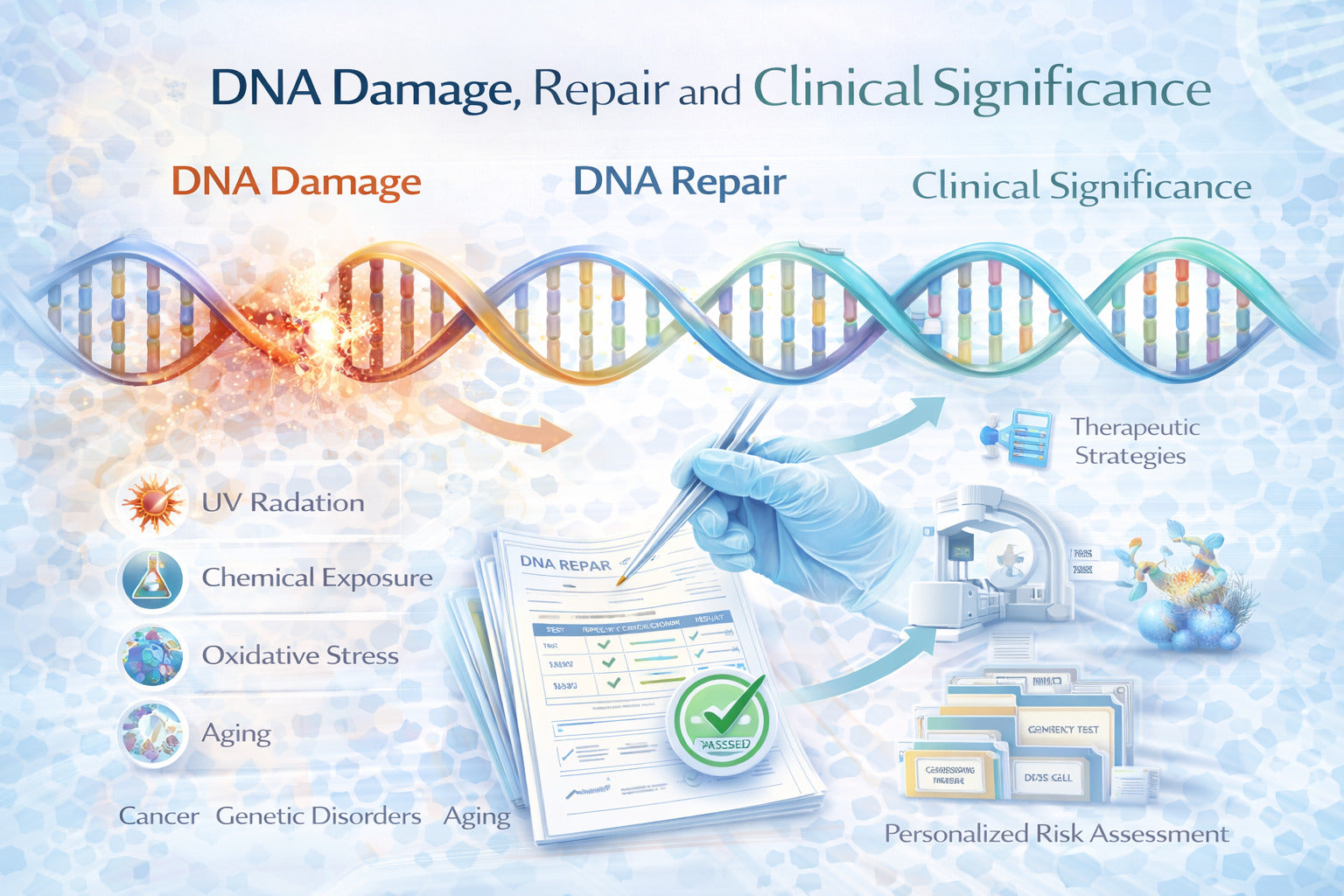
DNA is one of the most valuable molecules in biology because it stores the instructions that support growth, repair, inheritance, and normal cellular function. A clear understanding of what DNA is, DNA structure, and DNA function helps explain why cells work so hard to protect genetic material. Once that foundation is clear, it becomes easier to understand DNA Damage, DNA Repair, and their broader Clinical significance.
What is DNA, and why does it matter so much?
DNA stands for deoxyribonucleic acid, the molecule that stores hereditary instructions in living organisms. It carries the code that helps cells grow, divide, produce proteins, and maintain biological order.
The basic function of DNA is to store and transmit genetic information. This information must remain stable enough to preserve life processes, yet flexible enough to allow controlled replication and gene expression. That is why DNA integrity matters so much in health, research, and diagnostics.
DNA structure supports stability
The classic DNA structure is a double helix made of two strands twisted around each other. These strands are built from nucleotides and held together by complementary base pairing. This arrangement supports both stability and accurate replication.
A strong DNA structure helps cells:
- store genetic information efficiently
- copy information during cell division
- support controlled gene expression
- maintain biological continuity across generations
DNA function depends on healthy genetic material
The DNA function of coding and controlling cellular activity depends on the quality of the molecule itself. When DNA remains stable, cells can work with great precision. When damage appears, the cell activates repair pathways to maintain this precision.
What is DNA damage?
A common question is what is DNA damage? DNA damage refers to changes in the DNA molecule that affect its normal chemical structure or sequence integrity. These changes can range from small base modifications to strand breaks and larger distortions in the genetic code. DNA Damage does not automatically mean permanent harm. In many situations, the cell quickly recognises the problem and uses specialised mechanisms to fix it. This is one of the reasons DNA biology is so dynamic and resilient.
Common forms of DNA damage
Different types of DNA Damage can appear in cells depending on the source and context. Common examples include:
- single-strand breaks
- double-strand breaks
- base mismatches
- base oxidation or chemical modification
- crosslinking between DNA strands
- damage caused by replication stress
These forms of damage can affect how genetic information is read, copied, or regulated.
Why does DNA damage happen?
DNA damage can occur as part of normal biology or from external factors. Cells naturally experience stress during metabolism and replication, while environmental exposures can also affect DNA integrity.
Common contributors include:
- normal cellular metabolism
- reactive oxygen species
- ultraviolet light
- ionizing radiation
- chemical exposure
- replication errors
- viral interactions in some biological settings
Understanding these sources helps explain both the science of DNA Damage and its broader Clinical significance.

Why DNA damage matters in biology
DNA is the instruction system of life, so any disruption to it deserves careful attention. The reason DNA Damage matters is not only the presence of the lesion itself, but also its effect on DNA function, cell survival, gene expression, and replication accuracy.
DNA damage can change how cells behave
When damage affects important genes or regulatory regions, cells may respond differently. They may slow division, activate repair systems, or signal for controlled cell death. These protective responses help preserve tissue quality and overall biological balance.
DNA damage and genetic stability
Genetic stability is essential for healthy growth and reliable inheritance. Because DNA holds long-term biological instructions, protecting it supports everything from tissue maintenance to developmental accuracy.
DNA repair: the cell’s quality-control system
DNA Repair refers to the collection of cellular pathways that detect and correct damaged DNA. These pathways are remarkably sophisticated and help maintain the quality of genetic information over time. In a positive sense, DNA repair is one of biology’s best examples of built-in quality assurance. Cells constantly monitor their own genetic material and act quickly when problems are detected.
Main goals of DNA repair
The core goals of DNA Repair are to:
- preserve genetic accuracy
- support healthy cell division
- restore normal DNA structure
- reduce the impact of replication errors
- maintain long-term genomic stability
DNA repair connects structure and function
The relationship between DNA structure, DNA function, and DNA Repair is very close. Structure makes the molecule stable, function makes the information useful, and repair keeps both of those qualities working together.
Main DNA repair pathways
Cells use different DNA Repair pathways depending on the type of lesion. Each pathway has a specialized role, enabling the cell to respond efficiently to a wide range of DNA changes.
Base excision repair
Base excision repair helps fix small base lesions, especially those caused by oxidation, alkylation, or deamination. This pathway is important for maintaining the readability of the DNA code.
Nucleotide excision repair
Nucleotide excision repair removes bulky lesions that distort the DNA helix. It plays an important role in restoring proper DNA structure when larger abnormalities are present.
Mismatch repair
Mismatch repair helps correct errors that happen during DNA replication. This pathway supports fidelity and helps preserve accurate inheritance of genetic information.
Homologous recombination and non-homologous end joining.
These pathways help repair double-strand breaks. Homologous recombination is often described as a high-accuracy pathway because it uses a related template, while non-homologous end joining offers a rapid way to reconnect broken DNA ends.
DNA damage and repair in normal health
The relationship between DNA Damage and DNA Repair is not only relevant in disease. It is also part of normal, healthy biology. Cells continuously manage routine stress and maintain DNA quality through surveillance and repair systems.
Repair helps support healthy tissues.
Tissues that divide frequently depend on strong repair systems. This helps maintain cellular quality over time and supports healthy renewal in the body.
Repair helps preserve the DNA function of important genes.
Because the DNA function of genes is essential for protein production and regulation, repair systems help protect the instructions that cells rely on every day.
Clinical significance of DNA damage and repair
The Clinical significance of DNA Damage and DNA Repair is substantial because these processes influence disease biology, diagnosis, treatment strategy, and research priorities. In clinical and translational science, DNA integrity is often linked to how cells respond to stress, ageing, therapy, and inherited risk factors.
Clinical significance in cancer biology
One major area of Clinical significance is cancer research. When DNA damage accumulates or repair pathways become less effective, abnormal cell behavior can emerge. This is why DNA repair biology is so important in oncology, biomarker research, and precision medicine.
Clinical significance in inherited disorders
Some inherited conditions are linked to changes in genes involved in DNA Repair. Studying these conditions helps researchers understand why certain tissues become more sensitive to genetic stress and how repair pathways support long-term health.
Clinical significance in treatment response
DNA repair status can also influence how cells respond to treatment. In modern medical research, repair pathways are often studied because they may shape sensitivity to certain therapies and contribute to personalized care strategies.

DNA damage in diagnostics and molecular research
The study of DNA Damage has become increasingly important in laboratory science, molecular diagnostics, and research workflows. Accurate analysis depends on high-quality samples, controlled processing, and reliable molecular tools.
This is where FireGene’s scientific environment becomes highly relevant. FireGene supports workflows with nucleic acid extraction solutions, molecular diagnostic kits, molecular biology reagents and kits, sample preparation products, and life science buffers for DNA-based laboratory applications.
Why workflow quality matters in DNA analysis
High-quality DNA research depends on more than theory. It also depends on practical workflow consistency, including:
- clean sample preparation
- reliable nucleic acid extraction
- controlled reagent performance
- reproducible molecular analysis
- strong laboratory documentation
FireGene’s relevance to DNA-centred workflows
FireGene’s portfolio fits naturally into DNA-related scientific work because it supports laboratories working with nucleic acid handling, molecular testing, and assay development. That makes the brand context relevant for educational content around DNA Damage, DNA Repair, DNA structure, and DNA function.
DNA damage, viral testing, and broader molecular workflows
In some research and diagnostic settings, DNA quality is also discussed alongside pathogen detection and viral testing workflows. While the scientific context may vary, the broader principle remains the same: reliable molecular data depends on robust sample integrity, dependable reagents, and well-designed workflows.
Why does this matter in laboratory science
Whether a lab is studying genetic stability, molecular markers, or diagnostic signals, the quality of nucleic acid handling can make a meaningful difference. This is one reason DNA education remains so useful for labs building better molecular systems.
How DNA damage shapes future medical research
The future of precision medicine, targeted therapy, and advanced diagnostics continues to draw on the biology of DNA Damage and DNA Repair. Researchers are studying how damage pathways influence disease risk, therapeutic response, and biomarker development.
Areas of growing interest
Current and expanding areas of interest include:
- cancer genomics
- DNA repair biomarkers
- inherited repair pathway disorders
- targeted therapy development
- molecular diagnostics
- translational research based on nucleic acid analysis
This growing field adds even greater clinical significance to the study of DNA biology.
Practical takeaway: why this topic matters
Understanding what DNA damage is helps readers appreciate that DNA is not a static molecule. It is constantly monitored, protected, and repaired. Understanding DNA Repair shows how cells preserve order and support healthy biological function. Understanding the Clinical significance of these processes helps explain why DNA biology remains central in medicine and research.
A simple summary
In simple terms:
- What is DNA: the molecule that stores genetic instructions
- DNA structure: a double helix built for stability and accurate copying
- DNA function: storing and transmitting biological information
- DNA Damage: changes that affect DNA integrity
- DNA Repair: cellular pathways that detect and fix damage
- Clinical significance: the importance of these processes in health, disease, diagnostics, and therapy research
FAQs
What is DNA damage in simple words?
DNA damage refers to a change in the DNA molecule that alters its normal structure or genetic stability. Cells often respond positively by activating repair systems.
What is DNA repair?
DNA Repair is the set of natural cellular processes that identify and repair damaged DNA so genetic information remains accurate and useful.
Why is DNA damage clinically significant?
The Clinical significance of DNA damage is high because it can influence disease biology, treatment response, genetic stability, and modern molecular diagnostics.
How are DNA structure and DNA function connected to DNA repair?
DNA structure gives the molecule stability, DNA function gives it biological importance, and DNA Repair helps preserve both qualities over time.
Why do laboratories study DNA damage?
Laboratories study DNA Damage to understand disease mechanisms, improve diagnostics, support therapy research, and build stronger molecular workflows.
How does FireGene fit into DNA-related research?
FireGene supports DNA-related workflows through nucleic acid extraction products, molecular diagnostic kits, molecular biology reagents and kits, sample preparation solutions, life science buffers, and related scientific support tools.
Conclusion
DNA is a beautifully organized molecule that supports life through stable information storage, accurate replication, and coordinated biological function. Understanding what DNA structure and function mean makes it easier to appreciate the importance of DNA Damage, DNA Repair, and their far-reaching Clinical significance.


