
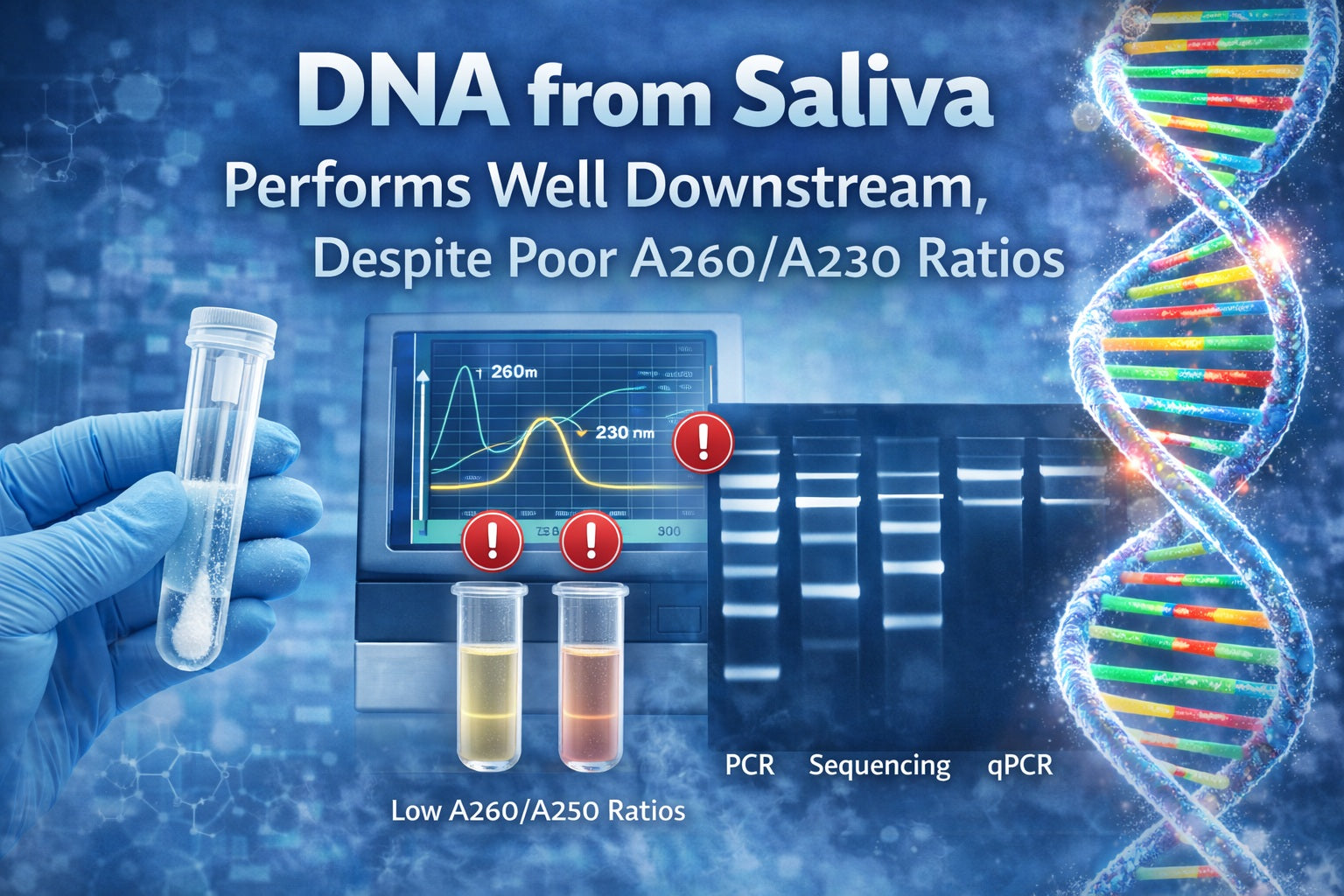
Saliva is one of the easiest sample types to collect, which is why saliva-derived DNA is widely used in research workflows ranging from population studies to clinical screening programs. If you’ve ever measured a saliva DNA prep and felt confused by a low A260/A230, you’re not alone. Many teams see “ugly” spectrophotometer numbers and assume the sample won’t work. In practice, saliva-derived DNA often performs impressively well in downstream assays even when the A260/A230 ratio looks poor.
Why saliva DNA often “works” even when A260/A230 looks bad
A260/A230 is commonly used as an indicator of contamination from compounds that absorb around 230 nm like chaotropic salts, phenol, carbohydrates, and some peptides. Saliva samples naturally contain a mix of components that can influence readings:
- Mucins and glycoproteins (saliva’s natural “gel-like” molecules)
- Food residue and oral-care ingredients
- Carryover salts from extraction chemistry
- Buffer components that don’t strongly impact enzymes at typical working dilutions
So you can end up with a low A260/A230 ratio while still having DNA that amplifies, digests, and sequences nicely. That’s because “spectral purity” is not always the same thing as functional DNA purity for enzymatic reactions.
A practical way to think about it: spectrophotometry is a signal about what might be present, while downstream performance is the final proof.
Quick refresher: what absorbance ratios actually measure
A260/A280 (protein-related signal)
- DNA absorbs at 260 nm.
- Proteins absorb strongly near 280 nm.
- A260/A280 is often used as a general check for protein carryover.
A260/A230 (salt/organic carryover signal)
- At 230 nm, many non-protein contaminants (salts, organics, carbohydrates) are detected.
- A260/A230 can be sensitive to residual wash buffers, salts, and sample matrix effects.
Both are helpful—but neither is perfect. Absorbance ratios can shift due to baseline correction, instrument calibration, low-concentration samples, and even the buffer used for elution.
The main reason saliva DNA performs well downstream
Most downstream enzymes (polymerases, ligases, restriction enzymes) care about inhibitors at the reaction concentration, not what was present in the undiluted eluate.
In many workflows, saliva DNA is:
- Eluted in a compatible buffer, then
- Diluted into PCR/qPCR or library prep mix, which reduces inhibitor concentration, and
- Used with robust enzyme mixes designed to tolerate small carryovers.
That combination is why saliva-derived DNA frequently delivers strong results in real experiments—even if A260/A230 is lower than you’d expect.
When a low A260/A230 is totally fine (and when it’s a real warning)
Low A260/A230 is often fine when:
- Your DNA amplifies cleanly by PCR/qPCR (expected band/curve, stable Ct)
- Your library prep input quantification is consistent
- Restriction digestion completes and yields the expected fragment pattern
- Replicates behave consistently across plates
It becomes a warning sign when you see:
- PCR inhibition (late Ct shifts, weak amplification, or inconsistent replicates)
- Poor ligation efficiency or reduced library yield
- Unexpected dropouts across targets in genomic analysis
- Strong variability between samples collected in the same way
In other words, the ratio itself is not the verdict—your assay behavior is.
Best practice: assess DNA quality with the right tools (not just NanoDrop)
If your project is sensitive—like WGS, exome, long-read sequencing, or low-input assays—add one or two functional checks. This gives a clearer picture of DNA quality than relying on ratios alone.
1) Use a fluorescence-based DNA quantification method
Fluorometric quant (e.g., dsDNA-specific dyes) focuses on the DNA signal and ignores many contaminants that distort 230 nm readings. It’s one of the most reliable ways to estimate usable input for PCR and sequencing.
2) Run a quick integrity check (optional but valuable)
A fast gel or fragment analysis can confirm if you have intact genomic DNA or if it’s partially sheared—especially important for structural variant work or long-amplicon assays.
3) Do a short “fit-for-purpose” PCR
A small amplicon (100–200 bp) and a longer target (500–1,000 bp) can quickly reveal inhibition and fragmentation. This combo approach gives you a real-world measure of readiness for genomic analysis.
Saliva DNA extraction tips that improve purity without slowing you down
Saliva is friendly to collect but complex to purify. These steps are simple and ensure consistent results.
Use collection and lysis conditions that fully dissolve the saliva matrix.
Incomplete lysis leaves mucins and glycoproteins in solution. That can drag down A260/A230 and cause variable yields. A longer incubation at the recommended temperature (and thorough mixing) often boosts consistency.
Keep centrifugation steps disciplined.
Pelleting debris properly reduces carryover. If your protocol includes a clarification spin, treat it as a quality step, not an optional one.
Don’t overload the binding capacity.
Too much sample volume can exceed the column or magnetic binding capacity, leading to increased carryover of salts and organics. If you need a higher yield, it’s often better to split into two extractions and pool them.
Add an extra wash when you see repeated low A260/A230 readings.
A targeted additional wash can improve DNA purity while maintaining strong yields. If your workflow already includes ethanol-based washes, an extra wash and full drying of the matrix can improve the ratios.
Elute smart
Eluting in a compatible buffer and allowing it to fully soak the membrane/beads for a minute can improve recovery and stability. Many teams also find that a slightly warmed elution improves yield without harming performance.
Why FireGene workflows fit saliva DNA work well
FireGene’s focus on nucleic acid extraction and purification supports real-world samples that don’t behave like clean lab controls. Saliva is exactly that kind of sample rich in biological matrix, variable by donor, and sensitive to handling. A reliable extraction approach helps you get DNA that behaves consistently in downstream PCR and sequencing workflows, even when spectrophotometer ratios don’t look perfect.
If your downstream goal is fast, dependable genomic analysis, prioritize consistency and inhibitor control, then validate performance with a functional check. That’s the combination that keeps saliva-based studies moving efficiently.
Troubleshooting: low A260/A230 with saliva DNA (fast fixes)
Problem: A260/A230 is low, but PCR works well
This is a “green light” scenario. Your DNA is functionally strong. Keep your protocol consistent, quantify with fluorescence when possible, and move forward.
Problem: A260/A230 is low, and qPCR shows inhibition
Try:
- A small dilution series (1:5, 1:10, 1:20) to reduce inhibitors
- One additional wash in your extraction workflow
- Ensuring complete drying before elution (residual ethanol can inhibit)
Problem: Sample-to-sample variability is high
This is usually a collection or mixing variation. Standardize:
- Collection time (before food/drink if possible)
- Mixing intensity and duration
- Lysis incubation conditions
Consistency here often improves both yield and DNA quality.
FAQ
Why does DNA from saliva show poor A260/A230 ratios?
Saliva contains mucins, glycoproteins, and other compounds that can contribute to absorbance near 230 nm. Small carryovers from extraction chemistry can also lower the ratio, even when the DNA is usable.
Can I trust absorbance ratios to judge DNA purity?
Absorbance ratios are useful as screening signals, but they don’t always predict performance. For sequencing and quantitative workflows, pairing ratios with fluorescence quantification and a quick PCR check give a clearer picture of DNA purity and usability.
Will low A260/A230 ruin genomic analysis?
Not necessarily. Many saliva DNA samples perform well in downstream genomic analyses when diluted. If you see inhibition, small protocol adjustments (an extra wash, full drying, a dilution series) often resolve it.
What’s the best way to evaluate DNA quality for downstream work?
Use a dsDNA-specific fluorescence quant method for accurate input and, when needed, check integrity with a gel or fragment analysis. A short PCR is a fast “fit-for-purpose” test of DNA quality.
CONCLUSION
A low A260/A230 ratio can look alarming, but it doesn’t automatically mean failure. With saliva, it often reflects the sample matrix or minor carryover that doesn’t meaningfully inhibit downstream enzymes at working concentrations. Focus on functional validation, consistent saliva DNA extraction, and fit-for-purpose checks and your DNA from saliva can deliver strong, reliable results.


