
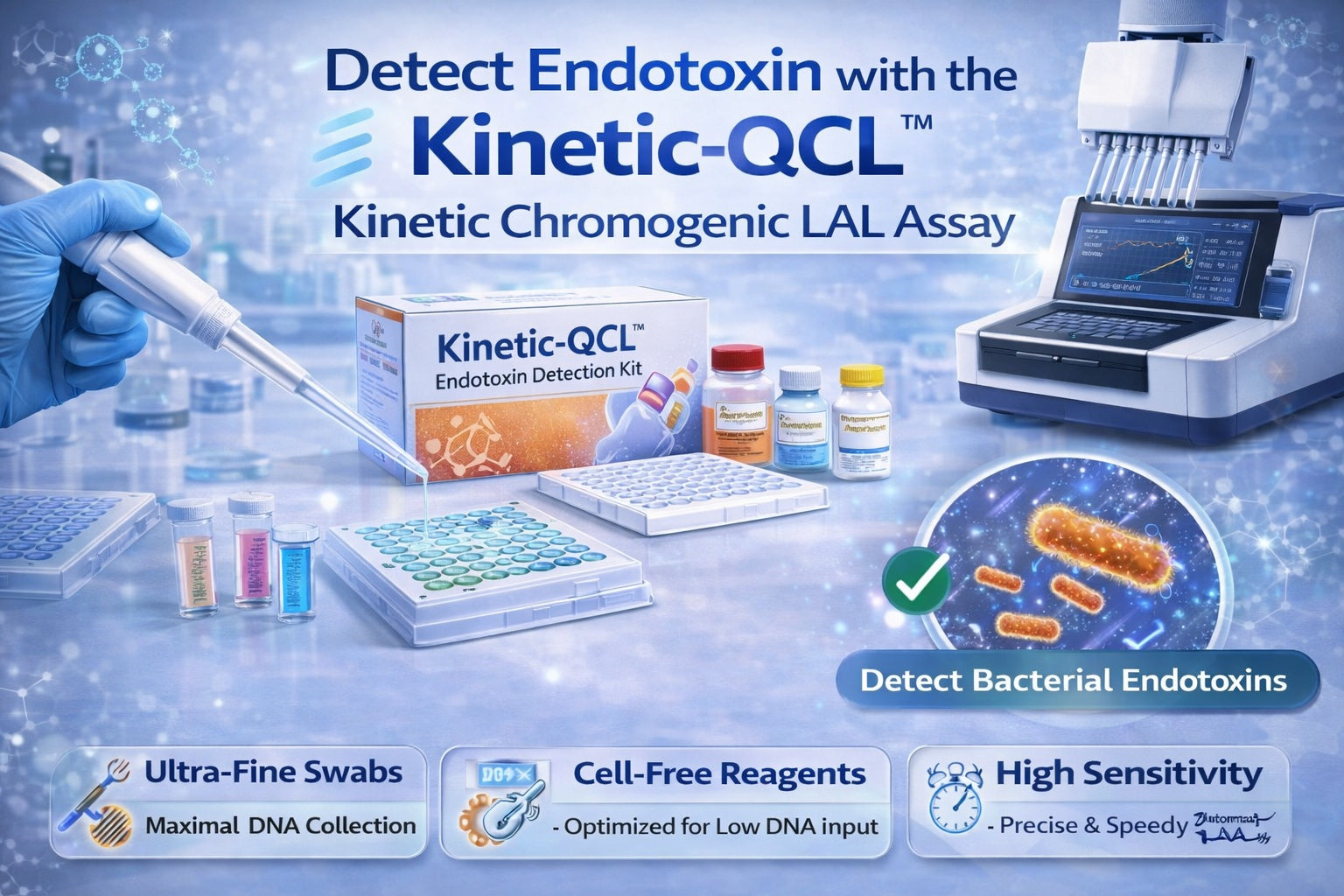
Endotoxin testing is a confident step in building safe, high-quality biopharmaceuticals and medical products. When teams want sensitive, quantitative endotoxin detection with clear readouts, a kinetic chromogenic format is a popular choice. One widely recognised approach is the Kinetic‑QCL Kinetic Chromogenic Assay, a type of LAL assay that measures colour development over time and converts the kinetic signal into an endotoxin concentration.
What is endotoxin, and why do we test for it?
Endotoxin (lipopolysaccharide, LPS) is a component of the outer membrane of Gram-negative bacteria. In bioprocessing and sterile manufacturing, endotoxin testing supports:
- Patient safety and product quality
- Process monitoring and contamination control
- Release testing and stability programs
A well-run endotoxin method provides fast, interpretable results and fits smoothly into routine QC.
What is a Kinetic Chromogenic Assay?
A Kinetic Chromogenic Assay is a kinetic (time-based) test in which endotoxin triggers an enzymatic cascade from Limulus Amebocyte Lysate (LAL). That cascade cleaves a chromogenic substrate, producing a colored product. The instrument repeatedly measures absorbance during the run.
Instead of looking only at an endpoint, the kinetic format measures how quickly the signal develops. The more endotoxin present, the faster the colour develops—so reaction time becomes an informative measurement.
This approach is popular because it supports:
- Quantitative results across a standard curve
- Strong sensitivity for low-level endotoxin
- Clear trend-based interpretation over time
How the Kinetic‑QCL kinetic chromogenic LAL assay works (step-by-step)
While exact kit procedures vary by manufacturer and lab SOP, the workflow typically follows this pattern:
1) Prepare standards and controls
A standard curve is prepared from a known endotoxin reference. Positive product controls (spikes) and negative controls are included to confirm that the method is functioning properly.
2) Prepare samples
Samples are diluted or conditioned as needed to reduce interference and keep the reaction in a reliable range.
3) Add LAL reagent + chromogenic substrate
The reaction mixture is assembled in microplate wells or tubes, depending on the format.
4) Read kinetically
A plate reader measures absorbance at set intervals. The software determines a time point (or threshold crossing) corresponding to the endotoxin concentration.
5) Quantify and validate
Results are calculated using the standard curve and validated against acceptance criteria, including spike recovery and curve fit. The kinetic approach turns a time-based signal into a concentration value that is easy to trend and report.
Kinetic chromogenic vs gel clot vs turbidimetric assay
All three are respected formats. The best choice depends on your lab goals and workflow.
Gel clot method
The gel clot method is a classic LAL approach that provides a qualitative or semi-quantitative result (i.e., the gel forms or does not form at a defined endotoxin limit). It’s valued for its simplicity and is often used when a pass/fail-style answer is most useful.
Turbidimetric assay
A turbidimetric assay measures the increase in cloudiness (turbidity) as the reaction proceeds. Like chromogenic kinetic methods, it can be quantitative and time-based.
Kinetic Chromogenic Assay
The kinetic chromogenic approach measures colour development (absorbance change) over time, providing quantitative outputs with strong sensitivity and clear kinetic behavior.
In practice:
- Gel clot shines for straightforward limit testing.
- Turbidimetric assays shine for kinetic turbidity-based measurement.
- Kinetic chromogenic assays shine for quantitative, colour-based kinetic measurement.
Understanding reaction time in kinetic chromogenic LAL testing
In kinetic chromogenic assays, reaction time is the time required for the signal to reach a defined threshold (or for a specified change in absorbance).
A friendly way to interpret it:
- Higher endotoxin → faster cascade → shorter reaction time
- Lower endotoxin → slower cascade → longer reaction time
Because the method relies on time-based behavior, consistent incubation temperature, and proper plate handling and timing are excellent habits that help keep results stable.
What does the correlation coefficient mean in endotoxin assays?
When a kinetic chromogenic test builds a standard curve, the software evaluates how well the curve fits the standard data. The correlation coefficient (often denoted by “r” or “R”) is a goodness-of-fit statistic. A strong correlation coefficient supports confidence that the standard curve is behaving as expected.
In daily lab practice, a strong curve fit pairs beautifully with:
- Stable replicate performance
- Logical standard progression
- Acceptable control results (including spike recovery)
Together, these checks give a highly readable, audit-friendly result set.
Common sources of interference (and how labs manage them smoothly)
Many samples are “LAL-friendly,” and some contain components that can inhibit or enhance the reaction.
Positive, practical strategies include:
- Using validated dilutions to reduce matrix effects
- Including positive product controls to confirm recovery
- Ensuring clean labware and endotoxin-free water
- Standardising mixing and incubation conditions
These habits help endotoxin testing feel consistent across different sample types.
A simple best-practice checklist for kinetic chromogenic LAL assays
Use this checklist to keep runs smooth and reproducible.
Setup
- Equilibrate reagents and plate reader temperature
- Prepare standards carefully and label clearly
- Include negative controls and spikes/positive controls
Run quality
- Use consistent pipetting and mixing
- Minimise bubbles (they can affect absorbance reads)
- Start readings promptly and keep timing consistent
- Data review
- Confirm the standard curve behavior
- Check that the correlation coefficient meets your method criteria
- Review control, recovery, and replicate consistency
This structure helps your data look clean, and your reporting feel straightforward.
Where FireGene fits in kinetic chromogenic endotoxin detection
FireGene supports endotoxin testing workflows with kit formats designed for real QC needs. If your lab prefers a quantitative kinetic approach, FireGene’s endotoxin portfolio includes kinetic chromogenic options that align with routine endotoxin detection workflows.
FireGene’s broader focus on molecular testing tools also supports teams who value:
- Repeatable reagent performance
- Clear SOP-driven workflows
- Practical documentation for routine QC
If you’re building or refining an endotoxin program, choosing a format that matches your workflow—chromogenic kinetic, turbidimetric, or gel clot—helps your lab move efficiently with confidence.
FAQ
What is a Kinetic Chromogenic Assay for endotoxin detection?
A Kinetic Chromogenic Assay is a time-based LAL assay that measures colour development as endotoxin activates the LAL enzymatic cascade. The rate of colour development is used to calculate endotoxin concentration.
How is it different from the gel clot method?
The gel clot method provides a qualitative or limit-based result (gel forms or not), while kinetic chromogenic assays provide quantitative results by monitoring signal over time.
How is it different from a turbidimetric assay?
A turbidimetric assay measures changes in turbidity (cloudiness) during the reaction, whereas a chromogenic assay measures colour change. Both can be kinetic and quantitative.
Why is reaction time important?
In kinetic assays, reaction time reflects how quickly the signal reaches a threshold. Higher endotoxin levels typically lead to shorter reaction times, enabling quantification using a standard curve.
What does the correlation coefficient mean in this assay?
The correlation coefficient describes how well the standard curve fits the standards’ data. A strong fit supports confidence in calculated sample results.
conclusion
The Kinetic‑QCL Kinetic Chromogenic Assay style of LAL assay provides a sensitive, quantitative approach to endotoxin detection by measuring colour development over time. By understanding reaction time, monitoring curve-fitting metrics like the correlation coefficient, and choosing the right format compared with the gel clot method or a turbidimetric assay, labs can build an endotoxin testing workflow that feels reliable, readable, and ready for routine quality control.


