
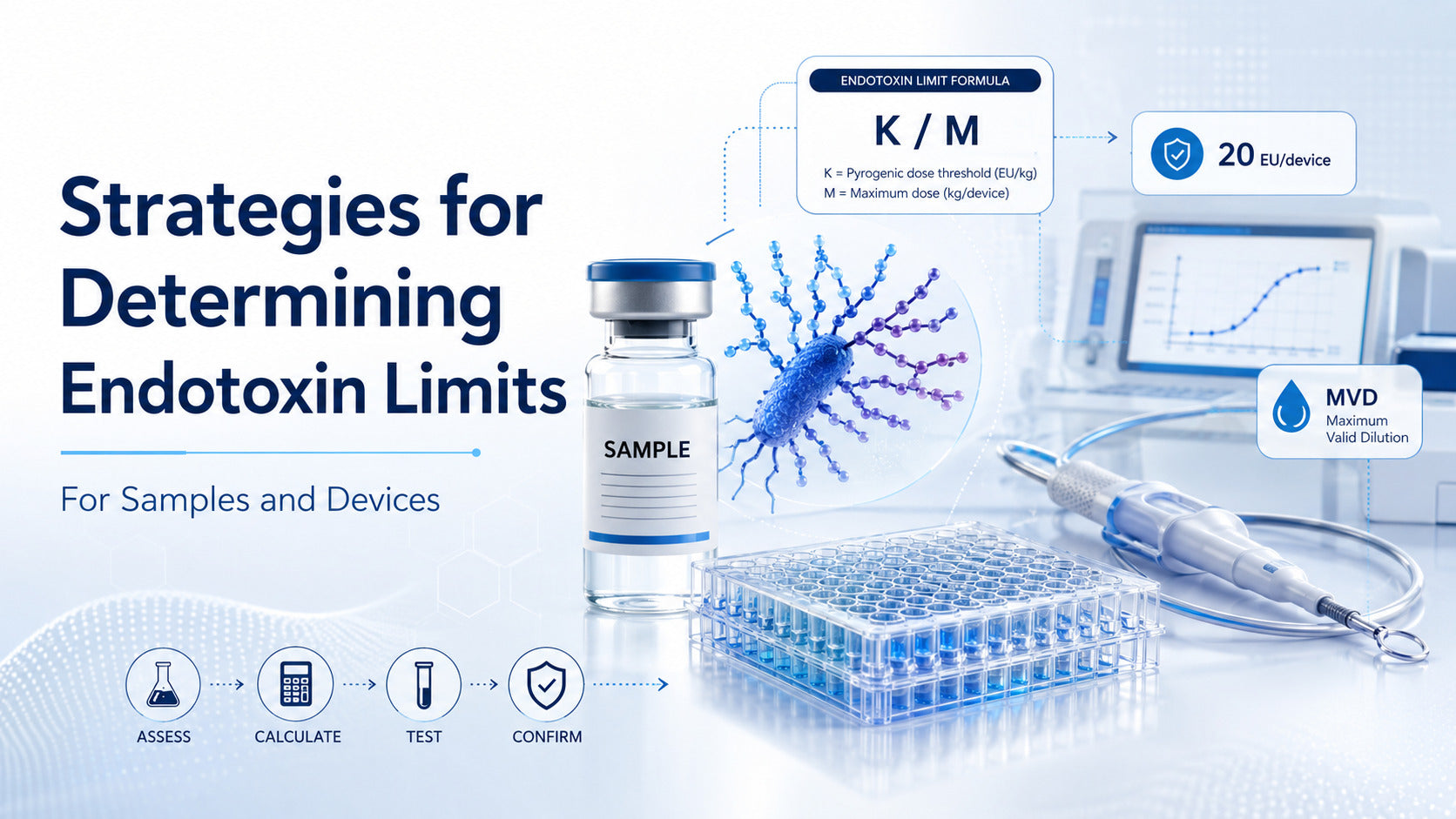
Determining an appropriate endotoxin limit is a critical step in the quality control of injectable pharmaceutical products, medical devices, raw materials and process samples. The limit establishes the maximum acceptable level of bacterial endotoxins for a specific product or test article and provides the acceptance criterion used during routine testing. There is no single endotoxin limit that applies to every sample. For an injectable product, the calculation is generally linked to the route of administration, maximum patient dose and amount delivered within one hour. For a medical device, the strategy usually depends on its intended use, the tissue or body system it contacts, the number of devices extracted and the volume of extraction solution.
A reliable approach, therefore, begins with understanding the product, its clinical use and the purpose of the test. Once the correct limit has been established, the laboratory can select a suitable Bacterial Endotoxins Test method, calculate the Maximum Valid Dilution and demonstrate that the sample does not interfere with endotoxin detection.
What Are Bacterial Endotoxins?
Bacterial endotoxins are lipopolysaccharide components associated with the outer membrane of Gram-negative bacteria. They may enter a manufacturing process through water, raw materials, equipment, personnel or the production environment. Endotoxins can remain present even after the bacteria that produced them are no longer viable. For this reason, a low bioburden result or successful sterilization process does not automatically prove that a product is free from endotoxin contamination.
When sufficient Endotoxin enters the body, it may trigger an inflammatory or pyrogenic response. The potential effects make endotoxin control particularly important for injectable products and devices that contact blood, cerebrospinal fluid or other sensitive body systems.
Why Endotoxin Contamination Matters
Endotoxin contamination is a patient-safety and product-quality concern. A strong control strategy may include qualified raw materials, suitable water systems, controlled manufacturing conditions, validated cleaning procedures and routine monitoring. Testing alone cannot compensate for a poorly controlled process. The most effective strategy combines contamination prevention with a scientifically justified endotoxin limit and a suitable analytical method.
What Is an Endotoxin Limit?
An endotoxin limit is the maximum amount of Endotoxin permitted in a product, sample or Device under defined conditions.
The limit may be expressed as:
- EU/mg
- EU/mL
- EU/unit
- EU/device
- EU/dose
The appropriate unit depends on how the product is administered, prepared and tested. For injectable pharmaceutical products, the limit is generally based on the maximum acceptable patient exposure. For medical devices, it is more commonly expressed as a total endotoxin burden per Device or as the equivalent concentration in a device extract.
Endotoxin Limit vs Test Result
The endotoxin limit is the acceptance criterion. The test result is the amount of Endotoxin measured in the sample. A Bacterial Endotoxins Test result must remain at or below the applicable limit for the sample or Device to comply with the established specification.
Endotoxin Limits for Injectable Pharmaceutical Products
Endotoxin limits for injectable pharmaceutical products are commonly determined using the K/M formula:
Endotoxin limit = K ÷ M
In this calculation:
- K is the maximum acceptable endotoxin exposure associated with the route of administration.
- M is the maximum dose administered per kilogram of patient body weight within one hour.
The dose should be based on the highest amount that can be administered under the approved or proposed instructions for use. This may include repeat doses, maintenance doses or incremental dosing that can occur within the same one-hour period.
Understanding K
For most applicable non-intrathecal injectable products, the commonly used maximum exposure is:
K = 5 EU/kg
For products administered intrathecally, or where inadvertent intrathecal exposure is relevant, a more restrictive value is generally applied:
K = 0.2 EU/kg
K is not the final endotoxin limit. It must be divided by M.
Understanding M
M represents the maximum product dose per kilogram of patient weight within one hour.
The information required to establish M may include:
- Maximum clinical dose
- Dose unit
- Route of administration
- Patient population
- Patient body weight
- Infusion duration
- Product concentration
- Repeat-dose instructions
A dose stated only as “50 mg” is not enough. The analyst must determine whether this means 50 mg per person, 50 mg/kg or 50 mg delivered over several hours.
Example: Product Dosed in mg/kg
Assume an intravenous product has a maximum dose of 25 mg/kg administered within one hour.
Endotoxin limit = 5 EU/kg ÷ 25 mg/kg
Endotoxin limit = 0.2 EU/mg
Example: Whole-Person Dose
Assume a maximum adult dose of 50 mg and a justified patient weight of 70 kg.
First, calculate the dose per kilogram:
50 mg ÷ 70 kg = 0.71 mg/kg
Then calculate the limit:
5 EU/kg ÷ 0.71 mg/kg = approximately 7.04 EU/mg
This example shows why a whole-person dose must not be treated as a dose per kilogram.
Effect of Infusion Time
For a dose administered over several hours, calculate the amount delivered per kilogram within one hour:
Dose per kg per hour = Total dose per kg ÷ Infusion duration
If 50 mg/kg is infused uniformly over five hours:
50 mg/kg ÷ 5 hours = 10 mg/kg/hour
The resulting limit is:
5 EU/kg ÷ 10 mg/kg/hour = 0.5 EU/mg
For variable-rate infusions, the calculation should reflect the greatest amount that may be delivered during any one-hour interval.
Endotoxin Limits for Medical Devices
Endotoxin limits for medical devices are not normally derived from a pharmaceutical dose using K/M. Instead, the limit is selected according to the Device’s intended use, patient-contact category and applicable regulatory or compendial requirements.
Devices that may require bacterial endotoxin evaluation include:
- Catheters
- Administration sets
- Dialysis tubing
- Vascular grafts
- Heart valves
- Implantable devices
- Drug-delivery systems
- Devices contacting cerebrospinal fluid
- Other sterile devices carrying a nonpyrogenic claim
Cardiovascular and Lymphatic Contact
For many devices that directly or indirectly contact the cardiovascular or lymphatic systems, a commonly referenced limit is:
20 EU/device
Where an extract-based criterion is used, the equivalent concentration depends on the extraction volume.
Cerebrospinal-Fluid Contact
Devices that contact cerebrospinal fluid generally require a more restrictive limit. A commonly referenced device limit is:
2.15 EU/device
The applicable requirement should always be confirmed against the Device’s intended use, current standards and regulatory strategy.
Special Device Categories
Intraocular devices, combination products, patient-specific implants and newer device designs may need a product-specific assessment. A general device limit should not be applied automatically where the clinical exposure, material characteristics or contact pathway differ from conventional devices.

EU per Device vs EU per mL
Medical-device requirements are frequently expressed as both a total limit per Device and a concentration limit in the extraction solution.
The relationship is:
Extract limit in EU/mL = Device limit in EU/device ÷ Extraction volume in mL
Example: One Device Extracted in 40 mL
For a device limit of 20 EU/device:
20 EU/device ÷ 40 mL = 0.5 EU/mL
The laboratory acceptance criterion for the extract would therefore be 0.5 EU/mL.
Multiple Devices in One Extraction
If several devices are combined in one extraction, the allowable total endotoxin burden increases according to the Number of devices:
Extract limit = Device limit × Number of devices ÷ Total extraction volume
For five devices, each with a limit of 20 EU/device, extracted in 100 mL:
20 EU × 5 ÷ 100 mL = 1 EU/mL
The calculation must still ensure that the pooling approach can detect an unacceptable individual unit and does not mask contamination.
Developing a Medical Device Extraction Procedure
Solid or assembled medical devices cannot usually be tested directly. Endotoxin must first be recovered from the Device into a suitable extraction solution. The extraction procedure should represent the surfaces and components that may contact the patient during normal use.
Extraction Approaches
Depending on the device design, extraction may involve:
- Immersion
- Rinsing
- Flushing
- Agitation
- Extraction of the complete Device
- Extraction of patient-contacting components
- Extraction of internal fluid pathways
The chosen approach should provide meaningful access to the relevant surfaces.
Extraction Volume
The volume must be sufficient to contact the Device and allow laboratory testing, but it should not be unnecessarily large. A larger extraction volume lowers the concentration of recovered Endotoxin and therefore lowers the EU/mL acceptance criterion. Excessive volume may reduce analytical sensitivity or create a restrictive MVD.
Time, Temperature and Agitation
Extraction time, temperature and agitation can influence recovery from the device surface. The conditions should be clearly defined and scientifically justified. Complex geometries, porous materials, coatings and long internal pathways may require additional evaluation to confirm adequate recovery.
Whole Device vs Components
Finished-device testing provides the most direct assessment of the final product. Component or raw-material testing may still be useful as part of process control, supplier qualification or investigation. However, acceptable results for individual components do not automatically prove that the assembled Device meets the final endotoxin requirement. Manufacturing, assembly and packaging can introduce additional contamination.
Maximum Valid Dilution
Maximum Valid Dilution, or MVD, is the greatest sample dilution at which the method can still detect Endotoxin at the required limit.
A general relationship is:
MVD = Endotoxin limit ÷ Method sensitivity
Where sample concentration must be included, the formula should be adjusted so that all units remain consistent.
MVD is especially important when a sample or device extract interferes with the assay. Dilution may reduce inhibition or enhancement, but the sample must not be diluted beyond the point where the required limit can no longer be detected.
Strategies for Endotoxin Limit Testing
Effective strategies for endotoxin limit testing combine limit selection, sample preparation, method suitability and routine controls.
The recommended workflow is:
- Define the sample or Device and its intended use.
- Identify the applicable endotoxin limit.
- Select the appropriate reporting unit.
- Establish the extraction or sample-preparation procedure.
- Calculate the MVD.
- Evaluate inhibition and enhancement.
- Select a suitable BET method.
- Define storage, holding time and pooling conditions.
- Validate or verify the method as required.
- Document the scientific rationale.
This structured approach reduces the risk of using an incorrect limit or an unsuitable testing condition.
LAL Assay for Endotoxin Determination
The LAL assay for endotoxin determination has long been used for pharmaceutical products and medical devices. LAL refers to Limulus Amebocyte Lysate, a reagent that responds to bacterial Endotoxin.
BET methods may include:
- Gel-clot testing
- Kinetic chromogenic testing
- Kinetic turbidimetric testing
Recombinant reagent-based approaches may also be considered where they are suitable and supported by the applicable compendial and regulatory framework.
Gel-Clot Method
The gel-clot method provides a qualitative or semi-quantitative result based on the formation of a firm gel at the stated assay sensitivity. It is valued for its relatively straightforward format but provides less quantitative information than kinetic methods.
Kinetic Chromogenic Method
The kinetic chromogenic method measures the development of color over time. It provides a quantitative result and can be useful where a broader analytical range is required.
Kinetic Turbidimetric Method
The kinetic turbidimetric method measures increasing turbidity as the reaction proceeds. It also provides quantitative endotoxin determination.
Choosing the Right Method
The best method depends on:
- Required sensitivity
- Sample characteristics
- Product color or turbidity
- Expected endotoxin range
- Laboratory equipment
- Routine testing needs
- Regulatory strategy
No method should be selected solely because it is familiar. Suitability must be demonstrated for the actual sample.

Method Suitability and Interference
Medical device extracts and pharmaceutical samples may inhibit or enhance the test response.
Potential causes include:
- Extreme pH
- High salt concentration
- Proteins
- Preservatives
- Surfactants
- Chelating agents
- Anticoagulant coatings
- Heavy metals
- Adhesives
- Lubricants
- Particulates
- Strong color or turbidity
A positive product control is used to show that Endotoxin can be recovered and detected in the presence of the sample. If interference occurs, the laboratory may investigate a suitable dilution, pH adjustment or another justified sample-treatment approach while remaining within the MVD.
Sample Storage and Holding Time
Endotoxin recovery may change during storage. Sample containers, holding time, temperature and freeze-thaw cycles can influence the amount of assayable Endotoxin.
A testing procedure should therefore define:
- Storage temperature
- Maximum holding time
- Container type
- Mixing requirements
- Freeze-thaw restrictions
- Conditions for device extracts
Native Endotoxin in a real sample may behave differently from a purified reference standard, so stability should be demonstrated using representative materials.
Sample Pooling
Pooling can reduce testing time and laboratory workload, but it requires careful justification.
A pooled result may dilute Endotoxin from one contaminated unit across several acceptable units. The pooling design must therefore preserve the ability to detect a unit that exceeds the applicable limit.
Pooling may be unsuitable where:
- MVD is low
- Samples are heterogeneous
- The material is a suspension
- Individual-unit risk is significant
- Endotoxin distribution is likely to be uneven
When pooling is used, original units or aliquots may need to be retained for follow-up testing.
Relevant Standards and Guidance
A robust endotoxin-testing strategy should consider the current versions of relevant standards and guidance.
USP Chapter 85
USP <85> provides the compendial framework for the Bacterial Endotoxins Test and includes principles associated with gel-clot and photometric methods.
USP Chapter 161
USP <161> addresses bacterial Endotoxin and pyrogen testing for certain sterile, nonpyrogenic medical devices that contact the cardiovascular system, lymphatic system or cerebrospinal fluid.
ANSI/AAMI ST72
ANSI/AAMI ST72 covers test methods, routine monitoring and alternatives to batch testing for bacterial endotoxins in medical-device manufacturing.
ISO 11737-3
ISO 11737-3 provides general criteria for determining bacterial endotoxins on or in healthcare products, components and raw materials using BET methods. It supports method development and testing strategy, but does not itself establish specific product limits.
Current FDA Guidance
FDA guidance connects endotoxin testing with USP <85>, USP <161> and AAMI ST72. Current recommendations recognize gel-clot, photometric and kinetic principles and emphasize testing appropriate components and finished products.
FireGene supports laboratories and diagnostic organizations seeking dependable solutions for microbiological quality-control workflows and method implementation.
Common Mistakes to Avoid
Applying K/M to Every Device
K/M is used for dose-based pharmaceutical calculations. Conventional medical-device limits are generally selected according to intended use and patient contact.
Ignoring Extraction Volume
A correct EU/device limit can still produce an incorrect laboratory criterion if the extraction volume is not included.
Testing Beyond the MVD
Excessive dilution can make the method unable to detect Endotoxin at the required acceptance limit.
Assuming Sterilization Removes Endotoxin
A product may be sterile while still containing bacterial endotoxins.
Ignoring Product Interference
A low test result is not meaningful unless the method suitability has shown that the sample permits reliable endotoxin recovery.
Using Component Results as Final-Device Evidence
Component monitoring is valuable, but the final assembled product may still require its own justified testing strategy.
FAQS
What is the purpose of an endotoxin limit?
An endotoxin limit defines the maximum acceptable bacterial endotoxin level for a specific product, sample or medical device.
How are endotoxin limits for injectable pharmaceutical products calculated?
They are generally calculated using K/M, where K is the allowable patient exposure, and M is the maximum dose per kilogram delivered within one hour.
How are endotoxin limits for medical devices determined?
They are selected according to the Device’s intended use, patient-contact category and applicable standards, then converted into an extract limit based on device count and extraction volume.
What is the difference between EU/device and EU/mL?
EU/device represents the total acceptable endotoxin burden on one Device. EU/mL represents the equivalent allowable concentration in the extraction solution.
What is the Bacterial Endotoxins Test?
The Bacterial Endotoxins Test is an analytical procedure used to detect or quantify endotoxin activity in a product, sample or Device extract.
What is an LAL assay?
An LAL assay uses Limulus Amebocyte Lysate reagent to detect bacterial endotoxins through gel-clot, chromogenic or turbidimetric reactions.
What is Maximum Valid Dilution?
MVD is the greatest dilution at which the test can still detect Endotoxin at the applicable product or device limit.
Can medical devices be tested directly?
Liquid devices may sometimes be tested directly. Solid or assembled devices generally require extraction, flushing, rinsing or immersion before testing.
Conclusion
Strategies for determining endotoxin limits for samples and devices must begin with a clear understanding of the product and its intended use. For injectable pharmaceutical products, the K/M calculation links the limit to the maximum clinical dose and route of administration. For medical devices, the limit is generally linked to patient contact, the Number of devices tested and the extraction volume.
A complete strategy also includes a justified extraction procedure, Maximum Valid Dilution calculation, method-suitability assessment, suitable BET or LAL assay and controlled sample handling. By combining scientifically justified limits with effective contamination control and reliable testing, manufacturers can build a positive, risk-based quality strategy that supports patient safety, regulatory readiness and consistent product performance.


