
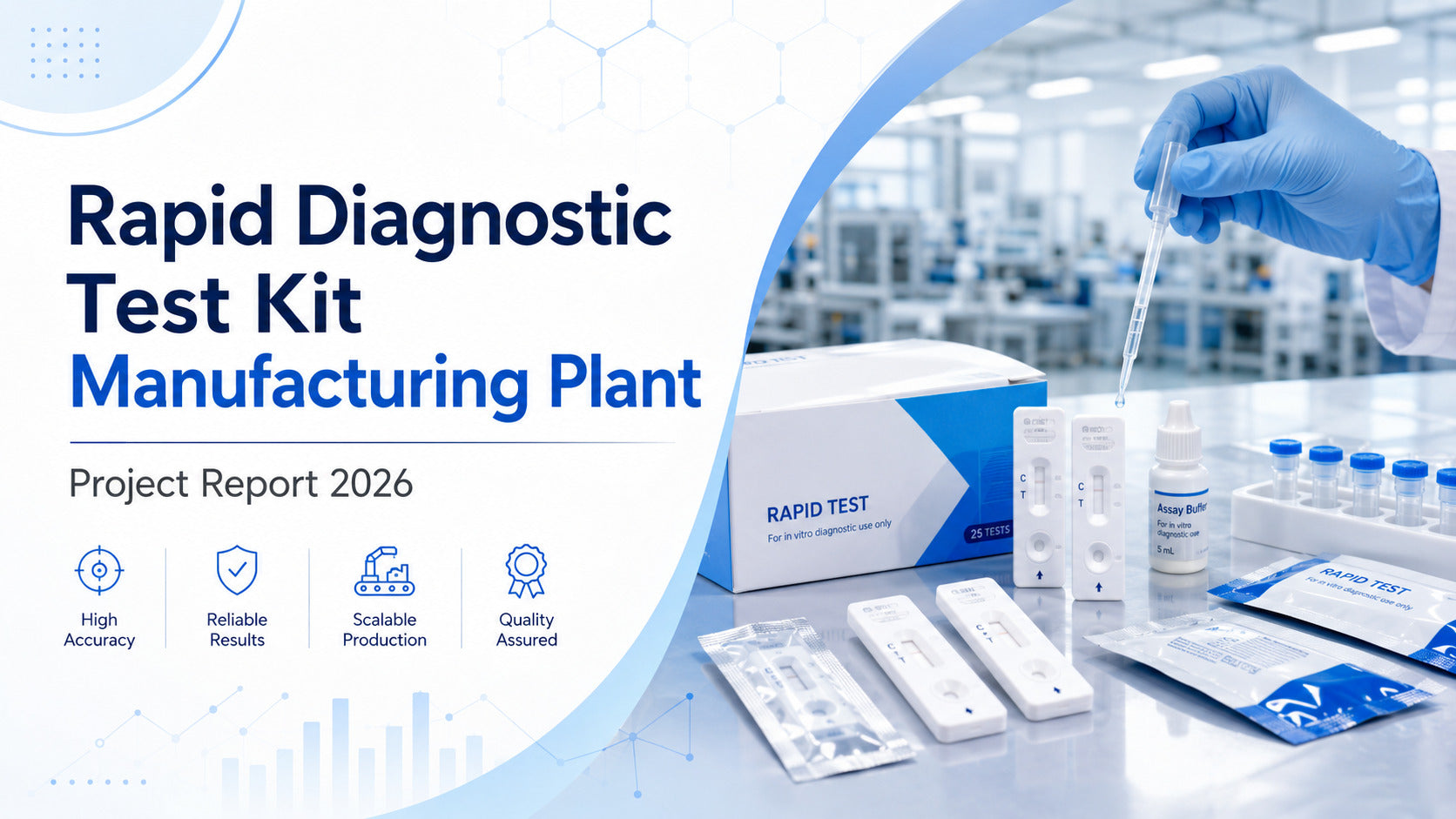
The demand for fast, accessible and reliable diagnostic solutions continues to grow across hospitals, laboratories, clinics, pharmacies and public health programs. Rapid diagnostic test kits play an important role in this transition because they can detect specific diseases, biomarkers, antigens or antibodies within a short period. The growth of early disease detection, preventive healthcare, home testing and decentralized healthcare delivery is creating new opportunities for manufacturers and investors. As point-of-care testing becomes more widely adopted, the need for efficient and scalable production facilities is also increasing.
This Rapid Diagnostic Test Kit Manufacturing Plant Project Report 2026 provides an overview of the plant setup, production process, machinery, raw materials, infrastructure, workforce, costs, investment requirements and potential revenue associated with establishing a manufacturing unit.
What Is a Rapid Diagnostic Test Kit?
A Rapid Diagnostic Test Kit is a medical diagnostic device designed to identify a specific antigen, antibody, pathogen or biomarker from a patient sample. Depending on the product, these kits may use blood, serum, plasma, urine, saliva or swab samples.
Most rapid tests provide results within approximately 10 to 30 minutes. They are commonly based on immunoassay or molecular detection technologies and are available in formats such as:
- Lateral flow strips
- Dipsticks
- Plastic cassettes
- Cartridges
- Test cards
A diagnostic test kit normally requires limited equipment and can be used in clinical, laboratory, field and home-testing environments. Its portability and fast turnaround time make it useful for emergency care, remote locations, mass screening and routine testing. Rapid testing is also an important segment of the wider In Vitro Diagnostics industry, which includes products used to examine samples collected from the human body.
Rapid Diagnostic Test Kit Project Summary
A typical rapid test kit manufacturing project includes the following major areas:
|
Project Area |
Details |
|
Product |
Rapid diagnostic test kits |
|
Production process |
Raw material preparation, reagent formulation, membrane coating, drying, cutting, assembly, inspection and packaging |
|
Main end users |
Hospitals, laboratories, clinics, pharmacies, public health agencies and home users |
|
Main applications |
Infectious diseases, pregnancy, glucose monitoring, cardiac markers and screening |
|
Important raw materials |
Nitrocellulose membrane, antibodies, antigens, reagents and plastic cassettes |
|
Main machinery |
Coating, drying, cutting, assembly, sealing, packaging and inspection systems |
|
Main investment areas |
Land, civil works, machinery, utilities, laboratory setup and working capital |
|
Financial analysis |
CapEx, OpEx, revenue, profit margins, ROI, NPV and break-even analysis |
Key Investment Highlights
Manufacturing Process
The production process generally includes:
- Raw material preparation
- Reagent formulation
- Membrane coating
- Drying and curing
- Cutting and assembly
- Quality inspection
- Packaging and labeling
Main End-Use Industries
Rapid diagnostic products are commonly supplied to:
- Hospitals
- Diagnostic laboratories
- Clinics
- Point-of-care centers
- Public health agencies
- Emergency medical services
- Pharmacies
- Home-testing and retail channels
Major Applications
The main applications include:
- Infectious disease detection
- Pregnancy testing
- Blood glucose and metabolic testing
- Cardiac marker detection
- Preventive screening
- Public health surveillance
Rapid Diagnostic Test Kit Plant Capacity
The production capacity of a facility depends on market demand, automation level, equipment speed, number of working shifts and product type. An industrial-scale facility may be designed for an annual production capacity of approximately 50 million to 100 million test kits. This scale can support high-volume production while allowing the manufacturer to serve different healthcare and retail channels.
Actual production capacity should be selected after considering:
- Expected market demand
- Product portfolio
- Machinery output
- Working days
- Shift structure
- Product rejection rate
- Packaging capacity
- Future expansion plans
A modular production system can help a manufacturer increase capacity as sales grow.
Rapid Diagnostic Test Kit Plant Profit Margins
The profitability of a rapid diagnostic manufacturing unit depends on product pricing, raw material costs, production yield, capacity utilization, market demand and distribution expenses.
Indicative project estimates suggest:
|
Financial Indicator |
Indicative Range |
|
Gross profit margin |
40–50% |
|
Net profit margin |
15–25% |
These margins are not fixed for every project. They can vary according to the type of test, production location, automation level, regulatory costs, sales channel and competitive pricing. Manufacturers supplying specialized or value-added medical diagnostic kits may achieve stronger margins than companies competing only through low prices.
Rapid Diagnostic Test Kit Plant Cost Analysis
The operating cost of a rapid diagnostic test kit production facility is mainly influenced by raw materials, utilities, packaging, labor, transportation, quality control and maintenance.
Indicative cost shares include:
|
Operating Cost Component |
Indicative Share |
|
Raw materials |
40–50% of OpEx |
|
Utilities |
10–15% of OpEx |
|
Packaging |
Depends on product format |
|
Transportation |
Depends on market location |
|
Salaries and wages |
Depends on automation and local labor costs |
|
Maintenance |
Depends on machinery and production scale |
|
Taxes and depreciation |
Depends on location and investment structure |
Nitrocellulose membranes, antibodies, antigens, reagents, pads and plastic cassettes are among the most important cost components. Long-term supplier agreements can help reduce material price fluctuations and improve supply continuity.
Major Applications of Rapid Diagnostic Test Kits
Hospitals and Diagnostic Laboratories
Hospitals and laboratories use rapid tests to support timely screening and faster clinical decisions. They may be used in routine testing, emergency diagnostics and infectious disease management.
Clinics and Point-of-Care Centers
Rapid tests allow healthcare professionals to perform certain tests close to the patient. This can reduce waiting time and decrease dependence on centralized laboratory infrastructure.
Public Health and Screening Programs
Large-scale screening programs use rapid diagnostic products for:
- Disease surveillance
- Outbreak monitoring
- Community screening
- Population health programs
- Emergency response
Home Testing and Retail Diagnostics
User-friendly formats allow individuals to perform certain preliminary tests at home. Pregnancy tests, glucose-related products and selected infectious disease kits are commonly distributed through retail and pharmacy channels.

Why Invest in Rapid Diagnostic Test Kit Manufacturing?
Growing Demand for Early Diagnosis
Healthcare providers increasingly focus on early disease detection because timely diagnosis can support faster treatment and better patient management.
Expansion of Point of Care Testing
Point-of-care testing allows diagnostic procedures to be performed closer to patients. This approach is becoming more important in clinics, emergency care, remote locations and decentralized healthcare systems.
Recurring and High-Volume Demand
Many rapid diagnostic products are single-use items. Hospitals, laboratories, screening programs and retail channels therefore create recurring demand.
Technological Development
Improvements in immunoassays, molecular diagnostics and biomarker detection are supporting the development of more sensitive and user-friendly products.
Scalable Production
A Rapid Test Kit Plant can begin with a selected product range and expand through additional coating, cutting, assembly and packaging lines.
Multiple Sales Channels
Manufacturers may supply products through:
- Hospitals
- Laboratories
- Distributors
- Pharmacies
- Government tenders
- Public health programs
- Retail channels
- Export markets
Rapid Diagnostic Test Kit Industry Outlook 2026
The rapid diagnostic industry is supported by rising healthcare expenditure, increased awareness of preventive screening and growing demand for faster diagnostic decisions. According to industry estimates referenced in the project study, the global rapid medical diagnostic kits market was valued at approximately USD 20.47 billion in 2025. It is projected to reach around USD 32.86 billion by 2034, representing an estimated CAGR of 5.4% between 2026 and 2034.
The market outlook is being supported by:
- Greater awareness of early diagnosis
- Increasing infectious and chronic disease burden
- Expansion of home healthcare
- Adoption of self-testing
- Wider use of rapid testing in hospitals and clinics
- Public health surveillance programs
- Demand for affordable diagnostic products
- Growth in preventive healthcare
Rapid diagnostic products can also help healthcare facilities improve patient flow by reducing the time required to receive selected test results.
How to Set Up a Rapid Diagnostic Test Kit Manufacturing Plant
Establishing a manufacturing facility requires careful planning across production, quality, infrastructure, procurement and financial management. The manufacturing process involves several connected operations.
Raw Material Preparation
Biological, chemical, membrane, plastic and packaging materials are received, inspected and prepared for production.
Reagent Formulation
Antibodies, antigens, buffers and other reagents are prepared according to the required product formulation.
Membrane Coating
Test and control reagents are applied to the nitrocellulose membrane using controlled dispensing or coating equipment.
Drying and Curing
The coated membrane is dried under controlled environmental conditions to maintain reagent stability.
Cutting and Assembly
The prepared membrane and pads are laminated, cut into strips and placed inside plastic cassettes or other test housings.
Quality Inspection
The assembled products are examined for consistency, correct positioning, performance and packaging quality.
Packaging and Labeling
The finished test is sealed in suitable packaging, labeled and packed for storage or distribution.

Mass Balance and Raw Material Requirements
A mass-balance analysis determines how much raw material is required to produce a defined number of finished kits.
The calculation should consider:
- Material input
- Production losses
- Quality-control samples
- Rejected products
- Packaging losses
- Salable finished units
This analysis helps manufacturers estimate production cost, reduce waste and plan inventory.
Rapid Test Kit Raw Materials
Important raw materials include:
- Nitrocellulose membranes
- Antibodies
- Antigens
- Reagents
- Sample pads
- Conjugate pads
- Absorbent pads
- Backing cards
- Plastic cassettes
- Extraction buffers
- Foil pouches
- Desiccants
- Labels
- Product cartons
Reliable suppliers should be selected to maintain consistent product quality and avoid production interruptions.
Rapid Test Kit Production Plant Machinery and Equipment List
A typical rapid test kit production plant machinery and equipment list includes:
|
Machinery or Equipment |
Main Use |
|
Membrane coating machine |
Applies test and control reagents |
|
Reagent dispensing system |
Provides controlled reagent dispensing |
|
Drying oven |
Dries coated membranes and treated materials |
|
Laminating machine |
Combines membrane, pads and backing card |
|
Slitting machine |
Cuts laminated sheets into smaller sections |
|
Strip cutting machine |
Produces individual test strips |
|
Cassette assembly system |
Places strips inside plastic cassettes |
|
Sealing machine |
Seals individual test pouches |
|
Packaging machine |
Packs tests and accessories |
|
Labeling machine |
Applies product and batch information |
|
Quality inspection equipment |
Checks product consistency and performance |
|
Analytical instruments |
Support quality-control testing |
Machinery selection depends on:
- Plant capacity
- Product type
- Automation level
- Available investment
- Required production speed
- Quality standards
- Future expansion plans
High-quality and reliable equipment can improve production efficiency, reduce waste and maintain product consistency.
Project Economics
The economics of a rapid diagnostic test kit plant depend on production capacity, technology, market location, machinery, raw materials and selling price.
Capital Investment
Capital investment may include:
- Land acquisition or lease
- Site preparation
- Civil construction
- Production machinery
- Laboratory equipment
- Utilities
- Warehousing
- Office infrastructure
- Installation
- Pre-operating expenses
Machinery and civil works normally represent a significant portion of the total project investment.
Equipment Costs
Equipment cost depends on production speed and automation. A manual or semi-automatic production line generally requires less initial investment, while an automated line requires higher capital but may provide greater output and consistency.
Raw Material Expenses
Raw materials are a major part of operating expenditure.
The actual expense depends on:
- Type of diagnostic kit
- Antibody and antigen costs
- Membrane specifications
- Cassette design
- Packaging format
- Production volume
- Supplier location
Infrastructure and Utilities
The financial plan should include the cost of:
- Land
- Construction
- Electricity
- Water
- HVAC
- Refrigeration
- Waste management
- Maintenance
Operational Costs
Ongoing operating expenses include:
- Raw materials
- Salaries and wages
- Utilities
- Packaging
- Transportation
- Quality control
- Equipment maintenance
- Repairs
- Taxes
- Depreciation
- Environmental compliance
Financial Planning
A detailed financial analysis should evaluate:
- Total investment
- Operating cost
- Product pricing
- Annual revenue
- Gross profit
- Net profit
- Return on investment
- Net present value
- Payback period
- Break-even point
Financial projections should be based on realistic assumptions related to market demand, production capacity, selling price and raw material costs.
Capital Expenditure Breakdown
|
Capital Cost |
Description |
|
Land and site development |
Land, registration and site preparation |
|
Civil works |
Production, laboratory, warehouse and office areas |
|
Machinery |
Coating, drying, cutting, assembly and packaging systems |
|
Laboratory equipment |
Quality testing and analytical instruments |
|
Other capital costs |
Installation, utilities, furniture and pre-operating costs |
Operational Expenditure Breakdown
|
Operating Expense |
Details |
|
Raw materials |
Membranes, biological materials, reagents and cassettes |
|
Utilities |
Electricity, water, HVAC and refrigeration |
|
Packaging |
Pouches, desiccants, labels and cartons |
|
Salaries and wages |
Production, laboratory and administrative staff |
|
Transportation |
Incoming materials and finished products |
|
Maintenance |
Machinery servicing and repairs |
|
Depreciation |
Reduction in asset value |
|
Taxes |
Applicable local taxes |
|
Other expenses |
Quality, storage, administration and compliance |
Revenue and Profitability Analysis
Revenue depends on:
- Number of kits produced
- Capacity utilization
- Product selling price
- Sales volume
- Market demand
- Distribution network
- Product mix
- Export opportunities
Profitability should be assessed over several years because a new plant may require time to reach full production capacity.
A financial model should normally include:
|
Financial Measure |
Purpose |
|
Total income |
Measures annual sales revenue |
|
Total expenditure |
Measures annual project expenses |
|
Gross profit |
Revenue minus direct production costs |
|
Net profit |
Final profit after total expenses |
|
Gross margin |
Shows production profitability |
|
Net margin |
Shows overall profitability |
|
ROI |
Measures return on investment |
|
NPV |
Measures the present value of future cash flows |
|
Payback period |
Estimates how long investment recovery may take |
Latest Industry Developments
The rapid diagnostic industry continues to receive attention from global health organizations. In October 2025, the World Health Organization held discussions related to accessibility, affordability and wider use of rapid diagnostic tests. The event focused on production, distribution, regulation and adoption, particularly in low- and middle-income countries.
In May 2025, the World Health Organization and the Medicines Patent Pool announced a sublicensing arrangement intended to expand access to selected rapid diagnostic technologies for infectious diseases. These developments reflect growing interest in regional production, technology transfer and stronger diagnostic capacity.
FAQS
What is the cost of setting up a rapid diagnostic test kit manufacturing plant?
The cost of setting up a rapid diagnostic test kit manufacturing plant depends on plant capacity, country, machinery, automation, raw materials, infrastructure, labor and regulatory requirements.
What machinery is required for rapid test kit production?
The main machinery includes membrane coating machines, reagent dispensers, drying ovens, laminating machines, strip cutters, cassette assembly systems, pouch sealers, packaging machines and quality-inspection equipment.
What are the main raw materials?
The primary materials include nitrocellulose membranes, antibodies, antigens, reagents, sample pads, conjugate pads, absorbent pads, backing cards, plastic cassettes, pouches and desiccants.
What is the normal production process?
The process includes raw material preparation, reagent formulation, membrane coating, drying, cutting, assembly, quality inspection, packaging and labeling.
What is the expected plant capacity?
A large-scale facility may be designed for approximately 50 million to 100 million test kits per year. Actual capacity depends on machinery, shifts, product type and demand.
What are the main operating costs?
The main operating expenses include raw materials, utilities, wages, packaging, transportation, maintenance, quality control, depreciation and taxes.
Who purchases rapid diagnostic test kits?
Major customers include hospitals, laboratories, clinics, pharmacies, public health agencies, screening programs and retail distributors.
How long does it take for a plant to break even?
The break-even period depends on investment size, annual sales, production cost, selling price and capacity utilization. A detailed financial projection is required to calculate it accurately.
Is rapid diagnostic test kit manufacturing profitable?
The project can offer attractive potential when the manufacturer has stable demand, efficient production, reliable suppliers, competitive pricing and strong quality control.
Can the plant be customized?
Yes. Plant location, capacity, machinery, automation and product range can be selected according to investor and market requirements.
Conclusion
The rapid diagnostic test kit industry offers promising opportunities for manufacturers and investors as healthcare systems continue to adopt faster and more accessible testing solutions. A successful manufacturing project requires careful selection of plant capacity, machinery, raw materials, location, utilities, workforce and sales channels. Financial planning must also consider capital expenditure, operating costs, pricing, revenue, profitability and break-even performance.
With a properly planned production facility and strong quality systems, a rapid diagnostic test kit manufacturing plant can serve hospitals, laboratories, public health programs and retail markets efficiently. FireGene continues to support the growing diagnostics sector by focusing on reliable, rapid testing and laboratory solutions. As demand for accessible diagnostic technologies grows, the brand remains committed to quality, innovation and practical healthcare applications.


