
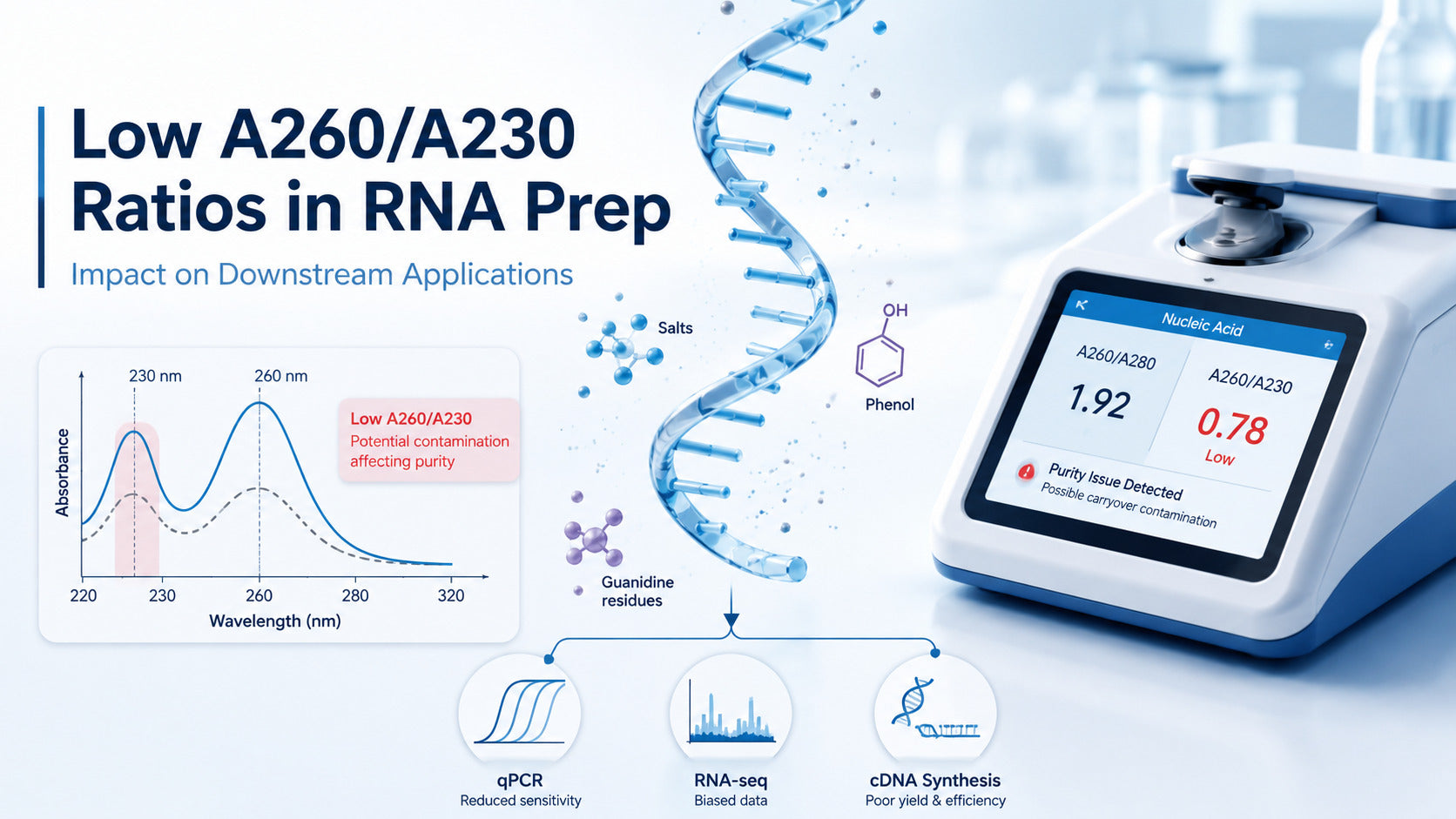
RNA purity is one of the most important quality control factors in molecular biology. Before RNA is used for cDNA synthesis, RT-PCR, RT-qPCR, RNA-seq, microarray analysis, or other downstream applications, researchers often check absorbance ratios to understand whether the sample is clean enough for reliable results. One of the most useful indicators is the A260/A230 ratio. A low A260/A230 ratio in RNA preparations often suggests contamination from substances that absorb near 230 nm, such as guanidine salts, phenol, ethanol, carbohydrates, peptides, detergents, or extraction buffer carryover. These contaminants may interfere with enzymes and reduce the reliability of RNA analysis.
However, a low A260/A230 value does not always mean the RNA sample will fail. The real impact depends on the contaminant type, RNA concentration, sample input volume, and the sensitivity of the downstream workflow.
What Is the A260/A230 Ratio in RNA Purity Assessment?
The A260/A230 ratio is a spectrophotometric measurement used to evaluate nucleic acid purity. RNA absorbs strongly at 260 nm, while many contaminants absorb near 230 nm. When absorbance at 230 nm is high, the A260/A230 ratio decreases. In simple terms, the ratio helps answer this question: Does the RNA preparation contain substances that may interfere with downstream applications?
A260/A230 is commonly checked with instruments such as NanoDrop or other UV-Vis spectrophotometers. It is usually reviewed together with A260/A280, RNA concentration, and RNA integrity metrics such as RIN, RIS, DV200, or electropherogram quality.
What Is an Acceptable A260/A230 Ratio for RNA Samples?
For clean RNA, an A260/A230 ratio of around 2.0 to 2.2 is often considered ideal. Some RNA samples with slightly lower values may still perform well, especially if the downstream assay is not highly sensitive to inhibitors.
A practical interpretation is:
|
A260/A230 Ratio |
General Meaning |
Risk Level |
|
2.0–2.2 |
Usually clean RNA |
Low |
|
1.8–2.0 |
Often acceptable, depending on application |
Low to moderate |
|
1.5–1.8 |
Possible contamination |
Moderate |
|
1.0–1.5 |
Likely contaminant carryover |
High |
|
Below 1.0 |
Strong contamination signal or very dilute RNA |
Very high |
These ranges should not be treated as universal pass/fail rules. A sample with a low A260/A230 ratio may still be usable if RNA integrity is good and no inhibition appears in the downstream assay. For sensitive workflows such as RT-qPCR or RNA-seq, it is better to confirm performance before using low-ratio RNA in important experiments.

What Causes a Low A260/A230 Ratio in RNA Preparations?
Low A260/A230 ratios are usually caused by RNA contamination from extraction reagents, sample matrix components, or incomplete purification. The source often depends on the RNA extraction method and sample type.
Common causes include:
|
Contaminant |
Possible Source |
Why It Matters |
|
Guanidine thiocyanate |
Lysis buffers, TRIzol-like reagents, column kits |
Strong absorbance near 230 nm; may inhibit enzymes |
|
Guanidine hydrochloride |
Wash or binding buffers |
Can reduce purity ratio and affect reactions |
|
Phenol |
Organic extraction |
Can inhibit reverse transcription and PCR |
|
Ethanol |
Incomplete drying after wash steps |
May reduce enzyme activity |
|
Salts |
Buffer carryover |
Can interfere with RT-PCR, qPCR, and library prep |
|
Carbohydrates |
Plant, tissue, or complex samples |
Can affect absorbance readings and purity |
|
Peptides/proteins |
Incomplete purification |
May reduce sample quality |
|
EDTA |
Buffer carryover |
Can affect magnesium-dependent enzymes |
|
Detergents |
Lysis buffers |
May inhibit downstream enzymatic reactions |
|
Heme |
Blood-derived samples |
Known inhibitor of PCR and RT-qPCR |
Does Low A260/A230 Always Mean Poor RNA Quality?
No. This is an important point that many basic articles do not explain clearly. A260/A230 measures purity, not integrity. RNA integrity tells you whether the RNA is degraded or intact. A sample can have a low A260/A230 ratio but still have good integrity. Similarly, a sample can have a good purity ratio but degraded RNA.
The effect of a low A260/A230 ratio depends on:
- The type of contaminant
- How much contaminant is carried into the final reaction
- RNA concentration
- RNA input volume
- Sensitivity of the downstream application
- Whether inhibitors are diluted below problematic levels
- Whether RNA integrity is still acceptable
This means low A260/A230 should be treated as a warning sign. It should trigger further review, not automatic rejection.
Effects of Low A260/A230 Ratio on Downstream Applications
Low A260/A230 ratios can affect downstream applications when contaminants interfere with enzymes, binding chemistry, amplification, labeling, or library preparation. The impact can range from mild variability to complete assay failure.
Effects on cDNA Synthesis
cDNA synthesis depends on reverse transcriptase, primers, nucleotides, magnesium, buffer conditions, and intact RNA templates. Contaminants from RNA extraction can reduce reverse transcription efficiency.
Possible effects include:
- Lower cDNA yield
- Incomplete reverse transcription
- Variable conversion efficiency
- Poor reproducibility between samples
- Biased gene expression results
- Reduced sensitivity in later PCR steps
Phenol, salts, ethanol, guanidine compounds, detergents, and EDTA can all affect reverse transcription if present at inhibitory levels.
Effects on RT-PCR and RT-qPCR
RT-PCR and RT-qPCR are among the most sensitive downstream applications affected by RNA purity. A low A260/A230 ratio may indicate inhibitors that interfere with reverse transcriptase or DNA polymerase activity.
Possible effects include:
- Delayed Ct or Cq values
- Weak amplification signal
- Reduced amplification efficiency
- Poor standard curve performance
- Higher technical variation
- False-negative results
- Inaccurate gene expression analysis
- Poor reproducibility between replicates
For diagnostic or quantitative workflows, this can be especially serious. Even small differences in inhibition can change apparent expression levels or reduce detection sensitivity.
Effects on RNA-seq and NGS Library Preparation
RNA-seq requires high-quality RNA because library preparation includes several enzymatic steps. These may include RNA fragmentation, reverse transcription, adapter ligation, PCR amplification, and cleanup. Contaminants associated with low A260/A230 ratios can reduce library quality.
Potential effects include:
- Low cDNA yield
- Poor library preparation efficiency
- Reduced library concentration
- Low library complexity
- Uneven transcript coverage
- Biased expression profiles
- Failed library QC
- Increased sequencing cost due to repeated preparation
For RNA-seq, purity should be interpreted together with RNA integrity metrics such as RIN, RIS, DV200, and electropherogram profile. A low A260/A230 ratio does not always mean RNA-seq will fail, but it increases risk if contaminants inhibit library preparation enzymes.
Effects on Microarray Analysis
Microarray workflows often involve cDNA or cRNA synthesis, labeling, amplification, and hybridization. If RNA contaminants interfere with these steps, data quality may decline.
Possible effects include:
- Weak labeling efficiency
- Reduced hybridization signal
- Increased background noise
- Poor sensitivity
- Less reliable expression profiling
Clean RNA helps produce stronger and more consistent microarray data, especially when comparing multiple biological samples.
Effects on Digital PCR and Other Enzymatic Assays
Digital PCR, RACE, in vitro translation, RNA ligation assays, and other RNA-based workflows may also be affected by low A260/A230 ratios. The main risk is enzyme inhibition.
Potential outcomes include:
- Reduced detection sensitivity
- Poor amplification
- Lower reaction efficiency
- Inconsistent replicate performance
- Reduced confidence in quantitative results
Any application that depends on reverse transcriptase, polymerase, ligase, or other enzymes can be sensitive to RNA preparation contaminants.
Low A260/A230 vs RNA Integrity: What Is the Difference?
This distinction is critical.
- A260/A230 ratio tells you about RNA purity.
- It indicates whether contaminants absorbing near 230 nm may be present.
- RNA integrity tells you whether RNA is degraded.
- It is evaluated using RIN, RIS, DV200, gel electrophoresis, TapeStation, Bioanalyzer, or similar methods.
A good RNA quality control process should check both. For example, an RNA sample may show:
- Good A260/A280
- Low A260/A230
- High RIN
In that case, the RNA may be intact but contaminated. The best next step may be a cleanup rather than discarding the sample.
How Low A260/A230 Ratios Affect RNA Analysis
RNA analysis depends on reliable sample preparation. When A260/A230 is low, results may become less predictable because inhibitors can affect enzymatic reactions differently across samples.
This can cause problems such as:
- Artificial differences in gene expression
- Poor comparison between treatment groups
- Lower assay sensitivity
- Reduced detection of low-abundance transcripts
- Increased variation between technical replicates
- Misleading interpretation of RNA quality
- Repeat experiments and higher workflow cost
For high-value samples or clinical research workflows, low A260/A230 should be investigated before proceeding.
How to Troubleshoot Low A260/A230 in RNA Samples
1. Check the Complete RNA QC Profile
Do not rely on one number. Review:
- RNA concentration
- A260/A280 ratio
- A260/A230 ratio
- RIN, RIS, or DV200
- Electropherogram or gel profile
- Sample type
- Extraction method
- Downstream assay requirements
2. Identify the Likely Contaminant
If low A260/A230 occurs after TRIzol or phenol-based extraction, suspect phenol or guanidine carryover. If it occurs after column extraction, suspect guanidine salts, wash buffer, or ethanol carryover. If the sample is from plants, blood, stool, or tissue, matrix-derived inhibitors may be involved.
3. Improve Wash and Drying Steps
For column or magnetic bead RNA extraction, incomplete washing or drying is a common reason for low purity.
Helpful steps may include:
- Avoid overloading the column or beads
- Follow wash volumes exactly
- Add an extra wash if compatible with the protocol
- Dry the membrane or beads properly
- Avoid ethanol carryover
- Use a clean nuclease-free elution buffer or water
4. Clean Up the RNA
If the RNA is valuable and its integrity is good, cleanup may improve purity.
Common options include:
- RNA cleanup column
- Magnetic bead cleanup
- Ethanol precipitation
- Lithium chloride precipitation
- Re-extraction for severe contamination
5. Use Controls Before Important Experiments
For RT-qPCR, include internal amplification controls, no-template controls, and no-RT controls. A small pilot assay can show whether the low A260/A230 ratio is actually affecting amplification.
6. Dilute the RNA When Appropriate
In some cases, dilution reduces inhibitor concentration enough to improve enzyme performance. This is useful only when RNA concentration is sufficient, and the assay can tolerate lower input.

When Can You Use RNA With a Low A260/A230 Ratio?
RNA with a low A260/A230 ratio may still be usable when:
- RNA concentration is sufficient
- A260/A280 is acceptable
- RNA integrity is good
- The downstream application is not highly sensitive to inhibitors
- Pilot RT-qPCR or cDNA synthesis works well
- Controls show no inhibition
- The same level of purity is consistent across all compared samples
However, cleanup or re-extraction is recommended when:
- A260/A230 is very low
- RNA concentration is also poor
- RT-qPCR shows delayed Ct/Cq values
- RNA-seq library prep is planned
- Samples are irreplaceable or of high value
- Results must be highly quantitative
- Contamination differs strongly between sample groups
Why RNA Extraction Quality Matters
RNA extraction is the foundation of accurate RNA analysis. A clean RNA preparation improves confidence in cDNA synthesis, RT-PCR, RT-qPCR, RNA-seq, transcriptomics, and molecular diagnostic workflows.
Using optimized RNA extraction kits, proper sample handling, and effective cleanup methods can reduce contamination and improve nucleic acid purity. FireGene supports molecular biology workflows with RNA extraction and nucleic acid purification solutions designed to help laboratories prepare samples for reliable downstream applications.
FAQs
What does a low A260/A230 ratio mean in RNA?
A low A260/A230 ratio usually means the RNA preparation may contain contaminants that absorb near 230 nm, such as guanidine salts, phenol, ethanol, carbohydrates, peptides, detergents, or buffer carryover.
What is an acceptable A260/A230 ratio for RNA samples?
A ratio around 2.0–2.2 is generally considered clean for RNA. Values slightly below this may still be usable depending on the application, sample concentration, and presence of inhibition.
Does low A260/A230 affect RT-qPCR?
Yes, it can. If contaminants inhibit reverse transcription or PCR, low A260/A230 may lead to delayed Ct/Cq values, weak amplification, reduced efficiency, false negatives, or inaccurate quantification.
Can low A260/A230 affect RNA-seq?
Yes. RNA-seq library preparation depends on enzyme-driven steps such as reverse transcription, adapter ligation, and PCR amplification. Contaminants may reduce library yield, lower complexity, or introduce bias.
Does low A260/A230 mean RNA is degraded?
No. A260/A230 measures purity, not degradation. RNA integrity should be checked using RIN, RIS, DV200, gel electrophoresis, Bioanalyzer, TapeStation, or similar methods.
Why is A260/A230 low but A260/A280 normal?
This pattern often suggests contamination by salts, guanidine, phenol, ethanol, carbohydrates, or other compounds that absorb near 230 nm, rather than protein contamination.
How can I fix the low A260/A230 after RNA extraction?
You can improve RNA purity by adding proper wash steps, drying columns or beads completely, avoiding ethanol carryover, using RNA cleanup columns, magnetic bead cleanup, ethanol precipitation, or re-extracting the sample if needed.
Can RNA with low A260/A230 still be used?
Sometimes yes. If RNA integrity is good and downstream controls show no inhibition, the sample may still work. For sensitive applications, cleanup or pilot testing is recommended.
Conclusion
Low A260/A230 ratios in RNA preparations are important because they can signal contamination that may affect downstream applications. The most common contaminants include guanidine salts, phenol, ethanol, salts, carbohydrates, detergents, and other extraction reagent carryover. These contaminants can reduce cDNA synthesis efficiency, delay RT-qPCR Ct values, lower amplification efficiency, affect RNA-seq library preparation, and reduce the reliability of RNA analysis. Still, a low A260/A230 ratio does not automatically mean the RNA is unusable. It should be interpreted together with RNA concentration, A260/A280, RNA integrity, sample type, and downstream assay performance.
For best results, laboratories should use clean RNA extraction workflows, proper quality control, and suitable cleanup strategies when purity is low. A balanced RNA quality assessment helps protect data accuracy and improves confidence in downstream molecular biology applications.


