
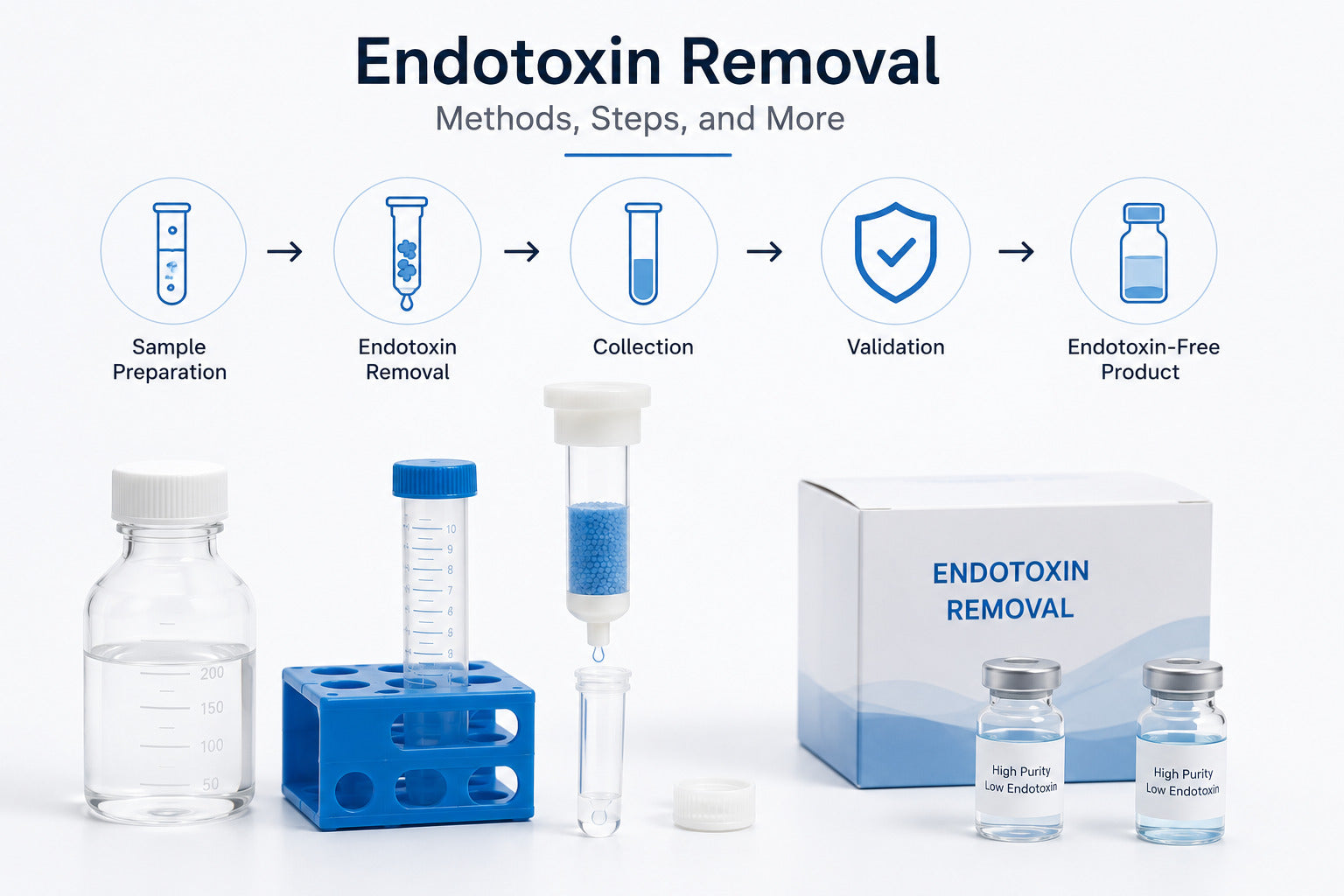
What is Endotoxin?
An endotoxin is a heat-stable lipopolysaccharide (LPS) found in the outer membrane of Gram-negative bacteria such as Escherichia coli and Salmonella. Its toxic activity is primarily associated with the lipid A portion of LPS. Endotoxins can be released during bacterial cell lysis or death, as well as through outer-membrane vesicles produced during bacterial growth. Endotoxins, also known as lipopolysaccharides (LPS), are components of the outer membrane of Gram-negative bacteria such as Escherichia coli. During bacterial growth, cell lysis, or recombinant protein purification, endotoxins can enter the protein preparation and remain difficult to remove.
In recombinant protein purification, endotoxin removal is important because even low levels of endotoxin contamination can affect cell-based assays, immune response studies, animal research, diagnostic development, and other biomedical workflows. A purified recombinant protein may appear clean by SDS-PAGE or chromatography, but still contain endotoxin that can influence downstream biological results. For this reason, endotoxin removal from proteins is an important quality step in protein purification. A strong workflow should reduce endotoxin while maintaining protein recovery, purity, structure, and biological activity.
Endotoxin Removal Methods
Different endotoxin removal methods are used depending on the target protein, buffer system, endotoxin level, and downstream application. No single method is ideal for every recombinant protein preparation, so choose based on protein size, charge, hydrophobicity, stability, and required final endotoxin level.
Endotoxin Removal by Ultrafiltration
Ultrafiltration is a size-based method for endotoxin removal. Endotoxin molecules can form large aggregates or micelles in solution, which may be retained by a suitable membrane while smaller molecules pass through. This method is simple, scalable, and useful during buffer exchange or protein concentration. It works best when the target protein and endotoxin aggregates have a clear size difference. However, ultrafiltration may be less effective when endotoxin binds tightly to the protein or when the protein itself is large.
Best use: buffer exchange, small proteins, partial endotoxin reduction.
Limitation: may not efficiently remove protein-bound endotoxin.
Endotoxin Removal by Adsorption
Adsorption-based methods use materials that bind endotoxin through hydrophobic, ionic, or mixed interactions. Activated carbon, polymyxin B-based adsorbents, and commercial endotoxin removal resins are common examples. Activated carbon is cost-effective and can remove endotoxin from certain preparations, but it may also bind target proteins, reducing recovery. Use more selective endotoxin-binding resins when specificity is important, while still optimizing conditions to protect protein yield and activity.
Endotoxin Removal by Phase Separation
Phase separation is one of the most commonly discussed methods for endotoxin removal from recombinant protein preparations. Triton X-114 phase separation for endotoxin removal is especially popular because endotoxin partitions into the detergent-rich phase after temperature-induced separation. Below its cloud point, Triton X-114 mixes with the protein solution. When warmed, the solution separates into an aqueous phase and a detergent-rich phase. Endotoxin preferentially moves into the detergent-rich phase, while many proteins remain in the aqueous layer.
This method can achieve a strong reduction in endotoxin levels, but it must be used carefully. Some proteins may be sensitive to detergent or temperature changes, and residual detergent should be removed after treatment.
Endotoxin Removal by Affinity Chromatography
Affinity chromatography uses endotoxin-binding ligands immobilized on a solid support. These ligands may include polymyxin B, histidine-based ligands, polycationic ligands, or specialized endotoxin-binding matrices. This method can provide high specificity because the resin is designed to bind LPS more strongly than the target protein. It is useful when protein recovery and endotoxin reduction must both be controlled.
However, affinity chromatography can be more expensive than other endotoxin removal methods. Use it when high specificity is needed and the workflow can support the added cost. Resin capacity, regeneration, buffer compatibility, and protein-resin interaction should be evaluated before scale-up.
Best use: high-specificity endotoxin removal.
Limitations: cost, resin capacity, and recovery optimization.
Endotoxin Removal by Ion Exchange Chromatography
Ion exchange chromatography is a powerful method for endotoxin removal in protein purification. Endotoxin is usually negatively charged under many purification conditions. Anion exchange chromatography can bind endotoxin while allowing some proteins to flow through, depending on the protein’s charge and buffer pH. This method is scalable, chromatography-friendly, and suitable for many downstream purification workflows. Use it when the protein charge and buffer pH support endotoxin binding. Salt concentration and pH are critical because they influence both endotoxin binding and protein behavior.
Best use: chromatography-based purification of recombinant proteins.
Limitation: sensitive to pH, salt, and protein pI.
Comparison of Endotoxin Removal Methods
|
Ultrafiltration |
Moderate |
Low |
Low |
Limited for protein-bound endotoxin |
|
Adsorption |
Moderate to High |
Medium |
Medium |
May bind target protein |
|
Phase Separation |
High |
Medium |
Low to Medium |
Residual detergent must be removed |
|
Affinity Chromatography |
High |
High |
High |
Resin cost and recovery optimization |
|
Ion Exchange Chromatography |
High |
Medium |
Medium |
Sensitive to pH and salt conditions |
|
Size Exclusion / Polishing |
Low to Moderate |
Medium |
Medium |
Lower capacity, usually not primary method |
Endotoxin Removal Process
The exact endotoxin removal process depends on the protein and purification goal. The following is a general example workflow for endotoxin removal from recombinant protein preparations using Triton X-114 phase separation.
1. Measure Starting Endotoxin Level
Before removal, measure endotoxin level using a suitable endotoxin testing method such as LAL-based testing. This gives a baseline and helps decide how strong the removal process needs to be.
2. Add Triton X-114
Add Triton X-114 to the recombinant protein sample at an optimized concentration. The sample should be mixed gently to avoid foaming or protein damage.
3. Low-Temperature Incubation
Incubate the sample at low temperature to allow the detergent to distribute evenly through the solution. This step helps endotoxin interact with the detergent before phase separation.
4. Warm Phase Separation
Warm the sample to trigger separation into an aqueous phase and a detergent-rich phase. Endotoxin partitions mainly into the detergent-rich phase.
5. Centrifugation
Centrifuge the sample to separate the phases clearly. The aqueous protein-containing phase should be collected carefully without disturbing the detergent layer.
6. Repeat if Needed
For stronger endotoxin reduction, the aqueous phase can be treated again. Repeated cycles may improve removal, but protein recovery and activity should be checked after each round.
7. Remove Residual Detergent
After Triton X-114 treatment, remove residual detergent using buffer exchange, dialysis, ultrafiltration, or chromatography.
8. Final Endotoxin Quantification
Measure endotoxin again after cleanup. Report endotoxin level as EU/mL or EU/mg protein, depending on the application.

Quality Control After Endotoxin Removal
Endotoxin removal should not focus solely on reducing endotoxin levels. Protein quality must also be confirmed.
Important QC checks include:
|
Endotoxin assay |
Confirms final endotoxin level |
|
Protein concentration |
Measures recovery after treatment |
|
SDS-PAGE |
Checks purity and degradation |
|
SEC-HPLC |
Checks aggregation and purity |
|
Activity assay |
Confirms protein function |
|
Buffer check |
Confirms compatibility with downstream use |
|
Residual detergent check |
Important after Triton X-114 treatment |
Best Methods for Endotoxin Removal in Protein Purification
The best method depends on the protein. For small, stable proteins, ultrafiltration and buffer exchange may be useful in the workflow. For charged proteins, ion exchange chromatography can be highly effective. For sensitive proteins, affinity-based or mild resin-based approaches may be better. For recombinant protein preparations with high endotoxin load, Triton X-114 phase separation can be considered if the protein tolerates detergent and temperature cycling.
A combined workflow often yields better results than relying on a single method. For example, a protein may be purified by affinity chromatography, treated by ion exchange or phase separation, polished by buffer exchange, and then confirmed by endotoxin testing.
Preventing Endotoxin Contamination During Protein Purification
Endotoxin removal becomes easier when contamination is controlled early. Use endotoxin-free water, clean buffers, certified consumables, sanitized chromatography systems, and low-endotoxin storage containers. Avoid reusing contaminated columns or tubing without proper cleaning. Test in-process samples when possible to identify where endotoxin enters the workflow.
FireGene supports endotoxin testing and purification-related workflows by helping researchers monitor endotoxin levels and improve confidence in recombinant protein preparations.
FireGene Endotoxin Testing and Protein Purification Support
For recombinant proteins used in sensitive biological applications, endotoxin control is an important part of final product quality. FireGene provides research-use solutions for endotoxin testing, sample quality monitoring, and molecular biology workflows. FireGene can support laboratories in evaluating endotoxin contamination, comparing purification steps, and confirming the cleanliness of recombinant protein preparations before downstream experiments.
Featured Workflow Applications
|
Cell-based assays |
Reduces LPS-driven immune activation |
|
Cytokine studies |
Helps avoid false inflammatory readouts |
|
Animal research |
Supports safer, cleaner protein preparations |
|
Diagnostic development |
Improves assay reliability |
|
Vaccine research |
Helps control unwanted immune stimulation |
|
Recombinant protein QC |
Confirms preparation suitability |
FAQs
What is endotoxin removal?
Endotoxin removal is the process of reducing lipopolysaccharide contamination from protein preparations, buffers, or bioprocess samples.
Why is endotoxin removal important in recombinant protein purification?
It helps produce cleaner recombinant proteins for cell-based assays, animal studies, diagnostic development, and biomedical research.
What are the best methods for endotoxin removal from proteins?
Common methods include ultrafiltration, adsorption, Triton X-114 phase separation, affinity chromatography, ion exchange chromatography, and polishing chromatography.
How does Triton X-114 phase separation remove endotoxin?
Triton X-114 separates into aqueous and detergent-rich phases when warmed. Endotoxin moves into the detergent-rich phase, while many proteins remain in the aqueous phase.
Can endotoxin removal reduce protein recovery?
Yes. Some methods may bind or damage the target protein. That is why small-scale optimization and protein recovery testing are important.
How do you confirm endotoxin removal?
Endotoxin removal is confirmed using endotoxin testing methods such as LAL-based assays, with results commonly reported as EU/mL or EU/mg protein.
Conclusion
Endotoxin removal is a key step in recombinant protein purification when proteins are intended for sensitive research or biomedical applications. Since endotoxin behavior depends on protein properties, buffer conditions, and downstream use, the best strategy is to choose the method carefully and confirm both endotoxin reduction and protein quality. A strong workflow includes endotoxin prevention, method selection, optimized removal, detergent or resin cleanup when needed, final endotoxin testing, and protein quality control. This approach helps produce cleaner recombinant protein preparations with better reliability for downstream experiments.
References
- Petsch D, Anspach FB. Endotoxin removal from protein solutions. Journal of Biotechnology. 2000.
- Liu S, Tobias R, McClure S, Styba G, Shi Q, Jackowski G. Removal of endotoxin from recombinant protein preparations. Clinical Biochemistry. 1997.
- Schneier M, Razdan S, Miller AM, Briceño ME, Barua S. Current technologies for endotoxin detection and removal for biopharmaceutical purification. Biotechnology and Bioengineering. 2020.
- Ongkudon CM, Chew JH, Liu B, Danquah MK. Chromatographic removal of endotoxins: a bioprocess engineer’s perspective. International Scholarly Research Notices. 2012.
- USP <85> Bacterial Endotoxins Test.


