
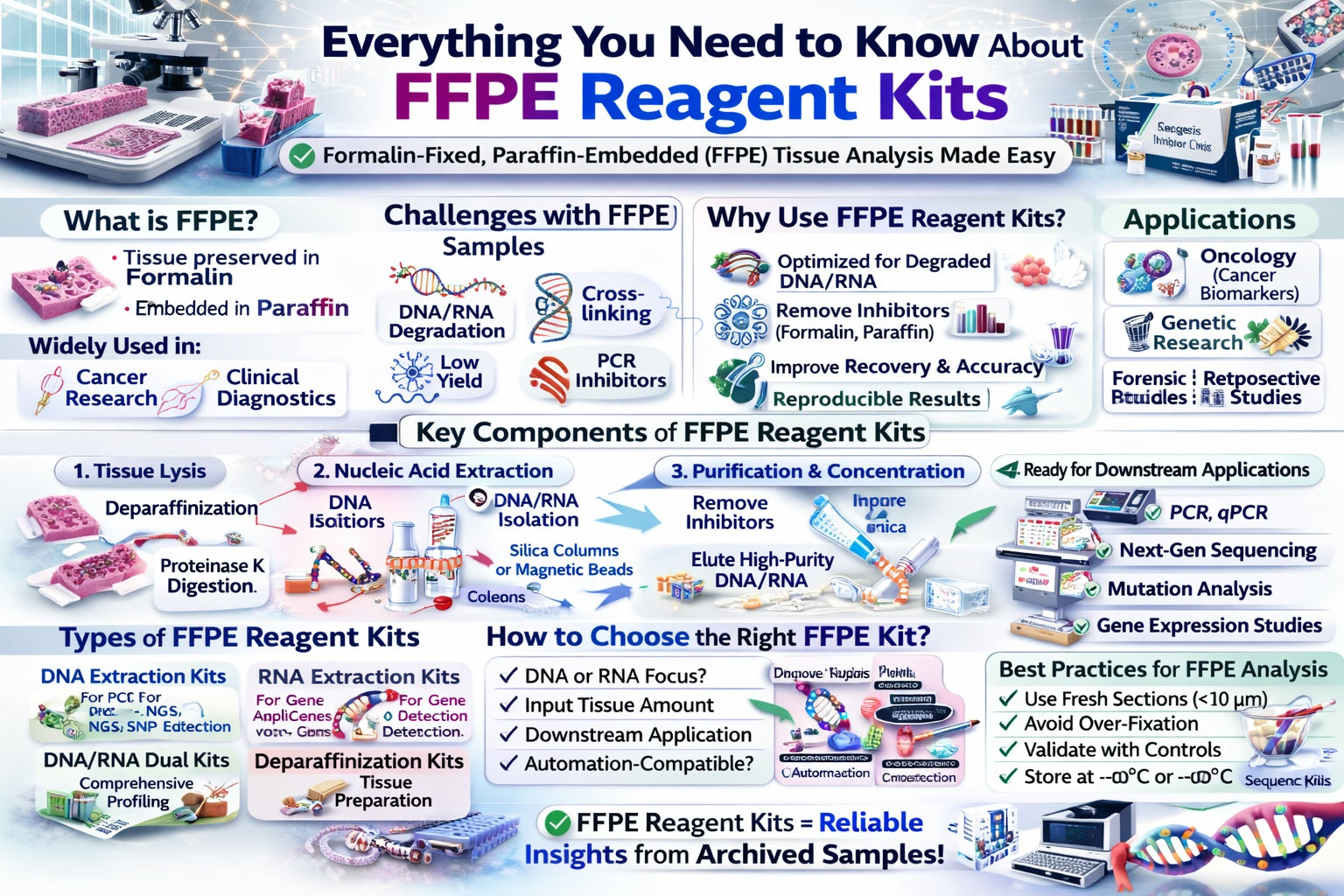
FFPE samples are some of the most valuable materials in modern labs because they connect today’s molecular tools with years of archived clinical history. From translational oncology to retrospective biomarker studies, formalin-fixed, paraffin-embedded tissue enables researchers to ask bigger questions using real patient material. The key to unlocking that value is having the right reagent kits, especially kits designed specifically for FFPE.
We’ll break down what FFPE reagent kits are, why Formalin-Fixed preservation changes nucleic acids, what to look for in DNA purification kits, and how FFPE extraction fits into workflows such as sequencing, PCR/qPCR, and even Forensic DNA analysis. You’ll also learn practical best practices for FFPE tissue DNA isolation, with a clear, human, lab-friendly structure aligned with FireGene’s molecular workflow focus.
What are FFPE reagent kits?
FFPE reagent kits are specialized kits and protocols used to process formalin-fixed paraffin-embedded tissue for downstream molecular analysis. They are designed to handle the unique challenges of FFPE samples, including:
- Paraffin removal (deparaffinization)
- Tissue lysis and protein digestion
- Crosslink reversal support
- Inhibitor removal
- Recovery of usable DNA and/or RNA
Because FFPE is a preserved format, the goal of these kits is to make archived tissue behave predictably in modern molecular assays.
Why formalin-fixed tissue needs special kits
Formalin-fixed preservation is excellent for histology and long-term storage, but it also introduces chemical changes to DNA.
Common FFPE characteristics include:
- DNA fragmentation (shorter pieces)
- DNA–protein crosslinks
- Base modifications that can influence amplification
- Variable quality depending on storage age and tissue type
High-performing reagent kits for FFPE are designed to address these realities, ensuring extracted nucleic acids perform smoothly in PCR and sequencing.
What FFPE reagent kits are used for
FFPE reagent kits support many important workflows, including:
- Targeted mutation testing
- Genotyping and biomarker studies
- Targeted sequencing panel preparation
- qPCR-based detection and validation
- Retrospective research studies
- Sample recovery for method development
Because FFPE archives can be large and richly annotated, FFPE workflows are especially powerful when combined with well-designed QC and standardized processing.
Types of kits you’ll see in FFPE workflows.
Depending on your downstream goal, you might choose different kit types.
1) Tissue kits (sample preparation and processing)
Many labs refer to upstream processing solutions as tissue kits. These kits may focus on:
- Efficient tissue lysis
- Debris removal
- Improving consistency before extraction
They are valuable because FFPE tissue can be dense and variable, and well-prepared samples make later steps more repeatable.
2) DNA purification kits (FFPE-specific extraction)
DNA purification kits are designed to extract DNA and remove inhibitors, making the DNA compatible with enzyme-driven workflows.
In FFPE contexts, these kits often emphasize:
- Deparaffinization support
- Proteinase digestion
- Crosslink reversal incubation steps
- Clean binding/wash/elution chemistry
3) Combined DNA/RNA workflows (when needed)
Some projects aim to extract both DNA and RNA from archived samples. These workflows can be especially useful in cancer studies, where both mutation and expression matter.
What to look for in a strong FFPE reagent kit
Choosing the right kit becomes easier when you focus on a few practical criteria.
1) Performance on real FFPE samples
Look for evidence that the kit works on samples with:
- Different tissue types
- Different archive ages
- Variable fixation times
The most valuable kits are designed for real-world variation.
2) Inhibitor removal
FFPE samples can carry inhibitors from the tissue matrix or processing steps. Strong inhibitor removal supports cleaner PCR and sequencing.
3) Recovery of amplifiable DNA
Because FFPE DNA is often fragmented, amplifiability matters as much as yield. Kits that support strong short-amplicon performance are often excellent for targeted assays.
4) Compatibility with downstream methods
A strong kit supports:
- PCR and qPCR
- Targeted sequencing panels
- Library preparation workflows
- Genotyping assays
5) Reproducibility and scalability
If you’re processing many samples, consistent results across batches and operators become a major advantage.
A practical FFPE tissue DNA isolation workflow (step-by-step)
Below is a lab-realistic overview of FFPE tissue DNA isolation. Exact details vary by kit and SOP, but the principles stay consistent.
Step 1: Section the tissue
- Use clean tools and fresh blades
- Keep section thickness consistent
- Choose pathology-reviewed regions when possible
Step 2: Deparaffinize
- Remove paraffin completely
- Avoid solvent carryover into lysis
- Keep tubes and samples clearly labeled throughout
Step 3: Lyse and digest proteins
- Use sufficient digestion time
- Mix well to expose tissue evenly
- Maintain recommended incubation temperature
Step 4: Support crosslink reversal
- Follow the kit’s reversal incubation step
- Keep time and temperature consistent
Step 5: Purify DNA
- Use the kit’s binding/wash/elution steps
- Ensure washes are complete
- Allow full drying when ethanol washes are used
Step 6: Elute in a consistent volume
- Smaller volumes increase concentration
- A short incubation can improve recovery
This workflow supports reliable DNA inputs for downstream analysis.
Quality control: how to assess FFPE DNA
FFPE samples benefit from QC that matches the final assay.
1) Quantification
Fluorescence-based methods provide strong estimates of usable dsDNA.
2) Purity screening
Spectrophotometer readings can help screen for inhibitor risk, though ratios may not always accurately predict performance.
3) Amplifiability testing
A short PCR or qPCR assay (100–200 bp) is one of the most practical methods for assessing the usability of FFPE DNA.
This QC approach supports confident decisions for sequencing and PCR workflows.
FFPE kits in forensic DNA analysis
Forensic DNA analysis often involves challenging samples—limited material, degraded DNA, and complex matrices. FFPE is not the most common forensic sample type, yet FFPE workflows and forensic workflows share important technical needs:
- Recovering usable DNA from degraded inputs
- Minimizing inhibitors
- Maximizing sensitivity and reproducibility
This is why the principles behind DNA purification kits for FFPE can feel familiar to forensic labs: both workflows are built around extracting the best possible DNA from difficult sources.
Where FireGene fits in FFPE reagent kit workflows
FireGene supports molecular workflows from sample preparation through downstream analysis, making it a practical partner for FFPE-based projects.
FireGene-aligned touchpoints include:
Sample preparation and tissue processing
FireGene’s Sample Preparation Kit category includes tissue-focused solutions that support handling complex tissue workflows.
Nucleic acid extraction and purification
FireGene’s Nucleic Acid Extraction portfolio aligns with projects that depend on clean DNA recovery and inhibitor removal for PCR and sequencing.
Downstream molecular readiness
After extraction, many labs use amplification and sequencing. FireGene’s broader molecular biology and diagnostics focus aligns with building repeatable testing pipelines.
The shared goal is simple: stable inputs create stable results.
FAQ
What are FFPE reagent kits used for?
FFPE reagent kits are used to process formalin-fixed paraffin-embedded tissue so DNA (and sometimes RNA) can be recovered for PCR, qPCR, sequencing, and biomarker studies.
Why do formalin-fixed samples require special reagent kits?
Formalin-Fixed tissue can contain fragmented DNA and crosslinks that reduce amplifiability. FFPE-specific kits include steps for deparaffinization, digestion, and crosslink reversal support.
What is FFPE tissue DNA isolation?
FFPE tissue DNA isolation is the process of extracting and purifying DNA from FFPE sections. It typically includes paraffin removal, tissue lysis, crosslink reversal support, and DNA purification.
Are DNA purification kits important for FFPE workflows?
Yes. DNA purification kits help remove inhibitors and recover amplifiable DNA, which supports consistent PCR and sequencing performance.
How do FFPE workflows connect to forensic DNA analysis?
Forensic DNA analysis often involves degraded DNA and inhibitors. FFPE workflows share similar challenges, so the quality principles—clean extraction and inhibitor removal—are closely aligned.
CONCLUSION:
FFPE archives are an incredible resource, and the right reagent kits make them truly usable for modern molecular analysis. Strong FFPE reagent kits support deparaffinization, digestion, crosslink reversal, and clean recovery of amplifiable DNA—often through reliable DNA purification kits and supportive tissue kits workflows. With consistent FFPE tissue DNA isolation and practical QC, archived formalin-fixed samples can deliver confident results for research, diagnostics development, and even technically demanding applications like Forensic DNA analysis.


