
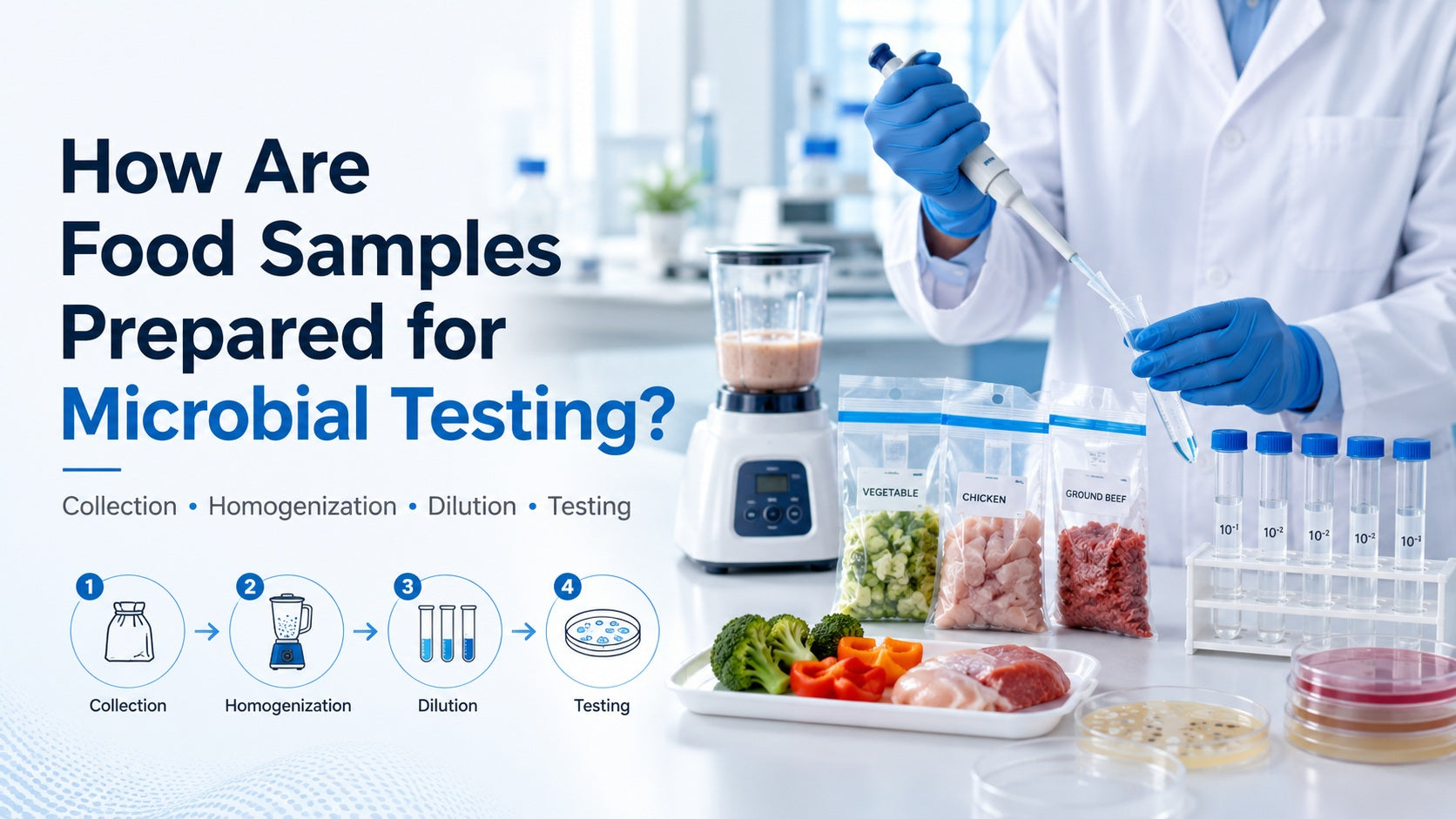
Microbial testing is the laboratory process of detecting, identifying, or measuring microorganisms in food samples to support food safety, quality control, research, and production monitoring. Food sample preparation is the set of steps used to collect, handle, homogenize, dilute, enrich, or extract a representative portion of food before microbial analysis. In the food industry, careful preparation helps laboratories generate consistent results across culture-based testing, rapid test kits, molecular diagnostics, PCR/qPCR workflows, and other microbiological methods.
Food samples are prepared for microbial testing by collecting a representative sample, labeling and transporting it properly, weighing a defined amount, adding sterile diluent or enrichment media, homogenizing the sample, preparing dilutions when needed, incubating for enrichment if required, and then applying the selected microbial analysis method. The exact workflow depends on the food type, target organism, testing method, and whether the lab is using culture-based testing, rapid screening, or molecular detection.
What Is Food Sample Preparation for Microbial Testing?
Food sample preparation for microbial testing is the process of turning a food item into a laboratory-ready test sample. Because food can be solid, liquid, oily, powdered, frozen, fermented, high-fat, high-protein, or highly processed, the preparation method must match the sample matrix.
A strong preparation workflow supports representative testing. For example, milk can often be mixed directly or diluted, while meat, seafood, produce, grains, feed, spices, and processed foods may require blending, stomaching, filtration, enrichment, or matrix-specific extraction. The goal is to make microorganisms or target analytes accessible for reliable testing while preserving the integrity of the method.
Why Sample Preparation Matters in Food Safety Workflows
Sample preparation matters because the quality of the starting material influences the entire microbial testing result. A well-prepared sample helps the lab distribute microorganisms evenly, reduce matrix interference, support detection sensitivity, and maintain repeatability between analysts.
In modern food safety programs, microbial testing may be used for raw ingredient screening, finished product release, environmental monitoring, shelf-life studies, production hygiene checks, pathogen surveillance, spoilage organism analysis, and research applications. Lab managers and food industry teams often combine conventional microbiology, rapid test kits, molecular diagnostics, PCR/qPCR, and automated microbial testing systems to support efficient workflows.
Good preparation supports:
- Representative microbial analysis
- Consistent dilutions and enrichment conditions
- Clear documentation and traceability
- Compatible downstream testing
- Efficient lab workflow planning
- Quality control across production lots
Key Applications of Microbial Testing in the Food Industry
Food Safety Screening
Food safety testing may screen for pathogens, indicator organisms, toxins, or residues, depending on the product type and testing goal. Rapid testing formats can help laboratories and production teams make timely research or quality decisions.
Quality Control and Shelf-Life Studies
Microbial analysis can help evaluate product quality, storage behavior, and process consistency. Aerobic counts, yeast and mold testing, coliform analysis, and related microbial indicators are commonly used in food quality workflows.
Molecular Diagnostics and PCR/qPCR Detection
Molecular testing may use DNA or RNA targets from food samples, enrichment cultures, or isolates. In these workflows, nucleic acid extraction and purification, PCR/qPCR reagents, and suitable controls are important for assay performance.
Environmental and Surface Monitoring
Swabs, sponges, and rinse samples are often used to monitor surfaces, equipment, and processing environments. Sample handling, transport media, and neutralizing buffers should match the intended test method.
Automated Microbial Testing in the Food Industry
Automated microbial testing can support higher throughput, standardized timing, digital tracking, and reduced manual variability. Sample preparation remains essential because automation performs best when the input sample is consistent and compatible with the platform.
Step-by-Step Workflow: Preparing Food Samples for Microbial Testing
Step 1: Define the Testing Objective
Start by identifying the reason for testing. Is the goal pathogen detection, quality indicator testing, spoilage analysis, molecular detection, toxin or residue screening, or research method development? The objective determines sample size, enrichment media, diluent, incubation conditions, and detection method.
Document:
- Food matrix and product type
- Target organism or analyte
- Test method and platform
- Required sample amount
- Enrichment or dilution needs
- Storage and transport conditions
- Reporting format and documentation requirements
Step 2: Collect a Representative Food Sample
Representative sampling is the foundation of reliable microbial testing. Food products can be uneven, especially items with mixed ingredients, surface contamination patterns, or variable moisture and fat content. Use sterile tools, clean containers, and clear labeling. For production settings, sample collection should align with internal SOPs and recognized food testing guidelines.
Step 3: Maintain Proper Handling and Transport
Samples should be handled in a way that supports the selected test method. Temperature control, timing, packaging, and chain-of-custody documentation help preserve sample quality. Perishable foods, frozen foods, dry powders, and high-moisture products may require different handling conditions.
Step 4: Weigh or Measure the Test Portion
Many microbial testing workflows begin with a defined sample mass or volume. A common approach is to weigh a representative portion into a sterile bag, tube, or container before adding diluent or enrichment media. Consistent measurement supports accurate dilution calculations and repeatable microbial analysis.
Step 5: Add Sterile Diluent or Enrichment Medium
The next step is to add a sterile diluent, buffer, or enrichment medium based on the test objective. Diluents support sample suspension and dilution, while enrichment media help recover and support target organisms before detection. The choice depends on the target organism, food matrix, and method.
Step 6: Homogenize the Sample
Homogenization distributes microorganisms from the food matrix into the liquid phase. Labs may use stomaching, blending, shaking, mixing, or other validated approaches. The method should be strong enough to release organisms from the matrix while remaining compatible with the downstream test.
Step 7: Prepare Dilutions or Enrichment Cultures
For quantitative microbial analysis, serial dilutions may be prepared before plating or instrument-based counting. For presence/absence pathogen testing, enrichment may be performed before detection. Molecular workflows may use enriched cultures, direct sample lysates, or extracted nucleic acids, depending on the assay design.
Step 8: Choose the Detection Method
After preparation, the sample is ready for the selected microbial testing method. Options may include culture-based plating, rapid test kits, lateral flow assays, molecular diagnostics, PCR/qPCR, immunoassays, or automated detection systems. The method should match the sample matrix, target organism, throughput, turnaround needs, and documentation requirements.
Food Sample Preparation Methods at a Glance
|
Sample Type |
Common Preparation Need |
Typical Workflow Consideration |
|
Milk and dairy |
Mixing, dilution, residue or microbial screening |
Matrix compatibility and storage temperature |
|
Meat and seafood |
Homogenization, enrichment, pathogen or residue testing |
Fat, protein, and surface distribution |
|
Produce |
Rinsing, blending, enrichment, surface organism recovery |
Uneven surface contamination patterns |
|
Grains and feed |
Grinding, mixing, extraction, toxin or microbial testing |
Dry matrix and representative subsampling |
|
Eggs |
Mixing, dilution, residue testing |
Matrix consistency and test compatibility |
|
Processed foods |
Homogenization and matrix-specific preparation |
Complex ingredients and preservatives |
|
Environmental swabs |
Transport media and neutralization |
Surface area, contact time, and method compatibility |
How to Choose the Right Kit, Reagent, or Workflow
The right microbial testing workflow depends on the sample, target, and decision timeline. A food manufacturer may need rapid screening for routine quality checks, while a research lab may need nucleic acid extraction followed by qPCR. A QC team may use both culture-based confirmation and rapid screening depending on internal procedures.
Before choosing a kit or reagent, consider:
- Is the sample milk, meat, feed, food, egg, tissue, honey, edible oil, or environmental material?
- Is the target a microorganism, toxin, residue, nucleic acid, or endotoxin-related analyte?
- Is the goal screening, detection, quantification, or confirmation?
- Is enrichment required before testing?
- Does the workflow need rapid results or high-throughput automation?
- Are molecular diagnostics, PCR/qPCR, or lateral flow test formats preferred?
- What documentation and storage conditions are required?
FireGene offers rapid test kits and food safety testing products, including food safety and veterinary residue rapid tests for sample types such as milk, meat, feed, egg, honey, edible oil, tissue, serum, urine, and food. For molecular workflows, related categories such as nucleic acid extraction and purification, PCR/qPCR reagents, and molecular diagnostics can support method development and downstream testing.
FAQs
How are food samples prepared for microbial testing?
Food samples are prepared by collecting a representative portion, labeling and transporting it properly, weighing or measuring the test portion, adding sterile diluent or enrichment media, homogenizing the sample, preparing dilutions or enrichment cultures, and applying the selected microbial testing method.
Why is sample preparation important in food microbiology?
Sample preparation is important because it helps create a representative, test-ready sample. It supports consistent microbial recovery, accurate dilution, suitable enrichment, and compatibility with culture-based, rapid, molecular, or automated testing methods.
What is homogenization in food microbial analysis?
Homogenization is the process of mixing or blending a food sample with diluent or enrichment media so microorganisms are more evenly distributed in the liquid phase for testing.
When is enrichment used in microbial testing?
Enrichment is used when the workflow needs to support the recovery and growth of target microorganisms before detection. It is common in presence/absence pathogen testing and some molecular or rapid detection workflows.
Can PCR or qPCR be used for food microbial testing?
Yes. PCR and qPCR can be used in molecular food testing workflows when the sample is prepared properly, and a compatible nucleic acid extraction is performed. The exact method depends on the target, matrix, and validation requirements.
Conclusion:
Food samples are prepared for microbial testing by collecting representative material, maintaining proper handling, measuring a defined test portion, adding sterile diluent or enrichment media, homogenizing the sample, preparing dilutions or enrichment cultures, and applying a suitable detection method. The best workflow depends on the food matrix, target organism or analyte, testing objective, and lab resources. Rapid test kits, molecular diagnostics, PCR/qPCR reagents, nucleic acid extraction tools, and lab buffers can all play a role in modern food safety and microbial analysis workflows.


