
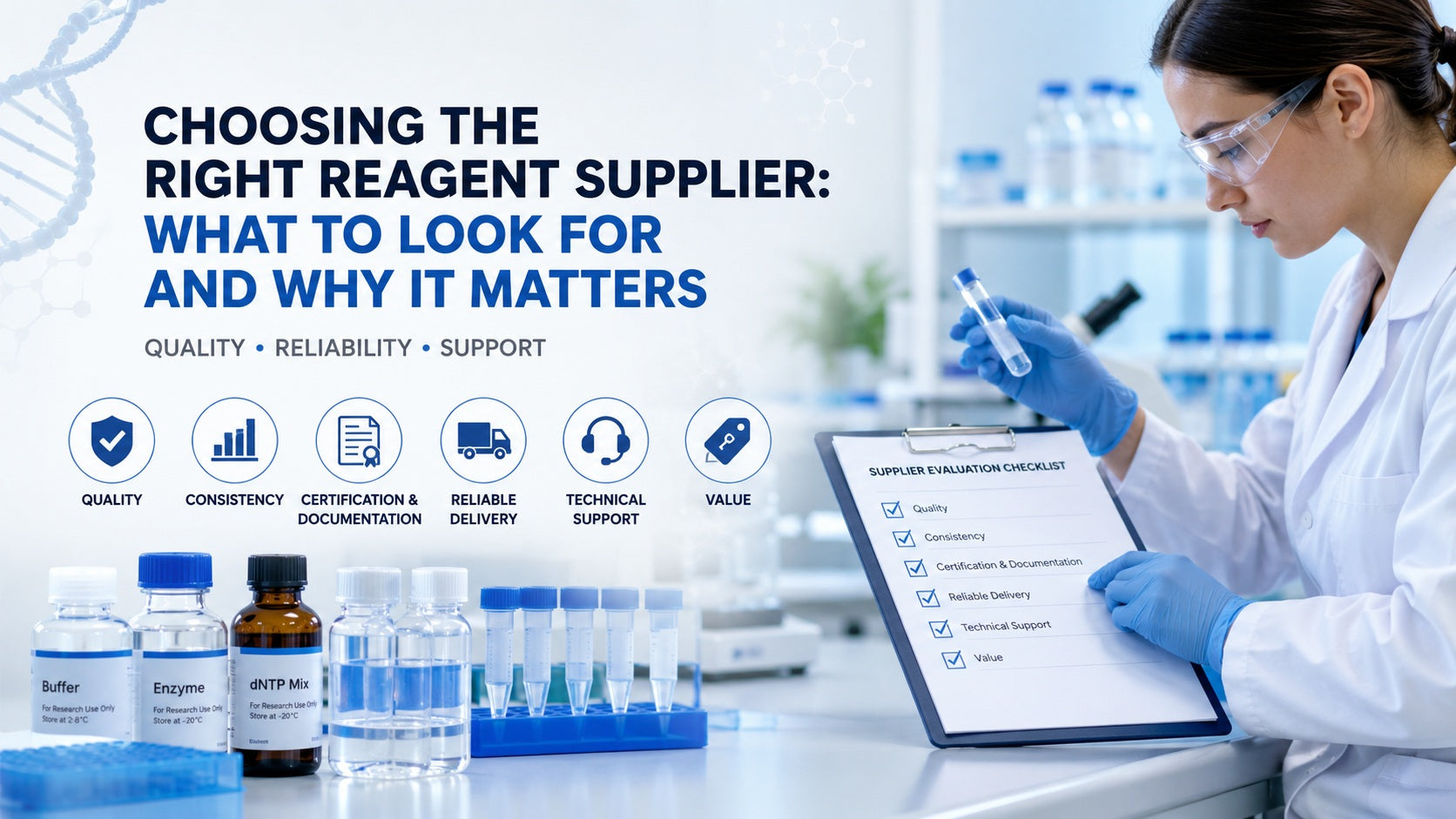
A reagent supplier is a company that provides laboratory reagents, kits, buffers, enzymes, assay materials, and related solutions used in life science research, molecular biology, diagnostics, sequencing, and quality control. Choosing the right reagent supplier matters because reagent consistency, documentation, availability, and application fit can directly support experimental accuracy, workflow efficiency, and scientific progress. For researchers, biotech teams, pharmaceutical QC groups, and lab managers, supplier selection is both a purchasing decision and a workflow reliability decision.
What Should You Look for in a Reagent Supplier?
When selecting a reagent supplier, look for product quality, lot-to-lot consistency, clear specifications, application-specific kits, technical documentation, reliable shipping, responsive support, and product categories that match your workflow. The best reagent supplier for laboratory research is not simply the lowest-cost option. It is the supplier that helps your lab choose suitable reagents for sample preparation, nucleic acid extraction, PCR, qPCR, NGS library preparation, single-cell sequencing, endotoxin testing, and routine molecular biology applications.
What Is a Reagent Supplier?
A reagent supplier provides the consumable materials that laboratories use to prepare samples, run assays, purify molecules, detect targets, and support scientific analysis. In molecular biology, this may include DNA polymerases, reverse transcription reagents, PCR master mixes, extraction kits, buffers, enzymes, endotoxin testing reagents, tissue dissociation kits, and sequencing preparation tools.
A strong supplier does more than list products online. It helps connect the reagent to the application. For example, a lab purchasing a nucleic acid extraction kit should understand whether the kit is suitable for tissue, blood, viral samples, cultured cells, or environmental material. A team planning single-cell sequencing should consider the dissociation method, cell recovery, nuclei isolation, debris removal, and downstream library preparation.
Why Reagent Suppliers Matter in Modern Lab Workflows
The importance of reagent suppliers in life science research is tied to reproducibility and workflow confidence. Laboratory reagents are used at critical points in an experiment. They help determine whether samples are prepared correctly, assays run consistently, and results are interpretable.
Modern labs often manage multiple workflows at once. A molecular biology group may perform nucleic acid extraction, PCR, qPCR, cloning, and sequencing. A diagnostics research team may need assay reagents, sample preparation tools, and molecular detection kits. A pharmaceutical QC team may evaluate endotoxin testing, documentation, and batch consistency. In each case, supplier choice influences how smoothly the lab can plan, purchase, run, and repeat work.
A dependable reagent supplier supports:
- Experimental accuracy through fit-for-purpose reagents
- Workflow efficiency through clear product organization
- Lab reliability through documentation and consistency
- Scientific progress through accessible research tools
- Procurement planning through product availability and support
- Quality control through lot information, specifications, and handling guidance
Key Applications That Depend on Supplier Selection
Molecular Biology and PCR/qPCR
PCR and qPCR workflows rely on enzymes, master mixes, primers, probes, buffers, and nucleic acid templates. Supplier selection should consider enzyme performance, reagent format, storage conditions, inhibition tolerance, and compatibility with the assay design.
Nucleic Acid Extraction and Purification
DNA and RNA quality affect downstream PCR, qPCR, cloning, NGS, and molecular diagnostics research. Labs should choose extraction kits based on sample type, target molecule, purity needs, elution volume, and throughput.
Single-Cell Sequencing Sample Preparation
Single-cell and single-nucleus sequencing workflows are highly sensitive to sample quality. Reagent choice may include tissue dissociation kits, nuclei isolation kits, cell cleanup reagents, debris removal products, and preservation solutions.
NGS Library Preparation
NGS library preparation depends on input quality, enzyme activity, cleanup efficiency, adapter ligation, amplification, and quantification. Consistent reagents and clear protocols help teams manage multi-step workflows.
Endotoxin Testing and QC
Endotoxin testing requires assay reagents, standards, endotoxin-free consumables, and careful workflow documentation. QC teams often prioritize supplier transparency, technical information, and consistent availability.
How to Choose the Right Reagent Supplier
Choosing a reagent supplier becomes easier when the decision is based on workflow requirements rather than price alone. Use the following process as a practical selection guide.
Step 1: Define the Application First
Start with the experiment or workflow. Are you preparing tissue for single-cell sequencing? Extracting RNA for RT-qPCR? Running endotoxin testing for QC research? Preparing NGS libraries? Each workflow has different reagent requirements.
Document:
- Sample type
- Target molecule or analyte
- Downstream assay
- Throughput needs
- Storage conditions
- Required documentation
- Reagent format preference
- Timeline for ordering and delivery
Step 2: Match Products to Sample Type and Workflow Stage
A reagent that performs well in one workflow may not be ideal for another. Tissue samples, blood, plasma, cultured cells, swabs, frozen tissues, and microbial samples may require different chemistries. Single-cell workflows may require dissociation and cleanup, while qPCR workflows may require reverse transcription and amplification reagents.
A supplier with organized categories helps buyers find the right fit faster.
Step 3: Review Quality, Consistency, and Documentation
For laboratory reagents, quality is not only about purity. It also includes lot-to-lot consistency, clear specifications, handling instructions, expiration information, and technical documentation. Lab managers should look for products that make internal documentation easier.
Helpful supplier materials may include:
- Product specifications
- Storage and handling instructions
- Protocols or user guides
- Lot or batch information
- Application notes
- Compatibility details
- Technical FAQs
Step 4: Evaluate Technical Support and Product Clarity
Scientific buyers often need more than a product title. They may need help understanding which kit fits their sample type, whether a reagent supports PCR or qPCR, or how a sample preparation product fits into a sequencing workflow. Responsive support and clear product pages reduce purchasing friction and help teams move confidently.
Step 5: Consider Availability, Shipping, and Procurement Fit
Product availability, shipping options, quote support, and ordering flexibility are important for busy laboratories. A suitable supplier should support both planned purchasing and routine replenishment. For lab managers, consistent supply helps reduce workflow interruptions and supports better scheduling.
Factors to Consider When Selecting a Reagent Supplier
|
Selection Factor |
Why It Matters |
What to Look For |
|
Application fit |
Reagents must match the workflow |
Products organized by PCR, extraction, sequencing, QC, or sample prep |
|
Sample compatibility |
Sample type affects reagent performance |
Tissue, blood, cells, viral samples, frozen tissue, or environmental sample options |
|
Documentation |
Supports reproducibility and purchasing confidence |
Protocols, specifications, storage conditions, FAQs |
|
Lot consistency |
Helps labs compare results across experiments |
Clear product information and quality-focused manufacturing |
|
Product range |
Reduces sourcing complexity |
Kits, buffers, enzymes, assays, and workflow reagents |
|
Technical support |
Helps buyers choose correctly |
Inquiry options and application-focused guidance |
|
Shipping and availability |
Supports project timelines |
Clear ordering, quote, and delivery information |
Common Supplier Selection Mistakes to Avoid
A positive purchasing strategy helps labs choose reagents with greater confidence. Instead of focusing only on cost or brand familiarity, buyers should consider the full workflow.
Helpful practices include:
- Compare reagents by application, not just product name
- Confirm sample compatibility before ordering
- Review storage conditions before planning experiments
- Check whether the kit supports the downstream assay
- Keep documentation aligned with internal SOPs
- Consider reorder timelines for recurring workflows
- Ask technical questions before purchasing a new workflow-critical reagent
These habits are useful for both new researchers and experienced procurement teams.
How FireGene Supports Reliable Research Workflows
FireGene develops, manufactures, and supplies products and services for molecular biology and diagnostic applications. Its product areas include single-cell sequencing sample preparation, tissue dissociation kits, endotoxin testing and QC, nucleic acid extraction and purification, NGS library prep kits, molecular diagnostics and PCR detection, PCR/qPCR and molecular biology reagents, rapid test kits, food safety testing, lab buffers, and general research reagents.
For lab managers and scientific buyers, this category structure supports workflow-based purchasing. A team can connect upstream sample preparation with extraction, amplification, sequencing, or QC tools. This makes it easier to plan experiments around the full method rather than purchasing isolated reagents one at a time.
FAQs
What is a reagent supplier?
A reagent supplier is a company that provides laboratory reagents, kits, enzymes, buffers, assay materials, and related products used in research, diagnostics, molecular biology, sequencing, and quality control workflows.
Why is choosing the right reagent supplier important?
Choosing the right reagent supplier supports experimental accuracy, workflow efficiency, reproducibility, and purchasing confidence. The right supplier provides products that match the sample type, application, and documentation needs of the lab.
What factors should lab managers consider when selecting a reagent supplier?
Lab managers should consider application fit, reagent quality, documentation, lot consistency, technical support, shipping reliability, product availability, and whether the supplier offers related products for the full workflow.
How do I choose laboratory reagents for molecular biology?
Choose laboratory reagents by defining the application first. Consider sample type, target molecule, downstream method, required sensitivity, storage conditions, protocol compatibility, and technical documentation before purchasing.
What makes a reagent supplier suitable for life science research?
A suitable reagent supplier for life science research offers application-focused products, clear specifications, reliable availability, scientific support, and reagents for workflows such as nucleic acid extraction, PCR, qPCR, sequencing, sample preparation, and QC.
Conclusion:
Choosing the right reagent supplier is an important decision for life science research, molecular biology, diagnostic applications, sequencing, and quality control workflows. The right supplier helps labs select reagents that match the sample type, application, documentation needs, and downstream method. For researchers, biotech teams, academic laboratories, pharmaceutical QC groups, and lab managers, the best reagent supplier for laboratory research supports both scientific quality and practical workflow planning. By evaluating application fit, product range, documentation, consistency, technical support, availability, and procurement needs, laboratories can make confident buying decisions that support reliable research and scientific progress.


