
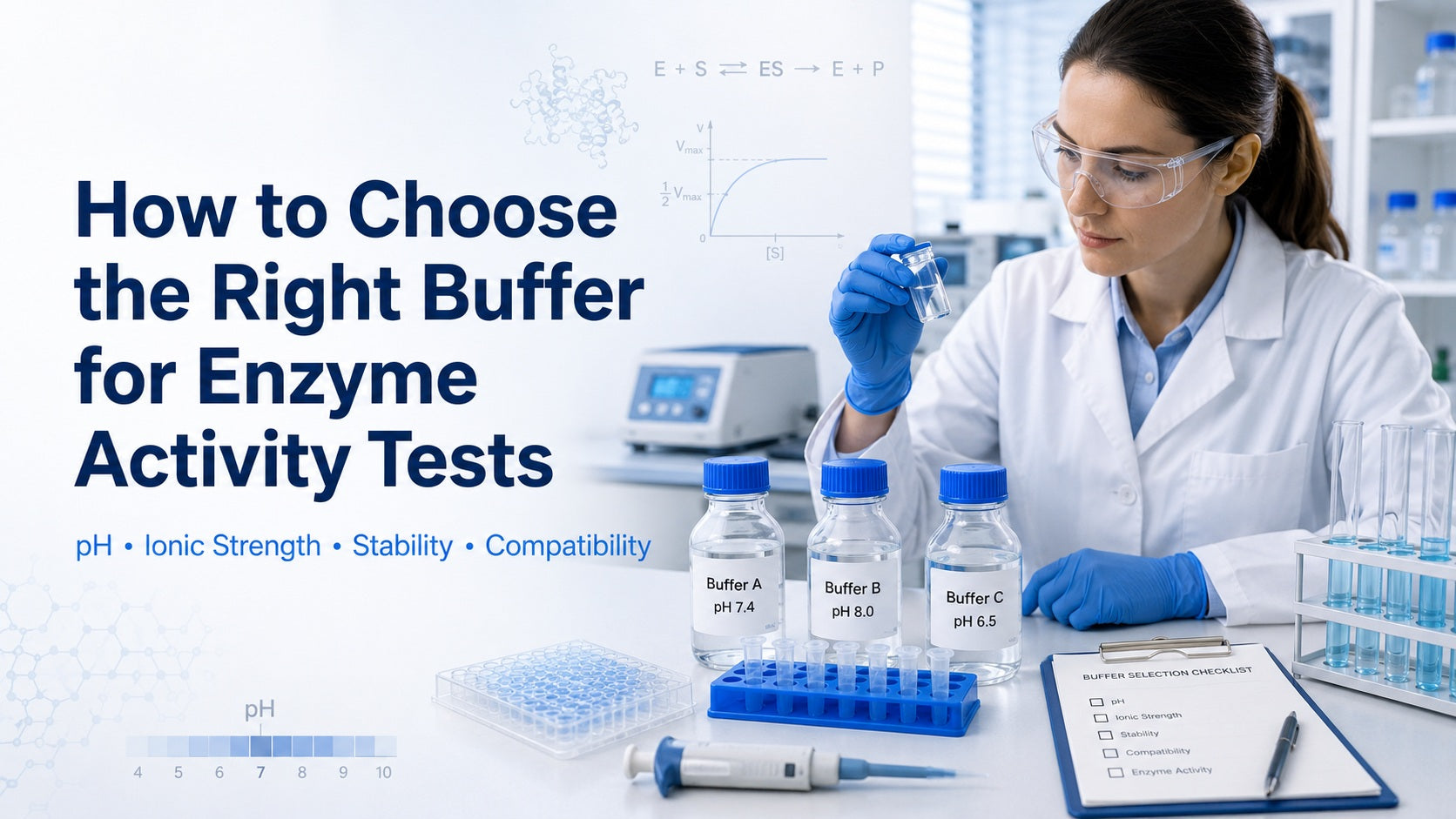
Enzyme activity tests measure how efficiently an enzyme converts a substrate into a product under defined reaction conditions. Buffer selection is one of the most important parts of enzyme assay design because the buffer controls pH, ionic strength, cofactor availability, protein stability, and assay compatibility. In biochemistry, molecular biology, diagnostic applications, PCR, qPCR, nucleic acid extraction, NGS library preparation, and quality control workflows, the right buffer helps create consistent conditions so enzyme activity can be measured with confidence.
How Do You Choose the Right Buffer for Enzyme Activity Tests?
To choose the right buffer for enzyme activity tests, start with the enzyme’s optimal pH range, then select a buffer with a suitable pKa near the assay pH. Next, evaluate ionic strength, metal ion requirements, enzyme inhibition risks, substrate compatibility, detection method, temperature, and downstream workflow needs. MES buffer, phosphate buffer, Tris, HEPES, MOPS, and acetate buffers may all perform differently because each has unique chemistry and interaction potential.
What Is Buffer Selection in Enzyme Activity Tests?
Buffer selection is the process of choosing a solution system that maintains the desired pH and chemical environment during an enzyme assay. A buffer is not only a pH stabilizer. It can influence enzyme structure, active-site charge, substrate binding, solubility, ionic strength, cofactor behavior, and signal detection.
For enzyme activity tests, a well-chosen buffer supports repeatable assay performance. A poorly matched buffer can make interpretation harder by shifting pH, interacting with substrates, binding metal ions, changing enzyme stability, or affecting the detection signal. This is why buffer selection should be treated as part of the assay design, not as a routine background step.
Why Buffer Selection Matters in Modern Lab Workflows
The importance of buffer selection in enzyme activity tests is clear across research and applied laboratories. Enzymes are used in many workflows, including polymerase reactions, reverse transcription, restriction digestion, ligation, protein assays, reporter assays, diagnostic research, endotoxin testing systems, and NGS library preparation.
For researchers and lab managers, the right buffer supports:
- Stable assay pH during the reaction
- Consistent enzyme activity and reproducibility
- Suitable ionic strength for enzyme-substrate interactions
- Proper availability of cofactors such as magnesium or calcium
- Compatibility with absorbance, fluorescence, colorimetric, or amplification readouts
- Clear comparison between samples, lots, or experimental conditions
- Efficient workflow transfer between operators or teams
In biotech, pharmaceutical QC, molecular biology, and academic laboratories, buffer consistency also supports documentation, training, troubleshooting, and procurement planning.
How pH Affects Enzyme Activity
pH affects enzyme activity by changing the charge of amino acids in the enzyme’s active site and the charge state of the substrate. Each enzyme has a working pH range where its structure and catalytic chemistry are well supported. Outside that range, activity may shift because substrate binding, folding, or catalytic residues respond to the environment.
When choosing a buffer, select one with an effective buffering capacity close to the target pH. A practical rule is to choose a buffer with a pKa within about one pH unit of the desired assay pH. This helps the buffer resist pH changes during the reaction.
For example:
- The MES buffer is commonly used in mildly acidic assay conditions
- Phosphate buffer is widely used in biological workflows near neutral pH
- Tris is often used in molecular biology reactions near neutral to slightly alkaline pH
- HEPES and MOPS are useful in many biochemical and cell-related systems
The best choice depends on enzyme class, substrate, cofactor, and detection method.
Role of Ionic Strength in Enzyme Assays
Ionic strength describes the total concentration and charge of ions in a solution. It affects electrostatic interactions between enzyme, substrate, cofactors, salts, nucleic acids, proteins, and assay components.
In enzyme assays, ionic strength can influence:
- Protein folding and stability
- Substrate binding efficiency
- Enzyme-substrate complex formation
- Nucleic acid structure in polymerase or nuclease reactions
- Metal cofactor activity
- Background signal or nonspecific interactions
Some enzymes work well at moderate salt concentrations, while others require very specific ion conditions. For nucleic acid enzymes, magnesium concentration is especially important because it can influence polymerase activity, primer-template interactions, and amplification efficiency. In other enzyme systems, calcium, zinc, manganese, potassium, or sodium ions may support stability or contribute to altered activity.
MES Buffer, Phosphate Buffer, Tris, and HEPES: Which One Fits Your Assay?
Different buffers can produce different enzyme activity results, even at the same pH. Their chemical groups, ion interactions, and assay compatibility vary.
|
Buffer Type |
Common Use |
Main Selection Consideration |
|
Mildly acidic biochemical assays |
Useful around lower pH ranges and often chosen when minimal interaction is desired |
|
|
Phosphate buffer |
General biological assays and protein workflows |
Familiar and versatile, but may interact with some metal-dependent systems |
|
Tris buffer |
Molecular biology and protein workflows |
pH can shift with temperature, so assay temperature matters |
|
HEPES buffer |
Biochemical and cell-related assays |
Useful near physiological pH and often selected for stable conditions |
|
MOPS buffer |
Biochemistry and molecular biology applications |
Helpful near neutral pH in selected enzyme systems |
|
Acetate buffer |
Acidic enzyme assays |
Useful for enzymes with lower pH optima |
Key Applications of Buffer Selection
Enzyme Activity Tests and Biochemistry Assays
Biochemistry assays often require careful buffer design because enzyme activity may respond to small changes in pH, salt, temperature, and cofactors. A structured buffer screen can help identify conditions that support clear activity measurements.
PCR and qPCR Workflows
Polymerase activity depends on optimized pH, magnesium concentration, salt balance, and stabilizers. Ready-to-use PCR/qPCR master mixes are often designed to simplify buffer selection and support consistent amplification.
Nucleic Acid Extraction and Purification
Extraction buffers support lysis, binding, washing, and elution. Buffer chemistry affects DNA and RNA purity, inhibitor removal, and downstream Compatibility with PCR, qPCR, sequencing, or molecular diagnostics research.
NGS Library Preparation
NGS library preparation includes enzyme-driven steps such as fragmentation, end repair, A-tailing, ligation, and amplification. Each step benefits from controlled buffer conditions and compatible reagents.
Quality Control and Diagnostic Research
In QC and diagnostic application workflows, buffer consistency supports documentation, lot comparison, assay reliability, and reproducible handling between teams.
Step-by-Step Guide: How to Choose the Right Buffer
Step 1: Define the Enzyme and Assay Goal
Identify the enzyme class, substrate, desired readout, reaction time, and measurement method. A polymerase assay, protease assay, glycosidase assay, and kinase assay may each require different buffer logic.
Step 2: Select the Target pH
Use the enzyme’s known or expected pH optimum as the starting point. Choose a buffer with a pKa close to the desired pH so it can maintain stable conditions throughout the assay.
Step 3: Review Cofactor and Ion Requirements
Check whether the enzyme requires magnesium, manganese, calcium, zinc, potassium, or another ion. Also, check whether the chosen buffer may bind, precipitate, or compete with required ions.
Step 4: Set Ionic Strength Thoughtfully
Choose a salt concentration that supports enzyme stability and substrate interaction. When optimizing, adjust ionic strength in a planned way rather than changing multiple variables at once.
Step 5: Confirm Detection Compatibility
Make sure the buffer does not interfere with absorbance, fluorescence, luminescence, colorimetric, electrophoresis, qPCR, or sequencing readouts. This is especially important when measuring low signal changes.
Step 6: Consider Temperature
Some buffers shift pH with temperature. Prepare and verify buffers at the temperature closest to the assay condition whenever possible.
Step 7: Validate With a Small Buffer Screen
When developing a new enzyme assay, compare a small set of buffers around the target pH. Keep enzyme, substrate, time, temperature, and detection conditions consistent so the buffer effect is easier to interpret.
Important Factors to Consider Before Buying Buffers or Enzyme Reagents
|
Buying Factor |
Why It Matters |
What to Look For |
|
Enzyme type |
Different enzymes prefer different pH and ion conditions |
Product notes, protocols, enzyme class guidance |
|
Target pH |
Buffer capacity depends on pKa |
Buffer range near assay pH |
|
Ionic strength |
Affects binding, stability, and assay signal |
Consistent salt formulation or clear preparation instructions |
|
Cofactors |
Many enzymes need metal ions |
Mg²⁺, Ca²⁺, Mn²⁺, Zn²⁺ compatibility |
|
Detection method |
Some buffers affect assay readouts |
Compatibility with fluorescence, absorbance, PCR, qPCR, or NGS |
|
Workflow format |
Kits can simplify routine assays |
Ready-to-use mixes, optimized kits, documented protocols |
|
Documentation |
Supports reproducibility and QC |
Specifications, storage guidance, FAQs, lot details |
Common Buffer Selection Mistakes to Avoid
Buffer selection becomes easier when labs use a practical and positive approach. Instead of assuming that all buffers at the same pH will behave the same way, compare buffer chemistry and ionic strength. Instead of switching from the MES buffer to the phosphate buffer without validation, run a small side-by-side test. Instead of building every reaction from separate components, consider optimized reagent systems when consistency is a priority.
Helpful practices include:
- Verify pH at the working temperature
- Keep buffer concentration consistent between assays
- Record salt and ion concentrations clearly
- Avoid unvalidated substitutions in established protocols
- Check whether the buffer interacts with cofactors or detection reagents
- Use clean water, calibrated pH meters, and suitable storage conditions
- Save protocol versions and lot details for repeat experiments
FAQs
What is the best buffer for enzyme activity tests?
The best buffer depends on the enzyme’s optimal pH, cofactor needs, substrate, ionic strength, temperature, and detection method. Common choices include MES, phosphate, Tris, HEPES, MOPS, and acetate buffers, depending on the assay conditions.
Why is buffer selection important in enzyme activity tests?
Buffer selection is important because pH, ionic strength, ions, and buffer chemistry influence enzyme structure, substrate binding, activity, stability, and assay readout. A suitable buffer helps produce more consistent and interpretable results.
How does pH affect enzyme activity?
pH affects enzyme activity by changing the charge of amino acids in the active site and the charge state of the substrate. Each enzyme has a working pH range where catalytic activity is well supported.
What is the role of ionic strength in enzyme assays?
Ionic strength affects electrostatic interactions between enzymes, substrates, cofactors, and salts. It can influence protein stability, substrate binding, enzyme activity, and background signal.
When should I use the MES buffer for enzyme assays?
The MES buffer is commonly considered for mildly acidic enzyme assay conditions. It may be useful when the desired pH is within its effective range and when the assay components are compatible with MES chemistry.
Conclusion:
Choosing the right buffer for enzyme activity tests requires more than matching a pH number. The best buffer supports the enzyme’s structure, active-site chemistry, substrate binding, cofactor needs, ionic strength, detection method, and downstream workflow. MES buffer, phosphate buffer, Tris, HEPES, MOPS, and acetate buffers all have different chemical profiles so that they may produce different activity results even at similar pH values. By using a step-by-step selection process and validating conditions with a small buffer screen, labs can build clearer, more reproducible enzyme assays.


