
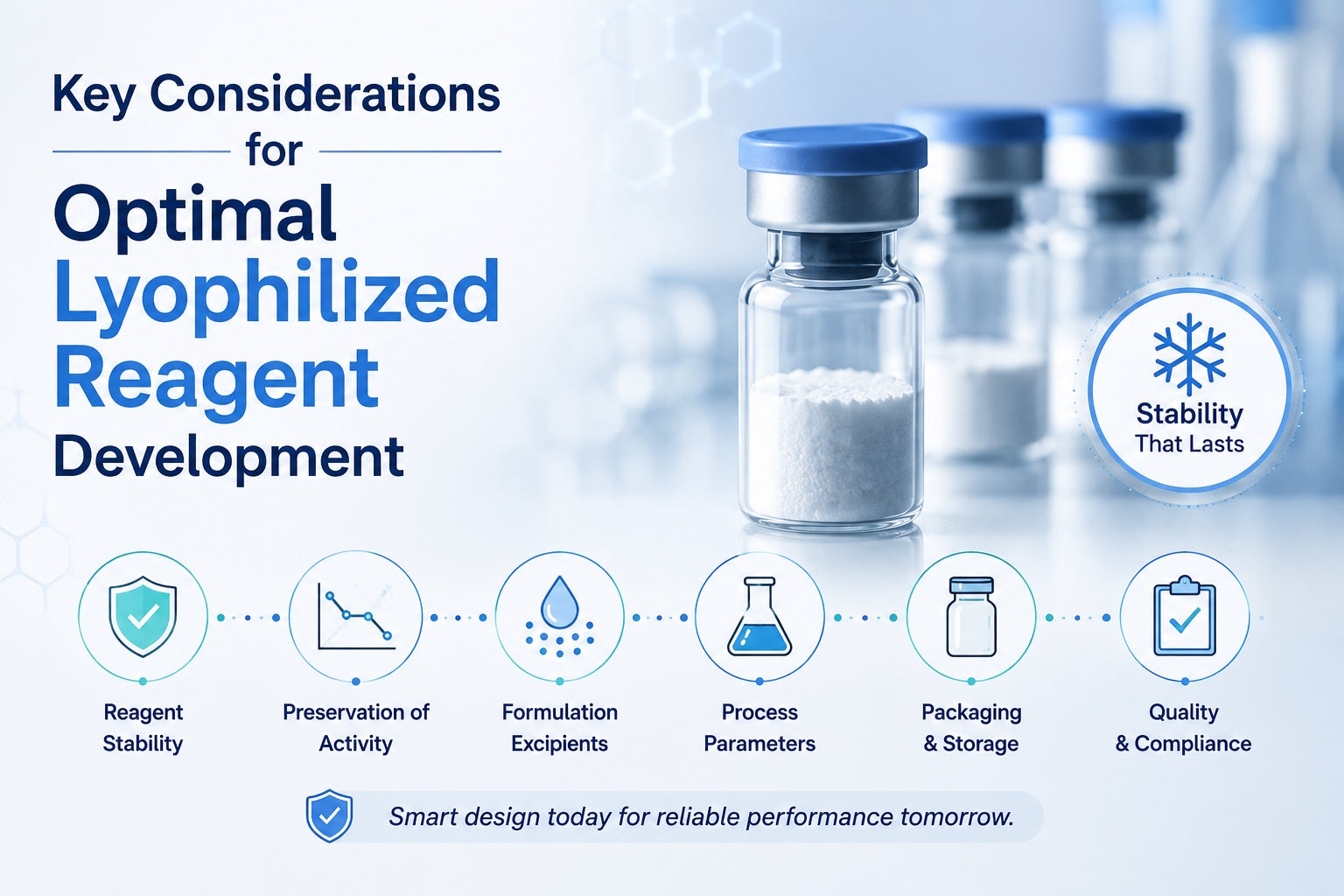
Lyophilization, also called freeze-drying, is a process that removes water from frozen materials under vacuum to create dry, stable lyophilized products. In molecular diagnostics and molecular biology, lyophilized reagents can help preserve enzymes, primers, probes, buffers, and assay components in a convenient dry format. For research labs, diagnostic developers, biotech teams, and quality control groups, optimal lyophilized reagent development supports reagent stability, workflow efficiency, simplified handling, and consistent assay performance.
What Matters Most in Lyophilized Reagent Development?
Optimal lyophilized reagent development depends on the formulation, active reagent stability, excipient selection, freezing behavior, primary drying, secondary drying, residual moisture, reconstitution performance, packaging, and stability testing. For molecular diagnostics, PCR, qPCR, RT-qPCR, NGS library preparation, and enzyme-based assays, the lyophilized format should preserve reagent activity while enabling easy storage, transport, and use at the bench.
What Is Lyophilization?
Lyophilization is a freeze-drying process used to stabilize moisture-sensitive materials. The process typically includes freezing, primary drying, and secondary drying. During freezing, the reagent formulation becomes solid. During primary drying, ice is removed by sublimation under vacuum. During secondary drying, additional bound water is reduced to reach the desired moisture level.
For lyophilized reagents, the goal is not simply to dry the material. The goal is to preserve activity, structure, and performance after drying, storage, rehydration, and use. This is especially important for enzymes, nucleic acid amplification reagents, antibodies, assay mixes, controls, and diagnostic components.
Why Lyophilized Reagents Matter in Modern Lab Workflows
Lyophilized reagents are valuable because many biological and molecular biology components are sensitive to water, temperature, and repeated handling. By converting liquid formulations into dry formats, labs may gain more flexible storage and easier assay setup.
The importance of lyophilized reagent development is especially clear in molecular diagnostics, where reagents may need to support consistent performance across different users, locations, shipping routes, and storage conditions. Lyophilized PCR and RT-qPCR reagents can also simplify workflow preparation because key reaction components may be pre-formulated into a ready-to-rehydrate format.
Benefits of lyophilized diagnostic reagents may include:
- Improved reagent stability compared with many liquid formats
- Easier shipping and storage planning
- Convenient unit-dose or ready-to-use formats
- Reduced preparation steps for end users
- Better workflow consistency between operators
- Useful formats for field, decentralized, or point-of-care research settings
- Easier integration into molecular diagnostics and assay development pipelines
Key Applications of Lyophilized Reagent Development
Molecular Diagnostics and PCR Detection
Lyophilized reagents are widely used in molecular diagnostics because amplification workflows rely on enzymes, primers, probes, salts, and buffers that must remain functional. Freeze-drying can support more convenient reagent handling for PCR, qPCR, RT-PCR, and RT-qPCR assays.
PCR/qPCR and Molecular Biology Reagents
Polymerases, reverse transcriptases, dNTPs, buffers, stabilizers, and amplification mixes can be developed into dry formats when the formulation is suitable. This can support routine molecular biology workflows and assay-ready formats.
Nucleic Acid Extraction and Purification Workflows
Although extraction reagents vary widely, lyophilized or stabilized components may be useful in sample preparation workflows where storage, shipping, or simplified setup is important.
NGS Library Preparation
NGS library prep includes multiple enzyme-driven steps, such as fragmentation, end repair, A-tailing, ligation, amplification, and cleanup. Lyophilization may support selected components or workflow-ready reagent formats when compatibility is validated.
Quality Control and Research Applications
QC teams and research labs benefit from consistent reagent performance, documentation, lot traceability, and storage planning. Lyophilized products can support reproducible workflows when development and validation are carefully designed.
How Lyophilization Improves Reagent Stability
Lyophilization improves reagent stability by reducing water content, which can slow many degradation pathways. Water can contribute to hydrolysis, enzyme instability, microbial growth risk in some formulations, and reduced long-term performance for sensitive reagents. By removing water under controlled conditions, freeze-drying helps preserve active components in a dry matrix.
However, stability depends on more than drying alone. The formulation must protect the reagent during freezing and drying, then support rapid and complete rehydration. Excipients such as sugars, polyols, polymers, proteins, salts, and surfactants may be used to support structure, cake appearance, solubility, and activity retention. The best formulation depends on the reagent type and assay requirement.
Step-by-Step Guide: Key Considerations for Optimal Lyophilized Reagent Development
Step 1: Define the Reagent and Workflow Goal
Start by defining what the lyophilized reagent must do. Is it a PCR master mix, RT-qPCR assay, enzyme blend, control, buffer, detection reagent, or multi-component diagnostic mix? Identify the active ingredients, final use case, storage target, rehydration volume, assay readout, and required performance range.
Step 2: Understand Active Component Sensitivity
Different components respond differently to freeze-drying. Enzymes may require stabilizers to preserve activity. Primers and probes may need protection from degradation. Fluorescent probes may require light-conscious handling. Salts and buffers may crystallize or shift pH during freezing. Understanding these sensitivities helps guide formulation design.
Step 3: Choose Cryoprotectants and Lyoprotectants Thoughtfully
Protective excipients help maintain structure and performance during freezing and drying. Common choices include trehalose, sucrose, mannitol, dextran, PEG, amino acids, proteins, and surfactants, depending on the application.
A formulation should support:
- Active reagent stability
- Attractive and consistent cake or bead structure
- Rapid reconstitution
- Minimal assay interference
- Compatibility with primers, probes, enzymes, and buffers
- Scalable manufacturing conditions
Step 4: Optimize Freezing Conditions
Freezing influences ice crystal formation, solute distribution, and product structure. Cooling rate, shelf temperature, fill volume, container format, and formulation composition all affect the final dried product. A well-planned freezing step supports repeatable drying behavior and final product quality.
Step 5: Develop Primary and Secondary Drying Parameters
Primary drying removes ice by sublimation. Secondary drying removes additional bound water. Both steps should be designed to protect the product structure while reaching the desired moisture level. Drying that is too mild may leave excess moisture, while overly aggressive conditions may affect sensitive components. Development should balance process efficiency with reagent performance.
Step 6: Evaluate Reconstitution Performance
A lyophilized reagent should rehydrate smoothly and predictably. Reconstitution time, mixing behavior, final clarity, pH, and assay performance should be evaluated. For diagnostic and molecular biology workflows, ease of use matters because end users need consistent results with clear instructions.
Step 7: Test Functional Performance After Drying
Functional testing confirms whether the reagent still performs as intended. For PCR/qPCR reagents, this may include amplification efficiency, Ct consistency, sensitivity, specificity, and comparison with liquid controls. For enzyme assays, activity retention and background signal may be measured. For NGS-related components, library yield and quality may be reviewed.
Step 8: Select Packaging and Storage Conditions
Packaging protects lyophilized products from moisture, oxygen, light, and handling variation. Vials, tubes, plates, pouches, desiccants, seals, and moisture-barrier packaging should be selected based on the use case. Storage guidance should be practical and clearly documented.
Step 9: Conduct Stability Studies
Stability testing helps confirm how the product performs over time. Real-time and accelerated stability studies can evaluate activity, moisture, reconstitution, appearance, and assay performance. Stability plans should reflect intended storage, shipping, and use conditions.
Formulation, Process, and QC Considerations at a Glance
|
Development Area |
What to Evaluate |
Why It Matters |
|
Formulation |
Enzymes, primers, probes, buffers, sugars, salts, surfactants |
Supports activity and rehydration |
|
Freezing |
Cooling rate, fill volume, container format |
Influences cake structure and drying behavior |
|
Primary drying |
Shelf temperature, chamber pressure, drying time |
Removes ice while protecting reagent quality |
|
Secondary drying |
Final moisture target and time |
Supports longer-term stability |
|
Reconstitution |
Time, volume, mixing, clarity, pH |
Supports end-user workflow efficiency |
|
Functional testing |
PCR/qPCR, enzyme activity, assay signal, controls |
Confirms performance after drying |
|
Packaging |
Moisture barrier, desiccant, sealing, light protection |
Preserves product quality during storage |
|
Stability |
Real-time and accelerated testing |
Supports shelf-life planning and documentation |
How FireGene Supports Reliable Research Workflows
FireGene supports molecular biology and diagnostic applications with product areas including molecular diagnostics and PCR detection, PCR/qPCR and molecular biology reagents, nucleic acid extraction and purification kits, NGS library prep kits, endotoxin testing and QC, lab buffers, rapid test kits, and single-cell sequencing sample preparation. FireGene also highlights lyophilization technology for PCR diagnostic reagents and molecular diagnostic workflows.
For teams developing or selecting lyophilized reagents, this workflow coverage helps connect formulation decisions to real laboratory use, from sample preparation and extraction to amplification, detection, sequencing, and QC.
FAQs
What are the benefits of lyophilized diagnostic reagents?
Benefits may include improved storage flexibility, easier shipping, simplified assay setup, unit-dose convenience, reduced preparation steps, and more consistent handling between users or locations.
What excipients are used in lyophilized reagents?
Common excipients include sugars such as trehalose and sucrose, polyols such as mannitol, polymers, proteins, amino acids, salts, and surfactants. The best choice depends on the reagent, assay chemistry, and desired product format.
What should be tested after lyophilizing a reagent?
After lyophilization, teams should test appearance, residual moisture, reconstitution time, pH, functional assay performance, stability, and packaging compatibility. For PCR/qPCR reagents, amplification performance and Ct consistency may be useful checkpoints.
Are lyophilized reagents useful for PCR and qPCR?
Yes. Lyophilized PCR and qPCR reagents can be useful when enzymes, primers, probes, buffers, and assay components are formulated and dried correctly. They can support convenient handling and storage in molecular biology and diagnostic workflows.
How do I choose a lyophilized reagent development partner?
Choose a partner or supplier based on formulation experience, molecular biology knowledge, lyophilization capabilities, functional testing support, packaging options, documentation, stability planning, and alignment with your target assay workflow.
Conclusion:
Lyophilization is a powerful freeze-drying approach for creating stable, convenient lyophilized reagents for molecular diagnostics, PCR/qPCR, enzyme assays, NGS library preparation, and research workflows. Optimal development requires careful attention to formulation, excipients, freezing, drying, residual moisture, reconstitution, packaging, and stability testing. The best lyophilized products are designed around the full workflow, not only the drying step. By choosing suitable reagents, development support, and documentation practices, labs can support reagent stability, workflow efficiency, and reliable assay performance.


