
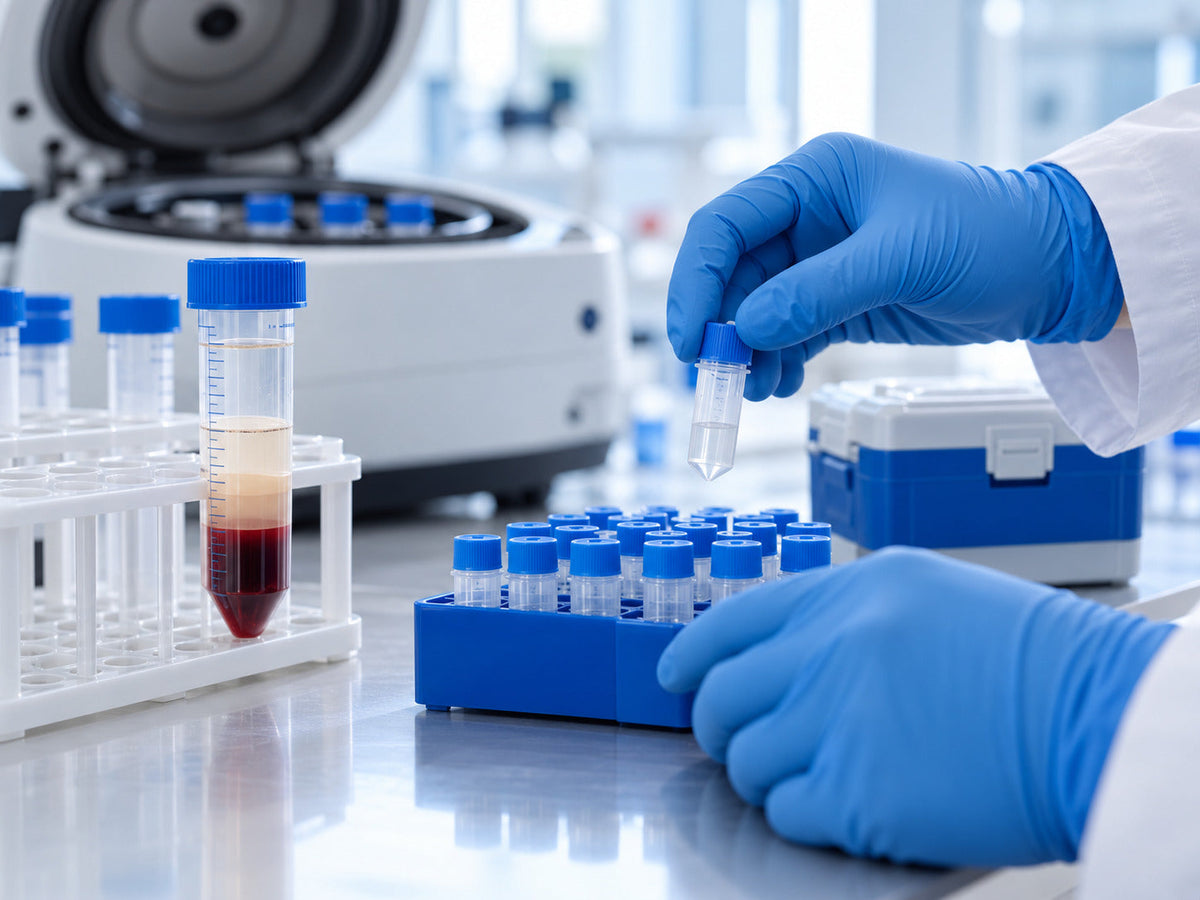
Isolation, freezing, and thawing of PBMCs form a connected workflow for preparing peripheral blood mononuclear cells for immediate experiments or future research. A successful plan matches the starting blood sample, isolation reagent, cryopreservation medium and post-thaw assessment to the intended application. For researchers purchasing reagents, the most useful approach is to consider the entire workflow. Isolation establishes the starting cell preparation, freezing supports sample banking, and thawing prepares the stored cells for the next experiment. FireGene offers relevant isolation and preservation products that laboratories can review around these stages. This guide explains the workflow, provides a product comparison and shows how to measure cell viability and recovery with clearly defined calculations.
PBMC Isolation, Freezing and Thawing at a Glance
Peripheral blood mononuclear cells include lymphocytes and monocytes. Researchers use these populations in immune profiling, functional assays, cell culture and other cell-based studies. A connected workflow makes it easier to coordinate materials, record sample history and compare results across experiments.
|
Workflow stage |
Main objective |
What to prepare or record |
|
Sample planning |
Match starting material to the experiment |
Sample type, collection details and intended assay |
|
Isolation |
Prepare a PBMC-enriched suspension |
Isolation reagent and its instructions |
|
Counting |
Establish the starting cell quantity |
Concentration, suspension volume and viability |
|
Freezing |
Bank defined aliquots |
Compatible medium, vial loading and cooling procedure |
|
Storage |
Maintain organized sample access |
Storage location and temperature records |
|
Thawing |
Prepare stored cells for use |
Thawing instructions, medium and washing materials |
|
Quality assessment |
Establish usable cell quantity |
Viable-cell count, recovery and assay-specific checks |
Review the PBMC isolation collection alongside the cell and tissue preservation collection when planning purchases.
Plan the Experiment Before Selecting Reagents
The downstream application provides the starting point for product selection. An experiment measuring cell-surface markers may have different handling requirements from an ELISpot assay, FluoroSpot assay or single-cell sequencing project.
Define the Starting Material
Record whether the project begins with whole blood, buffy coat or an apheresis-derived preparation. These materials differ in concentration and processing requirements. Select a reagent documented for the actual starting sample and follow its preparation instructions. For a detailed comparison, read Whole Blood vs Buffy Coat vs Leukopak for PBMC Isolation.
Decide Between Immediate Use and Sample Banking
Freshly isolated PBMCs can enter a suitable assay directly. Cryopreservation provides a route for storing aliquots and coordinating later experiments. For a study using frozen cells, include a representative freeze–thaw evaluation during development. Define what the stored preparation must deliver for the planned application.
Build a Materials List Around Each Stage
Organize the purchasing list into isolation, freezing, thawing and assessment materials. This makes it easier to identify which reagents are supplied with a product and which materials the laboratory provides separately.
How to Isolate PBMCs From Whole Blood
PBMC isolation commonly uses density-based separation followed by collection, washing and resuspension. The exact operating conditions belong to the selected reagent’s instructions. A clear workflow overview helps researchers connect those instructions with the required equipment.
Density Gradient Centrifugation
Density gradient centrifugation separates blood components according to their behavior in a specified separation medium. collect the mononuclear-cell fraction and continue with the documented washing procedure.Ficoll-Paque is a familiar example of a density-gradient medium used in published PBMC protocols. The phrase PBMC isolation using Ficoll-Paque describes a particular reagent workflow; other isolation products should be used with their own instructions.

Collecting and Washing the Cell Fraction
Prepare receiving tubes, washing materials and labeling before separation begins. After collecting the intended fraction, follow the selected workflow for washing and resuspension. Consistent handling gives the laboratory a clearer basis for comparing samples. Use relative centrifugal force, expressed as ×g, when recording centrifugation instructions. Rotor details and the selected protocol should remain part of the method record.
Establishing a Pre-Freezing Baseline
After isolation, record cell concentration, suspension volume and viability. This baseline supports aliquot planning and later recovery calculations. Note the counting method and dilution factor so the measurement can be interpreted consistently. For the dedicated isolation-stage guide, review Human PBMC Isolation Solution.
Related FireGene Products for Workflow Planning
The following products provide relevant purchasing routes for isolation and preservation planning.
|
Product |
Catalog or SKU |
Listed format |
Documented role |
Selection step |
|
Catalog FG-BA3332; SKU FG-BA3332-100 |
100 mL |
Density-based preparation from diluted human peripheral blood; listed downstream applications include flow cytometry, single-cell sequencing and cell culture |
Review the sample requirements and separation instructions |
|
|
SKU FG-BA3309-100 |
100 mL/kit |
General cryopreservation of primary cells, cell lines and single-cell suspensions |
Request PBMC-specific application guidance and qualify the intended workflow |
The isolation listing specifies human peripheral blood. The freezing-kit listing describes broader cell-preservation applications; PBMC-specific suitability should be established through relevant documentation and experimental qualification. Both reviewed product pages display purchasing options. FireGene
Discuss PBMC Preservation Requirements →

How to Freeze Peripheral Blood Mononuclear Cells
PBMC freezing begins with a defined cell preparation and a cryopreservation workflow selected for the intended application. Prepare the medium, cryovials, cooling equipment and storage location before beginning the preservation stage.
Choose a PBMC-Compatible Cryopreservation Medium
A cryopreservation medium should have instructions and supporting information relevant to the cells being stored. Compare formulation, recommended cell concentration, cooling procedure, storage conditions and thawing requirements together.
Published protocols use different freezing formulations. For example, STEMCELL describes a serum-free medium containing DMSO and a controlled-cooling approach. This illustrates why medium selection and handling instructions should be treated as one system. When requesting a quotation, include the cell type, application and proposed storage workflow. These details make the product discussion more useful.
Plan Cell Concentration and Aliquot Size
Select vial loading according to the qualified protocol and the quantity needed for future experiments. Consider the viable cells required for the assay, controls and replicates. Add any evaluation aliquots to the plan before calculating the total quantity. For example, a laboratory may reserve one representative vial for post-thaw assessment and allocate the remaining vials to the planned study.
Coordinate Controlled Cooling
Use the cooling procedure specified for the selected medium and cell preparation. Document the cooling equipment, vial format, fill volume and storage-transfer procedure. These records support repeatability across operators and study days. A freezing-container workflow and a programmable controlled-rate freezer each require appropriate instructions.
Create Clear Storage Records
Label aliquots with a sample identifier, preparation date and relevant batch information.Maintain a separate record of vial location, viable-cell loading and medium lot. An organized inventory helps the team retrieve the correct aliquot efficiently. For broader storage planning, see the Biobanking Storage Guide.

How to Thaw Cryopreserved PBMCs
Prepare the receiving medium, tubes, counting materials and downstream workspace before retrieving a vial. The thawing procedure should match the selected cryopreservation system and the assay requirements.
Follow a Coordinated Thawing Procedure
Published PBMC protocols commonly describe rapid thawing followed by prompt transfer into an appropriate medium. The detailed endpoint, dilution steps and washing conditions vary between workflows. Use the qualified procedure for the actual cell preparation. For multiple vials, plan a batch size the operator can process consistently.
Dilute, Wash and Resuspend
Follow the specified medium-addition procedure and washing steps.
Record the final resuspension volume. This value is essential for calculating the total cells available after thawing. A measurement made immediately after dilution and one made after the final wash represent different workflow checkpoints. Label both clearly when comparing results.
Plan Post-Thaw Resting Around the Assay
Some functional-assay workflows include a resting period. Other applications use different preparation requirements. Choose resting conditions according to the assay protocol and assess their effect during development. Mabtech includes post-thaw resting in its ELISpot/FluoroSpot-oriented workflow, demonstrating the importance of application-specific preparation.
Measure Cell Viability and Recovery Separately
Cell viability and cell recovery answer different questions. Viability describes the proportion of counted cells classified as living. Recovery describes how many cells are retained relative to a defined starting quantity.
Three Measurements to Record
|
Measurement |
Calculation |
What it tells you |
|
Viability |
Viable cells ÷ total counted cells × 100 |
Proportion classified as viable |
|
Total cell number |
Total-cell concentration × suspension volume |
Number of counted cells in the preparation |
|
Viable-cell number |
Total cell number × viability fraction |
Living cells available at that checkpoint |
|
Viable-cell recovery |
Post-thaw viable cells ÷ pre-freeze viable cells × 100 |
Recovery relative to the defined baseline |
Use the same counting approach where practical and identify the timepoint used for each measurement.
Worked Viable-Cell Recovery Example
Suppose a vial contains 10 million viable cells at freezing.
After thawing and the final wash, the preparation contains:
- 8 million total cells
- 90% viability
The viable-cell number is:
8 million × 0.90 = 7.2 million viable cells
The viable-cell recovery is:
7.2 million ÷ 10 million × 100 = 72%
The preparation therefore has 90% viability and 72% viable-cell recovery. Recording both values gives a clearer picture than either percentage alone.

State the Denominator Clearly
If the starting record contains total cells rather than viable cells, calculate the baseline accordingly. Also specify whether the post-thaw count was measured after washing, resting or cleanup. Each checkpoint answers a distinct process question.
Match PBMC Quality to the Downstream Application
A useful quality plan connects the cell measurements with what the assay needs.
Flow Cytometry
For flow cytometry, consider viable-cell quantity, aggregates, suspension quality and the markers being measured. Include enough cells for the experimental panel and its controls. Evaluate the intended fresh or frozen preparation using the actual staining workflow.
ELISpot and FluoroSpot Assays
An ELISpot assay measures analyte secretion at the single-cell level. A FluoroSpot assay uses fluorescence-based detection to assess selected secreted analytes. For these functional readouts, combine viable-cell counting with assay controls and an appropriate functional assessment.
PBMC Culture and Functional Experiments
PBMC culture conditions should fit the intended stimulation, observation period and readout. Define whether the objective involves the mixed population or a selected subset. This influences cell quantity and preparation decisions.
Single-Cell Sequencing
Single-cell workflows require preparation according to the selected platform’s instructions. Review viable-cell concentration, aggregates and sample composition together. The single-cell sequencing collection provides related sample-preparation categories.
Use Checkpoints to Compare the Workflow
A checkpoint table helps identify where measurements were made and what they represent.
|
Checkpoint |
Recommended record |
|
Before isolation |
Starting volume, material type and collection history |
|
After isolation |
Cell concentration, total volume and viability |
|
Before freezing |
Viable cells per vial and medium details |
|
After thawing and washing |
Final volume, viable-cell number and recovery |
|
After resting or cleanup |
Updated cell quantity and assessment time |
|
Before assay setup |
Cells available for samples, controls and replicates |
If cleanup is part of the method, compare cell measurements before and after it. An increased viability percentage can occur alongside a smaller total viable-cell quantity. Review cell cleanup and suspension optimization products when evaluating a documented need for additional preparation.
Compare Products by the Complete Experiment
The most useful purchasing comparison goes beyond bottle size.
Calculate Reagent Consumption
Estimate isolation reagent use from the selected protocol and starting sample volume. Estimate freezing-medium requirements from vial number and fill volume. Include pilot work, controls and planned repeat preparations. A 100 mL bottle represents a purchasing volume; the usable sample count depends on the qualified method.
Compare Complete Setup Requirements
List the medium, consumables, equipment and assessment materials required at each stage. This makes quotations easier to compare and helps the laboratory prepare a complete workflow.
Keep Lot and Method Records
Record reagent lots, preparation dates and protocol versions alongside the sample data. These details support repeat ordering and meaningful comparisons across batches.
What to Include in a PBMC Reagent Inquiry
Provide the supplier with:
- Starting material and species.
- Expected sample volume and sample count.
- Intended downstream assay.
- Immediate-use or cryopreservation plan.
- Proposed vial loading and storage workflow.
- Available cooling and counting equipment.
- Required documentation and purchasing quantity.
FireGene’s product pages provide catalog specifications and inquiry routes. Share the workflow requirements when requesting product guidance.
Request PBMC Reagent Pricing and Guidance →
Frequently Asked Questions
What Are PBMCs?
PBMCs are peripheral blood mononuclear cells, including lymphocytes and monocytes. They are widely used in immunology and cell-based research.
How Are PBMCs Isolated From Whole Blood?
A common approach uses density-based separation followed by collection, washing and resuspension. Follow the selected reagent’s instructions.
Is Ficoll-Paque Required for Every Isolation Workflow?
Ficoll-Paque is one established density-gradient medium. Select the product documented for your sample and use its corresponding method.
How Do I Choose a Cryopreservation Medium?
Review PBMC-specific compatibility, preparation instructions, cooling requirements, storage conditions and post-thaw assessment information.
Is Post-Thaw Resting Always Included?
Resting is application-dependent. Select it according to the assay protocol and evaluate the intended conditions.
How Is Viability Different From Recovery?
Viability is the living proportion of counted cells. Viable-cell recovery compares the living-cell quantity after processing with a defined starting viable-cell quantity.
Can One Workflow Support Every Downstream Assay?
Qualify the preparation for the intended application. Marker analysis, functional assays and sequencing may require different assessment criteria.
Build a Connected PBMC Workflow
Isolation, freezing and thawing work best when planned as connected stages. Define the sample, select compatible reagents, record viable-cell quantities and assess the preparation against the intended assay. Use the isolation and preservation product information to build a shortlist, then request guidance for the actual workflow and purchasing quantity.


