
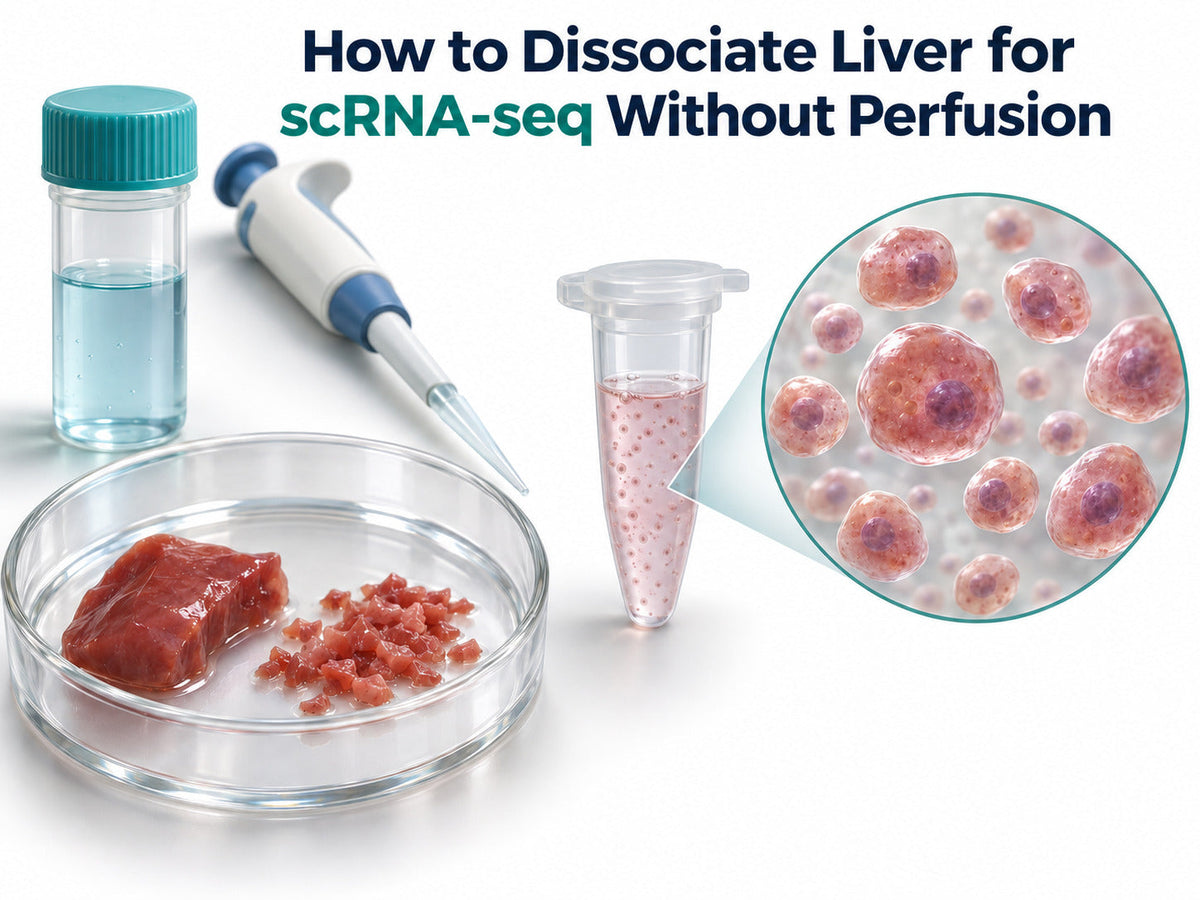
Quick answer: For liver dissociation without perfusion, mince excised tissue, then use enzymatic digestion, filtration, and washing. FG-BA3323 provides a documented tissue-digestion workflow; add FG-BA3311 when RBC cleanup is needed. Select the pack around tissue input and sample count, then assess viability and aggregates before scRNA-seq loading.
The Firegene Liver Dissociation Kit (FG-BA3323) Catalog
|
Product |
Catalog number / format |
Species or sample scope |
Published evidence / function |
Packs and USD prices |
Order |
|
FG-BA3323; enzymatic solution |
Human and mouse liver examples in product flyer |
Example project viability: mouse 95.16–97.85%; human 94.71–96.39% [1] |
10 reactions: $399; 50 reactions: $1,419 |
||
|
FG-BA3311; lysis solution |
Mammalian single-cell suspensions |
Selective RBC removal from mammalian single-cell suspensions |
100 mL: $38; 500 mL: $168 |
Why Choose FireGene Liver Dissociation Kit (FG-BA3323)?
FG-BA3323 combines human and mouse liver project data, lot-specific quality documentation, and a defined preparation protocol to support reagent selection for scRNA-seq. Published examples report cell viability, clumping, captured cells, and median genes, giving you practical evidence to assess alongside your study requirements. Choose 10- or 50-reaction packs to match your sample schedule. The documented workflow uses a water bath or rotating hybridization oven and a horizontal centrifuge. Optional FG-BA3311 supports RBC cleanup, while quotation and sample-request options help you plan initial evaluations and larger studies.
What Do FireGene’s Liver Preparation Data Show?
The product flyer reports the following results from example sequencing projects. These individual preparations provide sample-specific benchmarks for study planning.
|
Example project |
Cell viability |
Clumping rate |
Captured cells |
Median genes |
|
Mouse liver tissue 1 |
97.85% |
4.32% |
14,294 |
1,989 |
|
Mouse liver tissue 2 |
95.16% |
3.98% |
15,718 |
2,132 |
|
Human liver tissue 1 |
94.71% |
4.11% |
14,916 |
2,042 |
|
Human liver tissue 2 |
96.39% |
2.07% |
13,857 |
1,961 |
The COA for lot FG250821 records Pass against ≥85% viable hepatocytes and ≥1 × 10⁶ viable cells per 100 mg mouse liver. The certificate reports compliance with these lot-release specifications using a Pass result.
Which Kit Should You Order for Liver Dissociation Without Perfusion?
Select FG-BA3323 for intact tissue and FG-BA3311 for RBC cleanup. Order both when your preparation includes tissue digestion followed by erythrocyte removal.
|
Your starting point or purchasing need |
Select |
What belongs in your order |
|
Fresh liver fragments for a limited study |
FG-BA3323-10rxns |
A smaller reaction pack for the planned digestion work |
|
Repeated preparations across a larger cohort |
FG-BA3323-50rxns |
A larger pack aligned with expected consumption |
|
Released cells with residual mammalian RBCs |
FG-BA3311-100 or FG-BA3311-500 |
A lysis volume matched to the suspension volume and protocol |
|
Tissue digestion followed by RBC cleanup |
FG-BA3323 plus FG-BA3311 |
Separately specified digestion and lysis reagents |
Explore the single-cell sample preparation collection for preservation, nuclei preparation, and additional cleanup needs.

Which Pack Fits Your Study Size?
Choose the 10-reaction pack for limited initial work and the 50-reaction pack for repeated preparations. At the listed prices, the latter costs $28.38 per reaction, compared with $39.90 for the smaller pack. That saves $576 against five smaller packs, before shipping and taxes. Plan reaction consumption from tissue input and RBC lysis consumption from suspension volume.
When Does Liver Dissociation Without Perfusion Fit Your Study?
A non-perfusion liver dissociation protocol fits laboratories receiving excised tissue or resection fragments with limited access to intact vessels. Human liver dissociation for single-cell RNA sequencing has published washing, mincing, digestion, and fractionation workflows starting from excised tissue. For liver biopsy dissociation for scRNA-seq, specify the available tissue mass when requesting preparation guidance. The standard manufacturer input is approximately 200 mg; match the purchase and operating plan to your actual sample.
Describe whether you need hepatocyte isolation for scRNA-seq, liver non-parenchymal cell isolation, or a mixed suspension. Kupffer cell isolation from liver and liver sinusoidal endothelial cell isolation place different priorities on recovery. A defined target population helps align reagent selection, filtration, and cleanup.
Which Materials Should Accompany Your Reagent Order?
Prepare the following manufacturer-specified supplies before sample collection.
- FG-BA3323, with optional FG-BA3311 for RBC cleanup.
- RPMI 1640, PBS, and FBS.
- Water bath or rotating hybridization oven; horizontal centrifuge.
- Low-adsorption tips, 5-mL and 15-mL tubes, and 70-µm strainers.
- Cell counter, viability reagents, and sterile tissue-mincing tools.
Prepare PBS containing 5% FBS for the manual’s wash steps. The kit’s final suspension buffer and a sequencing platform’s loading buffer serve different stages; plan any required buffer exchange.
How Does the Non-Perfusion Liver Dissociation Protocol Work?
The manufacturer's manual describes direct processing of excised tissue through digestion, filtration, and washing. Its specified preparation uses approximately 200 mg of fresh liver tissue.
- Prepare digestion mix. Combine 240 µL Liver DS with 2,760 µL RPMI 1640 in a 5-mL tube.
- Wash and mince. Wash tissue with PBS. Keep liver tissue mincing consistent, then transfer the fragments into the digestion mix.
- Digest. For enzymatic digestion of liver tissue, incubate at 37°C for 0.5–2 hours. Shake water-bath tubes every 3–5 minutes, or rotate at 20–30 rpm.
- Choose the endpoint. Check cell number and viability during digestion. End incubation when the preparation is ready, then proceed with the manual’s filtration and medium-rinse steps.
- Filter and collect. Use a 70-µm strainer. Rinse the digestion tube with 3 mL RPMI three times, collecting 12 mL total filtrate.
- Pellet and wash. Centrifuge at 300 ×g, 4°C, for 5 minutes. Wash twice with 5 mL PBS containing 5% FBS, using the same centrifugation settings.
- Resuspend and assess. Use 50 µL–2 mL of the specified suspension buffer. Perform optional RBC removal, count, and proceed promptly.
This manual liver tissue dissociation workflow uses temperature-controlled digestion and regular mixing. If comparing collagenase liver dissociation or DNase I supplementation, discuss the existing formulation and protocol together. That keeps enzyme selection aligned with the documented preparation.
For RBC-rich preparations, FG-BA3311 supports red blood cell lysis in the liver single-cell suspension. Choose any further cleanup around your target populations. Percoll liver cell isolation and other enrichment methods select particular fractions; account for hepatocyte and non-parenchymal cell separation when planning recovery.

Which QC Targets Should You Meet Before Loading?
Use lot-release evidence for product selection and platform acceptance criteria for loading.
|
Check |
Target or decision |
|
Viability |
Aim for ≥90%, following 10x guidance. |
|
Aggregates and debris |
A suspension of intact single cells with minimal debris; inspect microscopically. |
|
Cell concentration |
Match the specific chemistry, intended recovery, and core-facility loading instructions. |
|
Loading buffer |
For compatible workflows, 10x describes PBS + 0.04% BSA on ice. |
|
Population recovery |
Confirm the intended cell types remain after cleanup. |
Recount after RBC lysis, enrichment, or buffer exchange. Assess cell viability after liver tissue dissociation alongside recovery and cell appearance. For liver cell clumping after dissociation, review mincing, mixing, digestion endpoint, and filtration with the manufacturer's protocol. For additional preparation support, consult liver cell isolation troubleshooting.

How Should Neonatal and Adult Mouse Liver Processing Differ?
FireGene’s product-page FAQ distinguishes neonatal samples within 7 days of birth from its regular adult workflow. It recommends gentler mixing and a different filtration choice for neonatal preparations.
|
Processing choice |
Neonatal mouse guidance |
Regular adult guidance |
|
Fragment preparation |
FAQ specifies pieces smaller than 0.5 mm³ |
Thorough mincing in the main manual |
|
Rotation |
15–20 rpm |
20–30 rpm |
|
Filtration |
40-µm sieve in neonatal FAQ |
70-µm strainer in the main manual |
Use these settings as manufacturer operating guidance and assess age-specific yields in your preparation. Match filter selection to the cell sizes and target populations you want to retain for loading. Liang’s developmental study used neonatal tissue digestion and perfusion-based processing for older groups. Its methods support age-specific selection of the preparation route.
How Should You Compare Perfusion, FACS, and Cold-Protease Workflows?
When comparing perfusion vs. non-perfusion liver dissociation, separate vascular delivery from subsequent digestion and cleanup. Likewise, liver dissociation without FACS describes a sorting choice; review perfusion separately in the selected method. A published cold-protease liver dissociation protocol includes portal-vein perfusion and testing in young mice. Compare its sample scope with your proposed workflow. For mechanical and enzymatic liver dissociation, match mixing equipment and enzyme chemistry to the selected method. Discuss dissociation-induced stress and liver scRNA-seq cell-type bias alongside viability. Tracking retained fractions helps interpret population recovery and plan a preparation suited to your research question.
FAQs
Should I Purchase the Dissociation Kit and RBC Lysis Kit Together?
Purchase the dissociation reagent when starting from intact liver tissue. Add RBC lysis when the released suspension needs erythrocyte removal. The two products address separate preparation stages. If your laboratory receives cells that are already dissociated, describe their composition to select the appropriate cleanup reagent.
Which Species Options and QC Documents Can I Request?
The product flyer includes human and mouse liver project examples, and the published COA documents a mouse-liver functional assay. Ask for the supplied lot’s COA and current manual with your quotation. Include animal age, disease state, and desired populations when asking about other species or custom requirements to focus the discussion on your preparation.
Can I Request an Evaluation Sample Before Ordering a Larger Pack?
The product pages provide an inquiry route for sample requests. Identify the catalog number, planned tissue input, assay, and evaluation quantity. Ask which sample options are available and whether charges apply. An evaluation request is also an opportunity to discuss the digestion and cleanup stages together before selecting cohort-scale quantities.
How Do I Obtain Bulk or Institutional Pricing?
Request a quotation with pack sizes, expected usage, billing details, and delivery address. For repeated studies, include the anticipated ordering schedule. Ask for any available institutional or bulk pricing and a clear breakdown of product and shipping charges. Compare pack price and total quoted costs against your planned consumption.
What Are the Lead Time and Delivery Conditions for US or Canadian Laboratories?
Provide your destination and required receipt date when requesting availability. Ask for dispatch timing, transit arrangements, shipping charges, and any destination-specific documentation. The product pages specify different storage temperatures for the two reagents. Coordinate receipt and laboratory storage around the handling instructions and shipping arrangements for each product.
Can I Use These Products for Frozen Liver or a Nuclei Workflow?
Describe whether the material is fresh tissue, snap-frozen tissue, or a cryopreserved cell suspension before ordering. Snap-frozen liver is commonly analyzed through a single-nucleus workflow. Published human liver comparisons support choosing between cells and nuclei according to the available material and desired population coverage. Request a preparation suited to that starting material.
References
Manufacturer evidence
- FireGene. Liver kit product flyer: species and example project results.
- FireGene. FG-BA3323 COA, lot FG250821.
- FireGene. FG-BA3323 manufacturer protocol.
Scientific and platform sources
- Wesley B. Primary Human Liver Dissociation for scSeq.
- Liang Y, et al. Postnatal liver development and single-cell transcriptomics. Developmental Cell.
- MacParland SA, et al. Human liver single-cell profiling and cell recovery. Nature Communications.
- Andrews TS, et al. Human liver single-cell and single-nucleus comparison. Hepatology Communications.
- 10x Genomics. Official single-cell sample preparation guidance.
- FireGene. Liver kit product-page FAQs.
- Subramanian S, Huppert S. Mouse Liver Single-Cell Dissociation with Cold Protease.
Request a Quote for Your Liver Preparation
Planning liver dissociation without perfusion? Order the FireGene Liver Dissociation Kit in the pack that fits your study. Add FG-BA3311 when your preparation needs RBC removal.
Send catalog numbers, quantities, species, age, tissue input, and shipping address. Include requests for evaluation samples, lot documentation, bulk pricing, or a discussion with scientific support.
Request a reagent quotation · Discuss your study with FireGene.


