
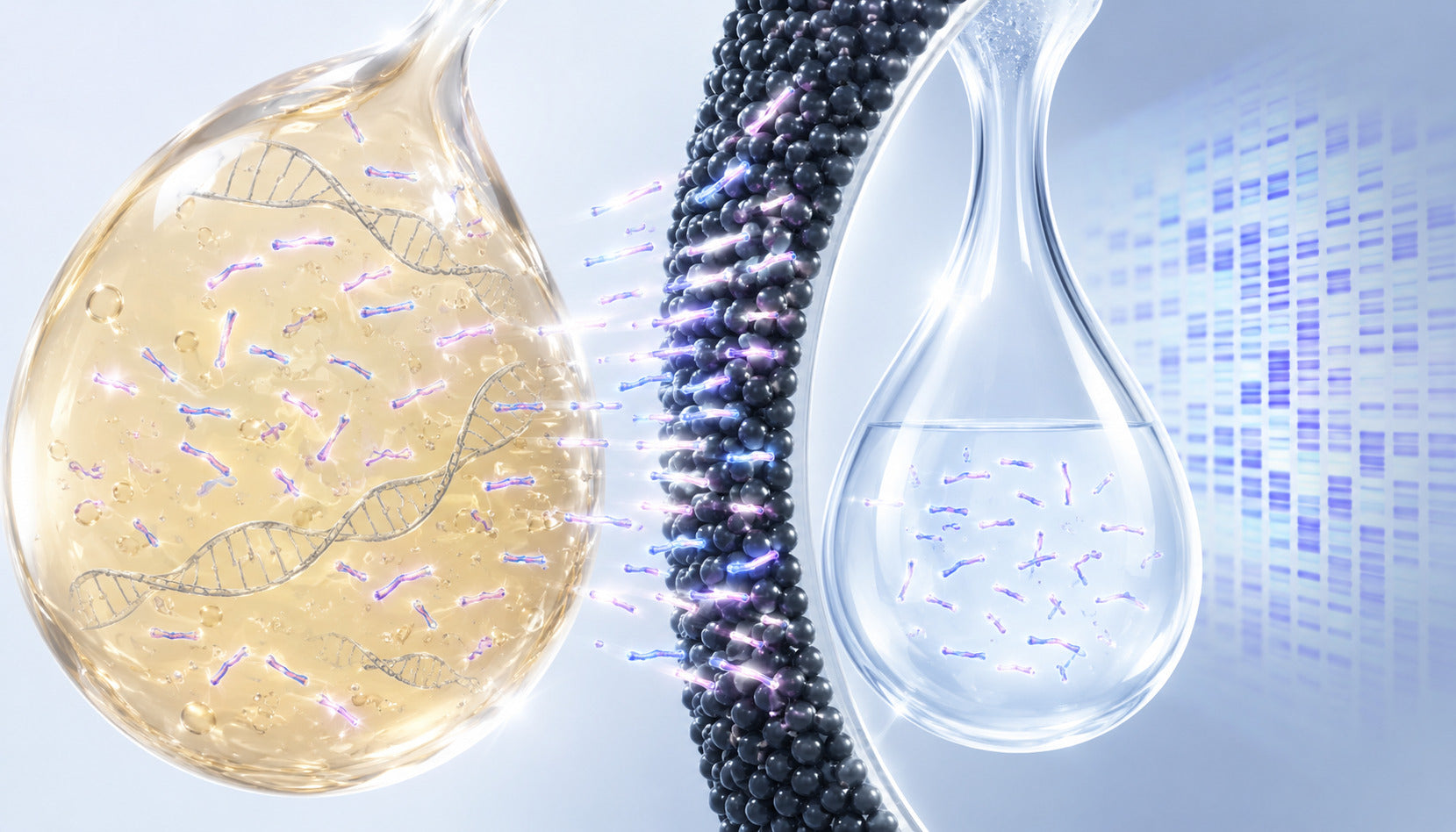
The best plasma cfDNA extraction kit for liquid biopsy and NGS should recover short, low-abundance cell-free DNA from the planned plasma volume while minimizing genomic DNA contamination and PCR or sequencing inhibitors. Before ordering, compare the supported collection tube, plasma input range, purification chemistry, fragment recovery, throughput, automation compatibility and downstream assay requirements. FireGene offers an available magnetic-bead kit for extracting cfDNA from 1–4 mL of EDTA plasma and supported cell-free DNA preservation-tube plasma. The purified material is documented for PCR, qPCR, chip detection and high-throughput sequencing workflows. Match the plasma tube, input volume, sample count and downstream assay before selecting the extraction format.
View or Order the Plasma cfDNA Extraction Kit | Request Bulk Pricing or Technical Guidance
Quick Plasma cfDNA Kit Selection Guide
|
Laboratory requirement |
Feature to prioritize |
Recommended option |
Buyer action |
|
cfDNA extraction from 1–4 mL EDTA plasma |
Large-volume plasma handling and magnetic-bead recovery |
Plasma cfDNA Extraction Kit |
|
|
Plasma collected in a cfDNA preservation tube |
Explicit compatibility with the selected tube |
Confirm the tube against current documentation |
Review specifications or contact support |
|
Liquid-biopsy PCR or qPCR |
Inhibitor removal and reproducible low-input recovery |
Magnetic-bead plasma cfDNA workflow |
Confirm assay input requirements |
|
Targeted NGS or other high-throughput sequencing |
Recovery of short cfDNA with sequencing-compatible purity |
Plasma cfDNA Extraction Kit |
Validate extraction and library QC together |
|
Medium- or high-throughput processing |
Automation and magnetic-separation compatibility |
Workstation-compatible magnetic-bead workflow |
Request instrument guidance |
|
Bulk projects or customized quantities |
Reaction count, batch plan and technical review |
Standard kit plus customized quotation |
Why Plasma cfDNA Requires a Specialized Extraction Kit
Cell-free DNA circulates in plasma as short fragments. In oncology research, the tumor-associated fraction is called circulating tumor DNA, or ctDNA. Total cfDNA can be scarce, while a target variant may represent only a small fraction of it. A genomic DNA kit targets abundant, high-molecular-weight DNA from cells or tissues. A plasma cfDNA kit must capture short fragments from a larger liquid volume while removing amplification and library-preparation inhibitors. Delayed plasma separation or cell disruption can release genomic DNA from blood cells, dilute the cfDNA signal and reduce low-frequency variant sensitivity. Evaluate the full workflow from blood collection through downstream QC.
Seven Factors to Compare Before Buying a Plasma cfDNA Extraction Kit
1. Plasma Type and Collection Tube Compatibility
Record whether the laboratory uses freshly prepared EDTA plasma or plasma from a dedicated cfDNA preservation tube. Follow the tube manufacturer’s handling and centrifugation instructions. The selected extraction kit should explicitly support the planned plasma type. The manufacturer’s documentation identifies EDTA plasma and supported cell-free DNA sample preservation-tube plasma, including examples such as Streck Cell-Free DNA BCT. Confirm the exact tube and protocol version before beginning a study.

2. Supported Plasma Input Volume
Plasma input affects the cfDNA available for analysis. More plasma may improve access to rare molecules but increases reagent, tube-capacity and handling requirements. The available kit is documented for 1–4 mL plasma input. Select a volume that fits the collection protocol, expected cfDNA concentration and downstream assay. If the project uses less than 1 mL, more than 4 mL or multiple pooled aliquots, request technical confirmation rather than assuming the standard workflow can be scaled linearly.
3. Short-Fragment Recovery
Plasma cfDNA is naturally fragmented, with a prominent mononucleosomal population often centered around approximately 160–200 bp. Extraction methods optimized primarily for high-molecular-weight genomic DNA may not provide the short-fragment recovery profile required for every cfDNA assay. Evaluate recovery across the assay-relevant fragment range, especially for targeted mutation panels and methylation analysis. Request current recovery information when fragment representation is critical.
4. Purification Chemistry and Inhibitor Removal
Magnetic beads bind nucleic acids under defined buffer conditions, allowing the captured DNA to move through wash and elution steps. This format can handle liquid samples without relying on repeated high-speed column centrifugation and can be adapted to compatible automated systems.
The Plasma cfDNA Extraction Kit uses magnetic-bead purification with a dedicated buffer system. According to the product documentation, the process does not require phenol or chloroform. Buyers should still follow the current protocol carefully because binding conditions, mixing, wash removal and elution volume can affect recovery and inhibitor carryover.
5. Compatibility with Liquid Biopsy and NGS
An extraction product supplies purified cfDNA; it does not replace library preparation, indexing, target enrichment or sequencing reagents. Its output must meet the chosen downstream method’s input requirements.
Before ordering, record:
- Minimum DNA input for library preparation
- Targeted, whole-genome or methylation workflow
- Required fragment-size profile
- PCR-based or PCR-free library strategy
- Unique molecular identifier requirements
- Sequencing platform and index design
- Expected variant allele frequency and analytical sensitivity
The manufacturer lists conventional PCR, qPCR, chip detection and high-throughput sequencing among the supported downstream applications. Laboratories should validate extraction performance with their own library-preparation chemistry, controls and analysis pipeline.
6. Manual Throughput and Automation
Manual processing suits pilot studies and small batches; larger projects benefit from standardized mixing, magnetic separation and timing. The product is documented as compatible with most automated nucleic-acid extraction instruments, pipetting workstations and magnetic-bar systems. Confirm the exact platform, instrument model, consumable format, sample volume and batch size before implementation.
7. Total Cost Per Usable Sample
Include repeats, controls, collection tubes, consumables, automation plastics, labor and downstream failures in the extraction cost. Low reagent pricing provides little value if recovery is insufficient. Compare representative plasma samples across the expected input range and measure successful libraries or reportable results—not concentration alone. Include controls, repeats and optimization work in bulk quantity calculations.
Magnetic Beads vs Spin Columns for Plasma cfDNA
|
Consideration |
Magnetic-bead workflow |
Spin-column workflow |
|
Plasma-volume handling |
Well suited to scalable liquid handling |
Depends on column capacity |
|
Automation |
Generally easier to automate |
Usually more manual |
|
Centrifugation |
Magnetic separation |
Multiple centrifugation steps |
|
Batch processing |
Suitable for medium or larger batches |
Often suitable for smaller batches |
|
Selection priority |
Instrument compatibility and mixing |
Column capacity and centrifuge access |
Performance depends on the specific kit and validated protocol; purification format alone does not determine cfDNA yield or downstream sequencing success.
Recommended Product: Plasma cfDNA Extraction Kit
The FireGene Plasma cfDNA Extraction Kit (SKU: FG-FG1102D-10rxns) is designed for cell-free DNA extraction from 1–4 mL of EDTA plasma and supported plasma preservation tubes. The currently selectable product format is listed as 10 reactions per kit. The product page currently shows a selectable 10-reaction format, while its specifications also reference 48- and 96-reaction configurations. Confirm the required format and current availability with FireGene before ordering larger quantities.
Product Features to Review
- Magnetic-bead cfDNA purification
- Compatibility with supported plasma collection formats
- Documented 1–4 mL plasma input range
- PCR, qPCR, chip-detection and high-throughput sequencing applications
- Compatibility with manual and supported automated processing
- Proteinase K, magnetic beads, lysis, wash and elution reagents
- Documented 12-month shelf life under the stated storage conditions
Proteinase K and the magnetic-bead suspension are documented for storage at 2–8°C, while other listed components are stored at room temperature. Always use the current manual and product label for storage, reagent preparation and operating instructions.
Ready to establish a plasma cfDNA extraction workflow?
Choose the available 10-reaction kit for evaluation, or provide your plasma volume, sample count, collection tube and automation platform for a customized quotation.
General Plasma cfDNA Extraction Workflow
Exact reagent volumes, incubation conditions and magnetic-separation steps should follow the current manual. A typical workflow includes:
- Collect and process blood. Follow the collection-tube instructions and laboratory SOP for plasma separation.
- Inspect the plasma. Record sample volume, storage history and visible hemolysis or other quality observations.
- Lyse the sample. Combine plasma with the specified lysis reagents and Proteinase K.
- Bind cfDNA to magnetic beads. Mix under the documented conditions to support short-fragment capture.
- Separate and wash the beads. Remove plasma-derived contaminants while retaining bound DNA.
- Elute the cfDNA. Choose the documented elution conditions appropriate for downstream concentration and recovery.
- Perform extraction QC. Quantify the recovered DNA and assess fragment distribution or assay performance as required.
Avoid unnecessary freeze–thaw cycles, standardize processing times, include extraction controls and maintain appropriate pre-PCR/post-PCR separation.
How to Evaluate Extracted cfDNA for NGS
Use a combination of QC measurements matched to the assay:
|
QC question |
Possible measurement |
Why it matters |
|
How much amplifiable cfDNA was recovered? |
Fluorometric quantification or a validated qPCR assay |
Supports library-input decisions |
|
Is genomic DNA contamination present? |
Fragment analysis or long-to-short amplicon assessment |
High-molecular-weight DNA can dilute the cfDNA fraction |
|
Does the fragment profile match expectations? |
Capillary electrophoresis or another validated sizing method |
Helps evaluate short-fragment representation |
|
Are inhibitors affecting amplification? |
Internal amplification control or qPCR performance |
Identifies extraction-related assay suppression |
|
Did library preparation succeed? |
Library yield, size distribution and adapter-dimer assessment |
Connects extraction quality to sequencing readiness |
|
Is sequencing performance acceptable? |
Mapping, duplication, insert-size and coverage metrics |
Measures the final effect of the sample-preparation workflow |
For low-frequency variant studies, extraction efficiency and molecular diversity are more informative than concentration alone. Leukocyte genomic DNA contamination can increase concentration without improving the cfDNA result.

Common Selection Mistakes
Choosing a General Blood DNA Kit
Whole-blood genomic DNA and plasma cfDNA are different targets. A whole-blood kit recovers cellular DNA and should not be substituted for a plasma cfDNA workflow.
Comparing Kits Without Standardizing Plasma Input
Yield comparisons are difficult to interpret when the input volume, tube type, storage time or elution volume changes. Standardize pre-analytical conditions before evaluating recovery.
Assuming Extraction Includes NGS Library Preparation
Extraction produces purified cfDNA. Library construction remains a separate stage and must be selected according to the sequencing platform, assay design and input requirements.
Scaling an Automated Protocol Without Verification
Instrument compatibility does not mean every manual step transfers unchanged. Verify mixing, magnetic capture, residual wash removal, elution and cross-contamination control on the intended workstation.
Ordering Checklist for Liquid Biopsy Research Workflows
Prepare the following information before purchasing or requesting technical guidance:
- Product SKU FG-FG1102D-10rxns
- Plasma type and collection-tube brand
- Plasma input volume per extraction
- Number of samples, controls and expected repeats
- Manual or automated processing method
- Automation platform and batch size
- Downstream PCR, qPCR, chip or NGS application
- Library-input, fragment-range and sensitivity requirements
Review the current product documentation and confirm that the kit’s intended use, sample type and workflow requirements match your laboratory application before ordering.
Review the product’s current intended-use statement before incorporating it into any regulated or clinical workflow.
FAQs:
What is the best cfDNA extraction kit for liquid biopsy?
Choose a kit designed specifically for plasma cfDNA, with a supported plasma-volume range, short-fragment recovery, inhibitor removal and compatibility with the planned downstream assay. For 1–4 mL of supported plasma, the magnetic-bead product featured in this guide provides a commercially available option.
Can plasma cfDNA be used for NGS?
Yes. Purified plasma cfDNA can support targeted sequencing and other validated NGS workflows. The extraction output must meet the library-preparation kit’s DNA input and quality requirements.
How much plasma is needed for cfDNA extraction?
The required volume depends on cfDNA concentration and assay sensitivity. The featured kit documents a 1–4 mL input range; confirm any volume outside that range with technical support.
What is the difference between cfDNA and ctDNA?
cfDNA includes extracellular DNA fragments circulating in plasma. ctDNA is the tumor-associated portion of cfDNA and may represent a small fraction of the total material.
Are magnetic beads suitable for automated cfDNA extraction?
Magnetic-bead chemistry can support automation when the instrument, magnetic separation, liquid volumes and mixing steps are compatible. Validate the exact instrument workflow before routine processing.
Does a cfDNA extraction kit also prepare an NGS library?
No. Extraction isolates and purifies cfDNA; library preparation adds sequencing-compatible adapters and indexes and may include amplification or target enrichment.
Choose the Right Plasma cfDNA Extraction Workflow
A strong cfDNA workflow begins with controlled blood collection and plasma processing, then uses extraction chemistry matched to short, low-abundance DNA. Compare input volume, tube compatibility, recovery, inhibitor removal, automation and downstream assay requirements before ordering. The available magnetic-bead kit provides a practical starting point for laboratories processing 1–4 mL plasma for PCR, qPCR, chip detection or high-throughput sequencing. Pilot representative samples, evaluate extraction and library QC together, and request technical guidance when scaling throughput or using specialized collection conditions.
Start with an available plasma cfDNA extraction format.
Order the 10-reaction kit for workflow evaluation or request project-specific quantity and automation guidance.
View the 10-Reaction Plasma cfDNA Kit | Request Bulk Pricing or Technical Support


