
Choosing the right Tissue dissociation temperature is one of the most important early decisions in sample preparation. For many researchers, the question is simple but highly practical: should tissue be processed at warm or cold temperatures? The answer depends on what matters most in the workflow, including cell yield, preservation of Gene expression, compatibility with Flow cytometry, and the behavior of different Enzyme treatments during dissociation.
Why temperature matters in tissue dissociation
Temperature influences how tissue responds during tissue dissociation. It affects enzyme activity, cellular stress, membrane stability, and the rate of cell separation from the surrounding matrix. Because of this, warm and cold workflows can lead to different results in Cell yield, Gene expression, and downstream assay behavior.
Warm and cold conditions support different priorities.
In simple terms, warm tissue dissociation often supports stronger enzyme activity. It may improve processing efficiency, while cold dissociation is often selected to help preserve more native cellular states and reduce stress-related transcriptional changes.
Why is there no one-size-fits-all answer
The best temperature depends on the experiment. A workflow designed for Flow cytometry may prioritise clean marker retention and viable cells. In contrast, a workflow built for Single-cell gene expression may place greater value on preserving the cells' original transcriptional profile.
Warm tissue dissociation: when it is useful
Warm Tissue dissociation usually relies on active Enzyme treatments at temperatures where enzymes perform efficiently. This approach is common in tissue workflows because it can more effectively degrade the extracellular matrix and facilitate faster cell release.
Benefits of warm enzymatic dissociation
Warm Enzymatic dissociation is often chosen because it may support:
- stronger enzyme performance
- faster tissue breakdown
- Improved cell yield in some tissues
- smoother release of cells from matrix-rich samples
For many laboratories, warm conditions remain a practical choice when the main goal is efficient recovery.
Warm conditions and cell yield
A major reason researchers use warm enzyme treatments is to improve cell yield. When enzymes are working near their preferred temperature range, tissue can dissociate more completely, potentially releasing more cells into suspension.
Warm workflows and downstream use
Warm Enzymatic dissociation can be especially useful when the downstream application values robust recovery, standard tissue digestion, and efficient sample processing. In routine workflows, this can make the protocol easier to reproduce across many samples.
Cold tissue dissociation: when it may be the better choice
Cold Tissue dissociation is often discussed in workflows where preserving native biology is especially important. Researchers interested in Gene expression and Single-cell gene expression may consider cold conditions, as lower temperatures can help reduce stress-induced changes that may occur during processing.
Why cold dissociation is gaining attention
Cold dissociation has attracted greater interest in advanced sample-preparation workflows because tissue handling can influence cell behavior. If processing changes transcriptional activity, that may affect how accurately the final data reflects the original biological state.
Cold conditions and gene expression preservation
One of the biggest reasons to choose cold tissue dissociation is to help preserve more natural Gene expression profiles. In some workflows, this is especially valuable for Single-cell gene expression studies where small shifts in transcription can influence interpretation.
Cold dissociation and cellular stress
Lower temperatures may reduce stress-related responses during sample preparation. This can be helpful when the goal is to maintain a more faithful picture of what cells were doing inside the tissue before processing began.

Warm vs cold tissue dissociation for single-cell gene expression
If the downstream goal is Single-cell gene expression, the temperature decision becomes especially important. Single-cell analysis is highly sensitive to sample-preparation effects, and dissociation conditions can influence the transcriptome before sequencing or profiling even begins.
Why single-cell workflows need extra care
In Single-cell gene expression studies, the aim is often to capture each cell's biology as accurately as possible. Because of this, many researchers pay close attention to dissociation time, temperature, handling speed, and reagent choice.
When cold may have an advantage.
Cold tissue dissociation may be preferred when preserving transcriptional integrity is more important than maximising raw cell yield. In these settings, a slightly more selective recovery may still be valuable if the cells better reflect the original tissue state.
When warm, it may still be useful.
Warm Enzymatic dissociation may still be appropriate in single-cell workflows when the tissue type is difficult to process or when recovery would otherwise be too limited. The decision often comes down to balancing Cell yield with the need to preserve meaningful Gene expression patterns.
Warm vs cold tissue dissociation for flow cytometry
Flow cytometry has its own priorities. Researchers using Flow cytometry often care about viable cells, clean suspensions, preserved surface markers, and reproducible sample handling. Temperature can affect all of these factors.
Why flow cytometry workflows can differ.
Unlike transcriptomics-focused workflows, Flow cytometry may place more emphasis on marker quality, debris reduction, and consistent cell recovery. This means the best dissociation approach may differ from what is ideal for Single-cell gene expression.
Balancing marker preservation and recovery
Warm Enzyme treatments can help produce stronger dissociation and better Cell yield, but the full workflow must also protect markers and cell quality. Cold approaches may help reduce stress, but they must still produce a suspension suitable for accurate Flow cytometry analysis.
Practical takeaway for flow cytometry
For many Flow cytometry experiments, the best answer is the condition that gives a clean, viable, marker-friendly suspension with consistent recovery. In practice, this often requires method optimisation rather than assuming that a single universal temperature is always better.

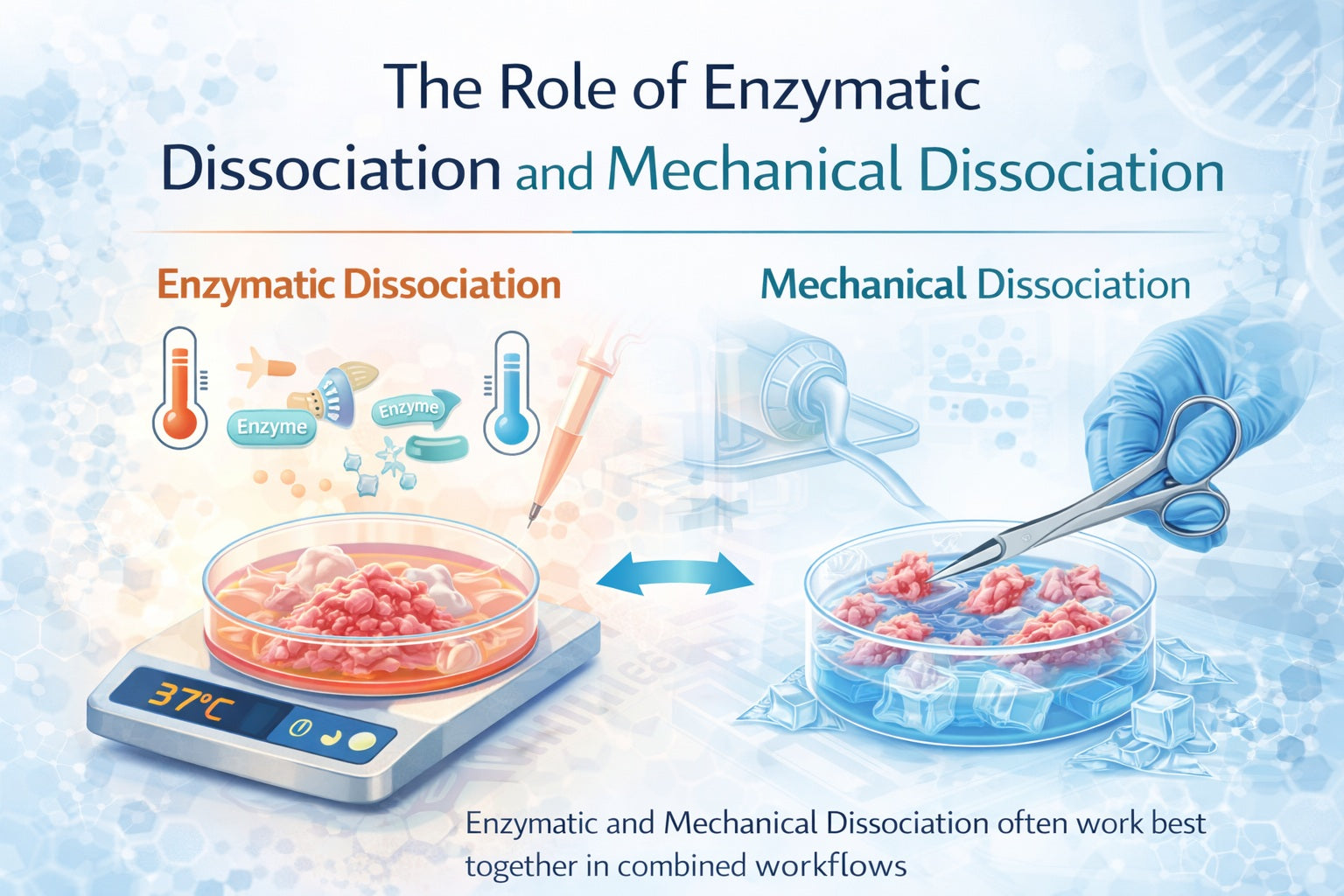
The role of enzymatic dissociation and mechanical dissociation
The warm-versus-cold decision should not be separated from method choice. Enzymatic dissociation and Mechanical dissociation each affect the outcome of Tissue dissociation, and many labs use a combination of both.
Enzymatic dissociation and temperature
Because Enzymatic dissociation depends on active Enzyme treatments, temperature often directly affects performance. Warm conditions usually support enzyme activity more strongly, while cold workflows may use specialised protocols to maintain control over digestion while reducing biological stress.
Mechanical dissociation as a supporting strategy
Mechanical dissociation can help break tissue into smaller pieces and support enzyme access. In some workflows, careful physical disruption improves efficiency without over-relying on digestion alone.
Why combined workflows often work best
In real laboratory practice, tissue dissociation often works best as a balanced system. Researchers may combine Mechanical dissociation with carefully selected Enzyme treatments and optimised temperature control to support the specific needs of the experiment.
How temperature affects cell yield and data quality
The debate is not simply warm versus cold. It is really about which condition gives the right balance between cell yield and data quality.
When cell yield is the top priority
If the main goal is strong recovery from dense or matrix-rich tissue, warm Enzymatic dissociation may be the more practical choice. This can be especially useful when low recovery would limit downstream analysis.
When gene expression fidelity is the top priority
If the main goal is preserving native Gene expression, especially in Single-cell gene expression studies, cold processing may offer meaningful advantages.
Data quality depends on the full workflow.
Temperature matters, but so do timing, tissue type, enzyme selection, cleanup steps, buffer systems, and overall handling consistency. The best results usually come from optimising/optimising the entire sample-preparation workflow rather than focusing on a single factor.
FireGene's relevance to tissue dissociation workflows
This topic aligns well with FireGene because tissue handling is closely tied to the brand's strengths in sample preparation. FireGene supports researchers with tissue dissociation kits, cell-cleanup reagents, cell- and tissue-storage solutions, molecular biology reagents and kits, nucleic acid extraction workflows, life science buffers, and related research tools.
FAQs
Should I use warm or cold tissue dissociation?
It depends on the experiment's goal. Warm Tissue dissociation may support better Cell yield, while cold dissociation may better preserve native Gene expression.
Is warm enzymatic dissociation better for cell yield?
Warm Enzymatic dissociation often supports stronger enzyme performance, which may improve Cell yield in many tissue types.
Is cold tissue dissociation better for single-cell gene expression?
Cold Tissue dissociation may be helpful for Single-cell gene expression because it can reduce stress-related transcriptional changes during processing.
What about flow cytometry?
For Flow cytometry, the best workflow is the one that provides viable cells, clean suspensions, and well-preserved markers. Either warm or cold conditions may work depending on the tissue and protocol.
How do enzyme treatments affect tissue dissociation?
Enzyme treatments help digest the extracellular matrix and support tissue breakdown. Their performance is often influenced by temperature, timing, and sample type.
Can mechanical dissociation be used with enzymatic dissociation?
Yes. Mechanical dissociation is often used alongside Enzymatic dissociation to improve tissue breakdown and support efficient sample preparation.
How does FireGene fit into this topic?
FireGene supports tissue-processing workflows with tissue dissociation kits, cell-cleanup reagents, storage solutions, molecular biology reagents and kits, nucleic acid extraction support, life science buffers, and related sample-preparation tools.
Conclusion
The choice between warm and cold Tissue dissociation is really a choice between workflow priorities. If recovery and digestion efficiency matter most, warm Enzyme treatments may be the best fit. If protecting native Gene expression or supporting Single-cell gene expression is the main goal, cold processing may offer stronger advantages. At the same time, Flow cytometry, Mechanical dissociation, tissue type, and downstream assay design all influence the final answer. The most effective approach is usually the one that has been tested and optimised for the real sample and real experiment.


