
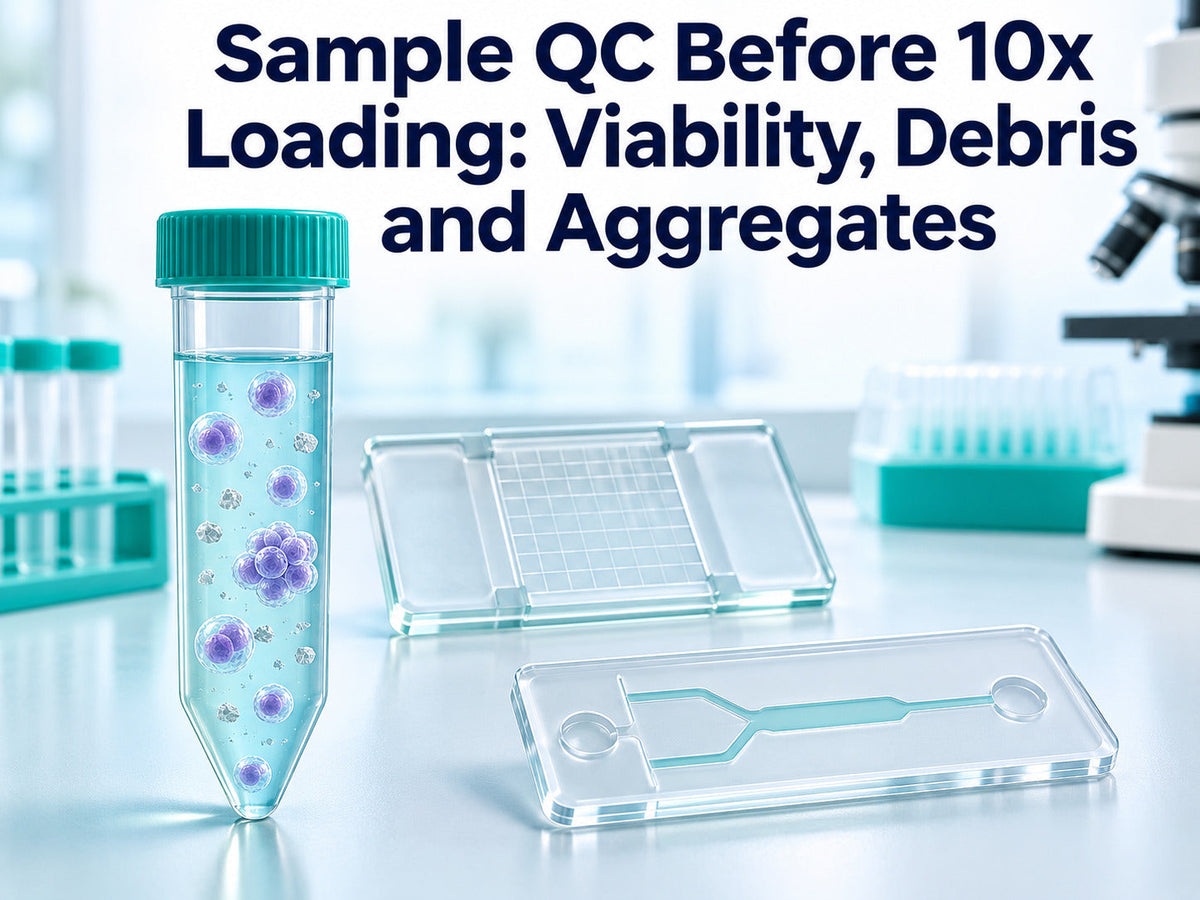
Quick Answer: Before loading a whole-cell suspension onto a 10x Chromium chip, check viability, viable cell concentration, debris, and aggregates. The 10x Genomics Cell Preparation Handbook recommends at least 70% viability, minimal debris, and low levels of aggregates. Confirm the input concentration and loading volume in your assay guide, then recount the final suspension just before loading.
FireGene Cleanup Products for Pre-Loading QC
|
FireGene product |
Catalog number |
Best suited for |
Listed pack size |
Order or inquire |
|
Dead Cell Debris & Impurities Removal Kit |
FG-BA3339-2rxns |
Suspensions that need both dead cell and debris removal |
2 reactions |
|
|
Anti-Clumping Agent for Single-Cell Suspensions |
FG-BA3345-100 |
Suspensions from dissociated animal tissue that need aggregate reduction |
100 mL |
Why Choose FireGene for Single-Cell Sample Cleanup?
FireGene offers a reagent for each of two common cleanup needs. Choose the Dead Cell Debris & Impurities Removal Kit (FG-BA3339) to address non-viable cells and visible debris together. The kit uses density centrifugation to remove dead cells, apoptotic bodies, and debris. Choose the Anti-Clumping Agent (FG-BA3345-100) to reduce aggregates in suspensions from dissociated animal tissue.
Use your baseline QC to choose a reagent for a pilot. After treatment, reassess debris or clumps and record the total viable cell count. If your study depends on a rare population, track its recovery separately. FireGene’s product pages include inquiry forms for pricing, bulk quantities, and evaluation sample requests.
Browse FireGene sample preparation kits
Four QC Metrics to Check Before 10x Chromium Loading
Start single-cell suspension quality control with a baseline measurement that helps you identify any cleanup needs. Repeat the checks on the final preparation you plan to load. Measuring viability and concentration on that same suspension gives you the values you need to calculate loading volume.
|
QC metric |
What to measure |
What a load-ready sample looks like |
How to prepare the sample for loading |
|
Viability |
Percentage of counted cells that are viable |
The 10x handbook recommends at least 70% for whole-cell suspensions. Use the applicable assay and facility criteria. |
Confirm the count and review the total viable-cell yield before selecting cleanup. |
|
Concentration |
Viable cells per µL and total viable cells available |
Final concentration and volume fit your chemistry and intended cell recovery. |
Adjust the concentration using an assay-compatible workflow, then recount. |
|
Debris |
Visible particles and tissue fragments |
Minimal debris, with small cells clearly distinguishable from particles |
Inspect representative fields and choose cleanup based on particle size and abundance. |
|
Aggregates |
Visible clumps and consistency of counts across aliquots |
Low levels of aggregates and repeatable counts |
Address clumps, then reassess the suspension and confirm viable-cell recovery. |
Match concentration to your 10x assay
The 10x Chromium sample requirements vary with the assay and chemistry. For example, the GEM-X Universal 3′ Gene Expression v4 4-plex on-chip multiplexing guide lists an optimal input concentration of 700–1,200 cells/µL for a recovery target of 500–5,000 cells per sample. Use the loading table for your chemistry to determine the volume. For nuclei or fixed-cell workflows, use the QC criteria in the corresponding assay guide.

How to Measure Cell Viability Before scRNA-seq
Trypan blue for suspensions with clear cell boundaries
Trypan blue is a dye-exclusion method. Cells with intact membranes exclude the dye, while cells with compromised membranes take it up and appear blue. Count the stained aliquot using a hemocytometer or compatible brightfield counter. This is a practical choice when individual cells are easy to distinguish and debris is minimal. When you see tissue debris in dissociated samples, inspect the counting field or review the counter images. Small cells can resemble particles, and clumps can make counts vary between fields. Check another aliquot if the first field looks atypical. A repeat count can help you interpret a result close to your viability criterion.
AO/PI for samples with visible debris
Acridine orange and propidium iodide (AO/PI) use fluorescence to classify nucleated cells by membrane integrity. The nuclear signal can help distinguish cells from non-nucleated material when debris complicates a brightfield count. Use a compatible fluorescence counter and review its images if the suspension contains small cells or aggregates. Use the same counting method for matched before-and-after measurements. If trypan blue and AO/PI give different results, review which objects each method classified as cells. Record viability percentage, viable cells per µL, and total viable cells available. Each value tells you something different about sample quality for scRNA-seq.

How to Prepare Your Sample for 10x Loading
1. Assess viability and available cell yield
If the initial count shows low cell viability in a single-cell suspension, check a second aliquot and review how the counter classifies questionable events. Once you confirm the result, calculate the absolute viable-cell yield. Use that number to assess how much viable material is available for cleanup and whether the expected recovery fits your loading target.
Dead cell removal before 10x loading can reduce the number of non-viable cells entering the assay. Dead and dying cells can release transcripts that contribute to ambient RNA. Check how many viable cells you recover after cleanup and evaluate ambient RNA from dead cells as part of sequencing QC. A higher viability percentage is most useful when you also know how many viable cells remain.
2. Bring viable cell concentration into the loading range
If the suspension is too concentrated, dilute it using a buffer compatible with your assay. If it is too dilute, consider a compatible concentration step and measure recovery afterward. Recount the suspension after either adjustment. Verify the units and dilution factor before using the viable cell count before loading to calculate loading volume.
Concentration tells you how many viable cells are available per microliter. Yield tells you how many viable cells are available in the entire recovered volume. Record both during single-cell RNA sequencing sample preparation. If the total viable-cell yield is limited, check whether a lower recovery target fits your experiment and assay guide.
3. Clear visible tissue debris
To check for debris before 10x loading, inspect several representative fields and review what the counter includes as cells. Cell debris in single-cell suspensions can resemble small cells, producing inaccurate cell counts. Confirm that the counting method distinguishes the two before you use the result to calculate loading volume. For debris removal before scRNA-seq, match the approach to the material you see. Single-cell suspension filtration can help with larger fragments and clumps. An assay-compatible wash may help with some smaller particles. If you’re choosing a debris removal kit for single-cell prep, check which sample types and materials the product is designed to handle.
If the suspension contains both visible debris and a substantial number of non-viable cells, a dead cell and debris removal kit gives you a combined cleanup option. After treatment, document the remaining debris, viable-cell concentration, and total viable-cell yield. Those measurements tell you whether the recovered suspension fits your loading plan.
4. Reduce aggregates and improve count consistency
Inspect multiple aliquots to see how consistently clumps appear. Reducing aggregates can help you obtain more consistent counts and prepare the suspension for chip loading. If you use filtration for oversized clumps, inspect the recovered suspension for larger cells that matter to your study. For suspensions from dissociated animal tissue where aggregation is the primary concern, consider the FireGene Anti-Clumping Agent. After treatment, inspect for remaining clumps and measure final viability, viable-cell concentration, and total viable cells. Use those results to complete your sample QC before 10x loading.

Printable Single-Cell Sample QC Checklist
Sample ID ____________________ Date ____________________
Sample type __________________ Operator ________________
10x assay and chemistry _____________________________________
Target cell recovery ___________ Counting method ___________
|
QC check |
Record your result |
Ready |
|
Viability |
Measured ______% · Assay or facility criterion ______% |
☐ |
|
Viable cell concentration |
Measured ______ cells/µL · Assay input range ______ cells/µL |
☐ |
|
Total viable cells available |
Recovered volume ______ µL · Total viable cells ______ |
☐ |
|
Debris |
Acceptable ☐ · Cleanup or review planned ☐ |
☐ |
|
Aggregates |
Acceptable ☐ · Cleanup or review planned ☐ |
☐ |
|
Final loading volume |
______ µL · Verified against assay guide ☐ |
☐ |
|
Final recount |
Time ______ · Viability ______% · Viable cells/µL ______ |
☐ |
Cleanup performed _____________________________________________
Final decision ☐ Load ☐ Clean up and recheck ☐ Review before loading

FAQs
What is the minimum cell viability for 10x scRNA-seq?
The 10x Genomics Cell Preparation Handbook recommends at least 70% viability for whole-cell suspensions. Use this viability threshold for single-cell RNA sequencing alongside the instructions for your chemistry and any sequencing core acceptance criteria. Complete the loading decision by checking concentration, visible debris, and aggregates.
What else should you check when viability is high?
Check for visible debris and clumps, then measure viable cell count and concentration. Compare those measurements with your assay’s input requirements and planned recovery target. A high viability percentage tells you the proportion of viable cells. The total viable cell count tells you how many you can load.
Should you recount cells after filtration or cleanup?
Yes. Filtration and cleanup can change both the number of cells recovered and their concentration. Recount the processed suspension and record its available volume. Use those measurements to calculate loading volume. The 10x Genomics sample preparation guidance also recommends recounting just before chip loading.
Which viability method should you use for a debris-heavy sample?
AO/PI can help distinguish nucleated cells from non-nucleated material when debris complicates a brightfield count. Review the counter images to see how small cells and clumps are classified. For a before-and-after comparison, use the same counting method for both measurements.
Can you use the same QC checklist for nuclei?
Yes. You can use the checklist structure to record nuclear integrity, debris, aggregates, and nuclei concentration. Use the acceptance criteria and loading range in your nuclei assay guide. The whole-cell viability recommendation and the nuclei integrity check apply to their respective sample types.
References
- 10x Genomics. Cell Preparation for Single Cell Protocols. Handbook CG00053, Rev D.
- 10x Genomics. Guidelines for Accurate Target Cell Counts Using 10x Genomics Single Cell Solutions. Technical Note CG000091, Rev B.
- 10x Genomics. GEM-X Universal 3′ Gene Expression v4 4-plex On-chip Multiplexing User Guide. CG000768, Rev B.
- Assessment and Comparison of Viability Assays for Cellular Products.
- Determination of Cell Viability—Acridine Orange/Propidium Iodide (AO/PI) Staining Method.
Request a FireGene Sample Preparation Quote
Share your tissue type, starting viability, debris or aggregate burden, downstream assay, and number of samples. Include the viable-cell yield you need after cleanup and any cell population you plan to track.
Request a quote for the Dead Cell Debris & Impurities Removal Kit · Inquire about the Anti-Clumping Agent


