
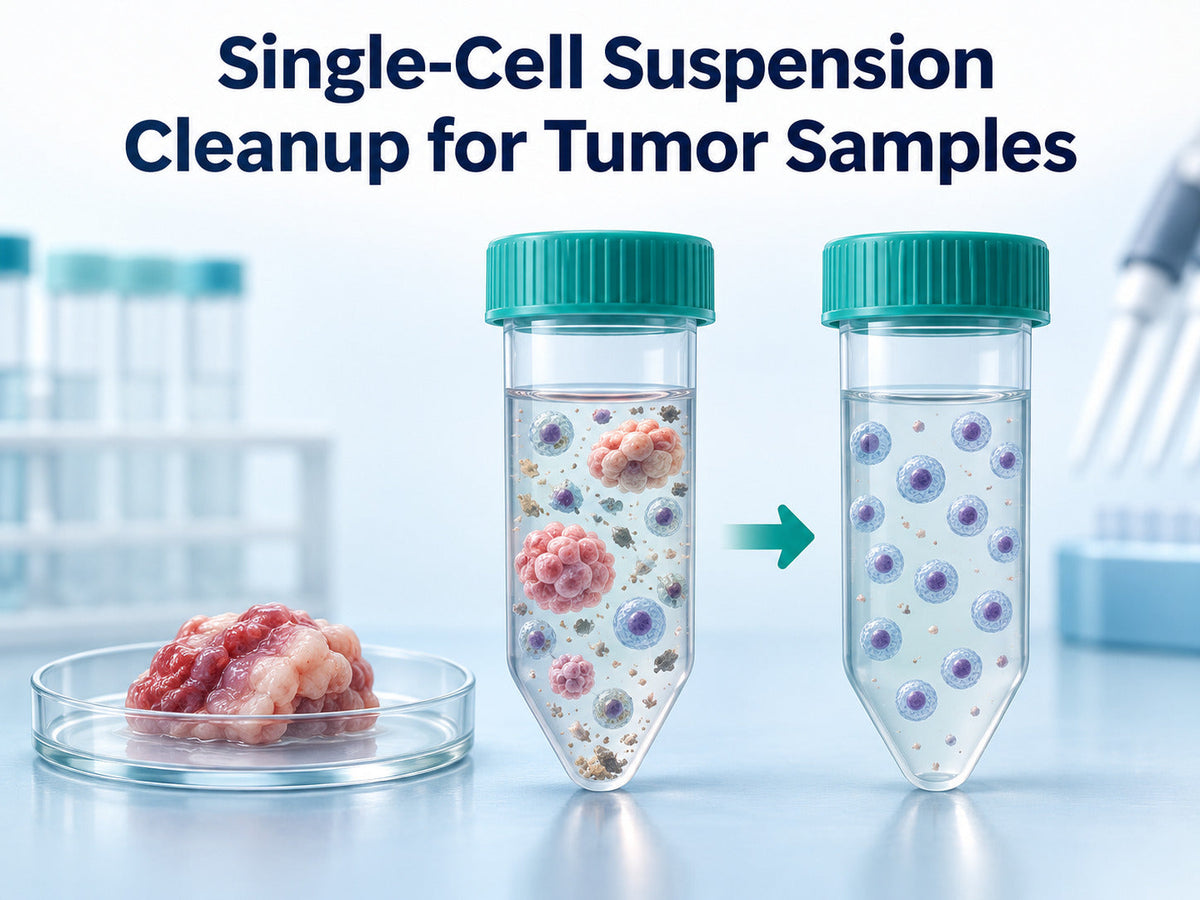
Quick answer. Start tumor single-cell suspension cleanup by checking viability, debris, clumps, and red blood cells after dissociation. Consider RBC lysis when erythrocytes interfere with the assay and density-based cleanup when dead cells and debris coexist. Before loading, confirm that the suspension meets your assay requirements and contains enough viable tumor and immune cells.
The FireGene Tumor Dissociation and Cleanup Kit Catalog
|
Product |
Catalog number |
Starting material |
When to choose it |
Order |
|
Tumor Dissociation Kit |
FG-BA3320 |
Solid tumor tissue |
Prepare a single-cell suspension for counting, cleanup, or downstream profiling. |
|
|
Dead Cell Debris & Impurities Removal Kit |
FG-BA3339 |
An existing suspension from dissociated mammalian tissue |
Evaluate combined removal of dead cells and debris after dissociation. |
Both product pages display a 2-reaction option. Ask for pack availability and the applicable instructions when planning a larger study. For Research Use Only. firegene.com
Why Choose FireGene for Tumor Dissociation and Single-Cell Suspension Cleanup?
Choose FG-BA3320 when you start with solid tumor tissue and need a single-cell suspension. Consider FG-BA3339 when that suspension contains both dead cells and debris. The FireGene dead cell debris removal kit uses density separation to recover a live-cell fraction. firegene.com For a tumor microenvironment study, compare matched aliquots before and after cleanup. Check overall viability and the absolute number of viable tumor and immune cells you retain. Use those results to decide whether to include cleanup in the full study and how many reactions to order.
View the Tumor Dissociation Kit · View the Dead Cell and Debris Removal Kit · Request a quote
Why Are Tumor Suspensions Hard to Clean?
Two specimens from the same tumor can yield different suspensions. A viable region may release mostly intact cells, while a nearby necrotic region contributes damaged cells and fragments. During tumor biopsy single-cell preparation, record the sampled region and visible necrosis so you can interpret differences in recovery across specimens. Necrotic debris in tumor cell suspensions can include fragments from disrupted cells and residual tissue. Dense stroma can contribute tissue fragments and cell clumps in tumor single-cell suspensions. Blood-rich specimens can carry red blood cells into the preparation. Identify which of these problems is affecting counting or sample handling before choosing a cleanup method.
|
Main finding |
Why it matters |
What to evaluate |
|
Dead or dying cells |
A low viable fraction reduces the number of cells available for loading. |
Dead cell depletion and the absolute viable count afterward |
|
Necrotic fragments and extracellular debris |
Particles can complicate counting and inspection. |
Whether debris removal improves sample quality while retaining target cells |
|
Stromal fragments and cell aggregates |
Larger particles can interfere with counting or single-cell capture. |
Whether filtration suits the size of the cells you need to retain |
|
Red blood cells |
Erythrocytes can complicate counting and add unwanted material. |
Whether optional RBC lysis improves assessment of nucleated cells |
When several problems are present, record where each one first appears. Clumps visible immediately after dissociation and clumps that appear during later handling point to different stages to review. That distinction helps you choose where to intervene during tumor cell suspension cleanup.

How Do Low-Quality Cells Skew Tumor scRNA-seq Data?
Damaged cells can release transcripts into the suspension. This contributes to ambient RNA in tumor scRNA-seq. For example, a tumor-associated transcript detected at low levels in an immune-cell profile may come from background RNA. Check whether the broader expression profile supports the assigned cell identity. Sample quality also affects the proportions you report. Fragile cells can be lost during preparation, and computational QC can remove compromised profiles. Aggregates can contribute to multiplets, where one barcode represents material from more than one cell. Inspect the suspension before loading and review population representation in the pilot dataset.
If your question concerns tumor-infiltrating lymphocytes, a higher overall viability percentage tells you only part of the story. You still need enough viable lymphocytes for the planned comparison. You may also need tumor and stromal cells from the same specimen to interpret the surrounding microenvironment.

How Should You Plan Post-Dissociation Cleanup for Tumor Samples?
Use the sequence storage → dissociation → optional RBC lysis → targeted cleanup → QC. Set the downstream assay requirements before your pilot. Then use the observations at each stage to decide which handling steps your sample needs.
1. Record Storage and Transport Conditions
For solid tumor sample preparation for scRNA-seq, record the interval between collection and processing, the preservation method, and the tissue region sampled. Follow your study’s specimen handling plan. If samples arrive at different times, record those differences so you can assess whether they track with viability or population recovery.
2. Assess the Suspension After Dissociation
Choose a method for tumor tissue dissociation for single-cell sequencing that suits your specimen and endpoint. Inspect the resulting tumor tissue single-cell suspension for intact cells, clumps, and residual fragments. Establish a baseline count and viability for the dissociated tumor cells before adding optional cleanup. This shows what the dissociation stage delivered.
3. Use RBC Lysis When Erythrocytes Interfere
Check whether red blood cells are abundant enough to interfere with counting or downstream analysis. If RBC lysis serves your workflow, use a method compatible with the planned assay and check nucleated cell recovery afterward. A count between RBC lysis and subsequent cleanup helps you identify which step changed recovery.
4. Choose Cleanup Based on the Material You Need to Remove
Dead cell removal from tumor samples and cell debris removal from tumor samples address different problems. Consider combined dead cell and debris removal from tumor suspensions when both are present. If intact non-viable cells dominate and debris is minimal, evaluate targeted depletion. If aggregates dominate, assess filtration with the size of your target cells in mind.
5. Check the Final Suspension Before Loading
Measure tumor cell viability before scRNA-seq loading and check tumor cell concentration before loading against your sequencing core’s criteria. Record the final volume and viable cell count after cleanup. For mixed specimens, specify whether the count represents all viable nucleated cells or an identified tumor-cell fraction.

Which Cleanup Method Fits Your Tumor Sample?
Density-based cleanup for tumor cell suspensions is an option when you need to address dead cells and fragments together. Magnetic dead cell depletion from tumor samples can suit a preparation in which intact dead cells are the main issue. Compare both approaches using the same recovery and sample quality measurements.
|
Approach |
When to evaluate it |
What to check afterward |
|
Density-based single-cell suspension purification |
The suspension contains both dead cells and visible debris. |
Viable yield, residual debris, and recovery of fragile populations |
|
Magnetic depletion |
You need dead cell removal from dissociated tumor tissue and have a compatible labeling and separation system. |
Recovery of viable cells and any particulate debris remaining |
|
Filtration |
Large aggregates or residual tissue dominate the preparation. |
Recovery of larger target cells and remaining clumps |
|
Routine QC and direct loading |
The suspension already meets your assay’s requirements. |
Viability, concentration, and sufficient cells for the planned run |
The removal of non-viable tumor cells can raise the live-cell percentage. If apoptotic cell removal is a study objective, define how you will identify those cells and assess what remains. Inspect extracellular debris in single-cell suspensions separately, since each measurement describes a different aspect of sample quality. When comparing a dead cell and debris removal kit for tumor samples with a dead cell removal solution for tumor suspensions, match the product to the material you need to remove. Compare viable target-cell recovery on representative samples before selecting single-cell suspension cleanup reagents for the full cohort.
Browse single-cell suspension cleanup reagents
How Do You Protect Rare Immune Cells During Cleanup?
Define the immune populations your study needs before selecting a cleanup method. If a rare lymphocyte or myeloid subset drives the experiment, track it separately from bulk viability. Compare matched aliquots where tissue permits, using the same criteria to identify the population before and after treatment. Report both the absolute count and the proportion of the target population. Suppose an aliquot starts with 1,000 viable target immune cells among 100,000 viable cells. After cleanup, it contains 750 target cells among 50,000 viable cells. The target population rises from 1% to 1.5% of the sample, while its absolute count falls. This illustrative example shows why target-cell recovery after cleanup needs its own measurement.
|
Checkpoint |
What to record |
What it tells you |
|
After dissociation |
Total viable cells and estimated viable target cells |
What the tissue preparation released |
|
After each optional step |
Final volume, viable count, and target-cell count |
Viable cell recovery after tumor sample cleanup and where losses occurred |
|
After pilot sequencing |
Annotated tumor, immune, and stromal cells by specimen |
Which populations are represented after capture and analysis |
For tumor cell suspension cleanup for flow cytometry, assess target-cell recovery with a panel suited to the tumor type and study question. For scRNA-seq, review population representation in the pilot dataset. Together, these checks help establish whether live cell enrichment from tumor suspensions supports your endpoint.

What Can Colorectal and Renal Tumor Samples Teach You?
A 10x Genomics demonstrated protocol includes dissociated colorectal cancer and clear cell renal carcinoma samples as dead cell removal examples. For colorectal tumor cell suspension cleanup, record the sampled region and visible debris. For renal tumor cell suspension cleanup, document blood carryover and check nucleated cell recovery if you include RBC lysis. Use these examples to inform a pilot for your specific specimen.
If tumor types in your cohort consistently need different handling, record the preparation and cleanup decisions with each sample. Review those differences before comparing cell proportions between groups. For instance, if a group has more necrotic tissue and receives more cleanup, both tissue condition and processing can influence which cells appear in the dataset.
Frequently Asked Questions
When Should You Use Dead Cell Removal for Tumor scRNA-seq?
Consider it when the non-viable fraction interferes with sample assessment or makes the suspension unsuitable for loading. Check the starting viable count first. After cleanup, measure how many viable cells remain and whether the tumor or immune population you need is adequately represented.
Does Tumor Sample Cleanup Remove Ambient RNA?
Removing damaged cells can reduce a source of additional ambient RNA. RNA already released into the suspension may still contribute to background. Review unexpected marker expression in the context of the full cell profile, particularly when annotating rare populations.
Can You Skip Cleanup for a Small Tumor Biopsy?
Yes. Proceed after routine QC when the suspension meets your assay’s intake criteria and contains enough viable cells for the run. When tissue is limited, weigh the expected improvement in suspension quality against the number of target cells you need to retain.
Should You Use RBC Lysis on Every Tumor Sample?
Base the decision on observed erythrocyte carryover and its effect on the assay. If you use RBC lysis followed by density-based cleanup, check nucleated cell counts between the two steps. That gives you a separate recovery measurement for each intervention.
What Should You Include When Requesting a Kit Quote?
Share the tumor type, tissue format, sample count, estimated starting cell numbers, and downstream assay. Include any rare immune populations you need to retain and whether you plan to test matched aliquots. These details help determine the kit and reaction count to request.
References
- Preparation of a Single-Cell Suspension from Tumor Biopsy Samples for Single-Cell RNA Sequencing. PMID 37770788.
- Dead Cell Removal. 10x Genomics demonstrated protocol, CG000093.
- O’Flanagan et al. Dissociation of solid tumor tissues with cold active protease for single-cell RNA-seq minimizes conserved collagenase-associated stress responses. Genome Biology, 2019. DOI 10.1186/s13059-019-1830-0.
- Dead Cell Removal Kit. Miltenyi Biotec technical documentation, order no. 130-090-101.
- Dead Cell Debris and Impurities Removal Kit. Manufacturer user manual, FG-BA3339.
Order Reagents for Your Tumor Cleanup Pilot
Choose FG-BA3320 to prepare a suspension from solid tumor tissue. Include FG-BA3339 when your pilot needs to evaluate combined dead cell and debris removal. Share your specimen type, sample count, and target populations when requesting a quote.
Shop the Tumor Dissociation Kit · Shop the Dead Cell Debris Removal Kit · Request a quote


