
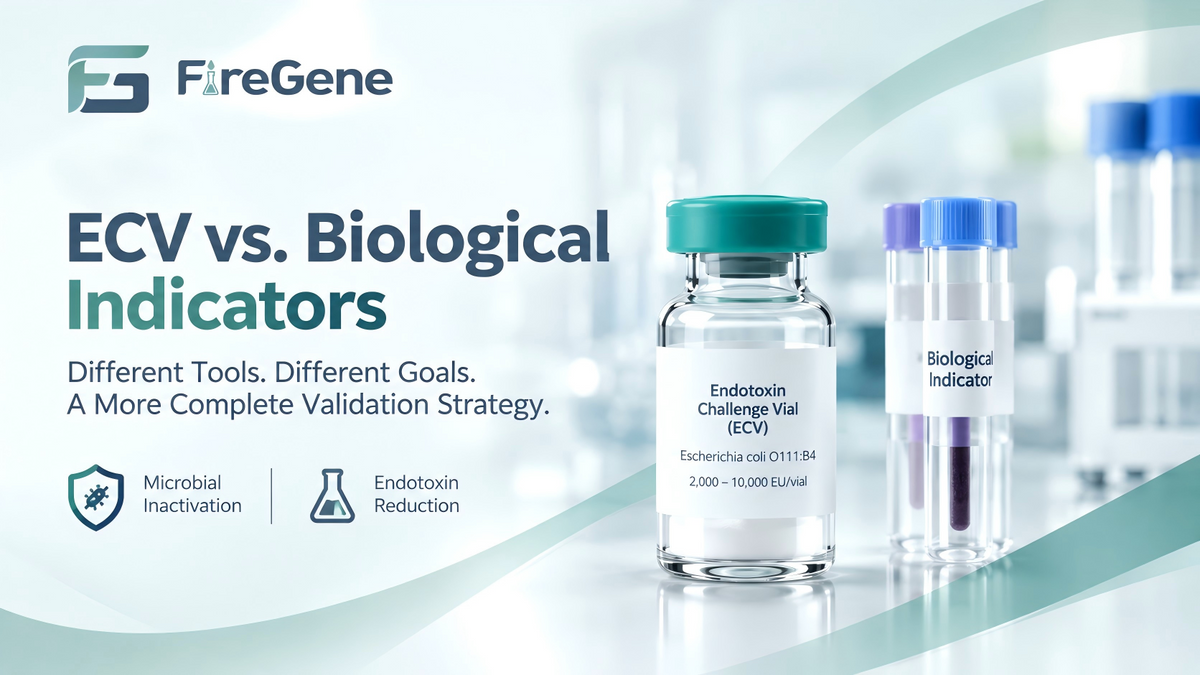
A dry-heat depyrogenation process must demonstrate that it achieves the intended reduction in endotoxin activity under defined conditions. Temperature and exposure time are important process parameters, but they do not independently quantify the reduction in endotoxin activity.
Endotoxin Challenge Vials (ECVs) provide a defined challenge for evaluating process performance. By measuring endotoxin activity before and after heat treatment, laboratories can calculate a log reduction value (LRV) and compare the result with predefined acceptance criteria.
I. What Is a Log Reduction Value?
A log reduction value expresses the decrease in measured endotoxin activity on a base-10 logarithmic scale.
The formula is:
LRV = log10 (Initial endotoxin activity / Residual endotoxin activity)
The initial activity is the appropriate baseline established for the study. The residual activity is the measured activity remaining after processing.
Both values must use a comparable measurement basis, such as EU/vial. If results are initially expressed in different units or volumes, the appropriate conversions must be completed before calculating the ratio.
II. What Does a 3-Log Reduction Mean?
A 3-log reduction represents a 1,000-fold decrease in measured endotoxin activity.
The corresponding percentage reductions are:
-
1-log reduction = 90% reduction.
-
2-log reduction = 99% reduction.
-
3-log reduction = 99.9% reduction.
A 3-log reduction is a commonly used benchmark for depyrogenation validation. However, it should not be treated as a universal acceptance criterion for every process or application. The applicable criterion must be defined in the approved validation protocol and evaluated against relevant regulatory and compendial requirements.
III. Worked Example: Calculating a 3-Log Reduction
Consider the following hypothetical results:
-
Initial endotoxin activity: 5,000 EU/vial
-
Residual endotoxin activity: 5 EU/vial
Step 1: Calculate the ratio.
5,000 / 5 = 1,000
Step 2: Calculate the log reduction.
LRV = log10 (1,000) = 3
Step 3: Calculate the percentage reduction.
Percent reduction = (1 - Residual activity / Initial activity) × 100%
Percent reduction = (1 - 5 / 5,000) × 100% = 99.9%
The calculated result is a 3-log reduction, equivalent to a 99.9% decrease in measured endotoxin activity.
This example assumes that the initial and residual values have been established on the same measurement basis. Actual studies must use the calculation method specified in the approved protocol.
IV. Why the Initial Value Matters
The initial value is critical because it determines the baseline against which the final result is evaluated.
The nominal potency printed in a product specification may not be identical to the activity recovered during an individual study. Reconstitution, handling, sample recovery, and analytical variability can affect the measured result.
The FireGene Endotoxin Challenge Vial has a listed potency range of 2,000–10,000 EU/vial for the specified product. For actual validation work, consult the applicable lot documentation and follow the approved procedure for establishing the initial value.
Do not automatically use the midpoint of a product's potency range as the initial activity.
V. Why Analytical Sensitivity Matters
For an initial activity of 5,000 EU/vial, a 3-log reduction corresponds to a residual activity of 5 EU/vial.
The analytical method must be capable of supporting the required conclusion at this residual level after accounting for reconstitution volume, dilution factors, recovery, and the method's validated working range.
A result below the detection or quantification limit must not automatically be treated as zero. If the analytical method cannot substantiate the required reduction, the result must be interpreted according to the predefined study procedure.
The FireGene Kinetic Chromogenic Endotoxin Test Kit provides quantitative endotoxin measurements within its specified working range. Its suitability for an ECV validation study must be established for the actual sample preparation, expected residual activity, and validation requirements.
VI. Common Calculation Errors to Avoid
Comparing incompatible units
Do not compare EU/mL directly with EU/vial without converting the results to a common basis.
Using an unsupported initial value
Follow the protocol's approach to assigned potency, untreated-control recovery, or another justified baseline.
Treating an undetectable result as zero
A result below the detection limit does not establish that no endotoxin activity remains.
Ignoring recovery and dilution factors
Incomplete recovery or incorrect dilution calculations can distort the calculated reduction.
Changing acceptance criteria after testing
Acceptance criteria should be established before the study and should not be changed retrospectively to make an unsuccessful result appear acceptable.
VII. Documenting the Validation Result
A traceable validation record should include the ECV product and lot, the basis for the initial activity, untreated-control results, equipment and cycle parameters, ECV placement, sample preparation, analytical method, dilution calculations, raw data, and final LRV.
The report should also explain how results below analytical limits were handled and whether the predefined acceptance criteria were met.
For additional technical context, consult USP General Chapter 1228.5: Endotoxin Indicators for Depyrogenation.
VIII. Frequently Asked Questions
Is a 3-log reduction equivalent to 99.9% reduction?
Yes. Mathematically, a 3-log reduction represents a 1,000-fold decrease, equivalent to a 99.9% reduction.
Can I always use the ECV's nominal potency as the initial value?
Not automatically. The applicable protocol must define how the initial value is established.
What if the residual result is below the detection limit?
Interpret it according to the validated analytical procedure and predefined calculation rules. Do not automatically report zero.
Does a 3-log result alone prove that the process is validated?
No. The result must be considered alongside the study design, equipment conditions, challenge placement, controls, analytical suitability, and applicable acceptance criteria.
Conclusion
Calculating endotoxin log reduction is mathematically straightforward, but a defensible validation result depends on reliable measurements and an appropriate study design.
By combining suitable ECVs, a validated analytical method, and predefined acceptance criteria, laboratories can generate meaningful evidence of dry-heat depyrogenation performance.
Explore the FireGene Endotoxin Challenge Vial and the FireGene Kinetic Chromogenic Endotoxin Test Kit for relevant product information.
FireGene Endotoxin Testing
Ready to run your endotoxin assay?
FireGene offers a complete endotoxin testing toolkit — from TAL reagents and CSE standards to pyrogen-free consumables and LAL reagent water. All products are aligned with USP <85>, EP 2.6.14, and JP 4.01.


