
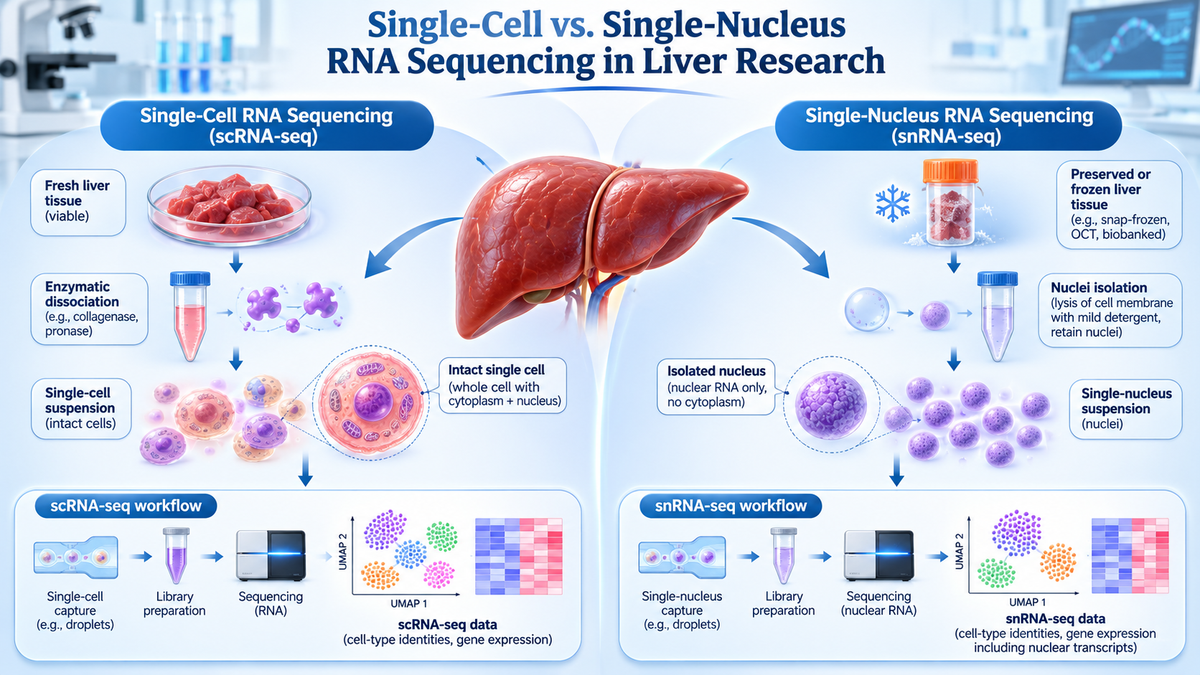
Single-cell RNA sequencing (scRNA-seq) and single-nucleus RNA sequencing (snRNA-seq) have become essential technologies for investigating cellular heterogeneity, transcriptional regulation, and disease-associated molecular changes in liver tissue. Although both techniques provide high-resolution transcriptomic information, they differ in sample preparation, RNA capture, cell-type representation, and susceptibility to experimental artifacts. scRNA-seq analyzes RNA from intact cells and is particularly useful for profiling viable hepatic and immune cell populations, whereas snRNA-seq examines nuclear transcripts and offers advantages for frozen or difficult-to-dissociate tissues. This article compares the principles, technical considerations, strengths, and limitations of both approaches, providing practical guidance for selecting appropriate methods in hepatic biology and liver disease research.
1. Introduction
The liver is a heterogeneous organ composed of hepatocytes, Kupffer cells, hepatic stellate cells, liver sinusoidal endothelial cells (LSECs), cholangiocytes, and multiple immune cell populations.
Understanding interactions among these populations is essential for investigating liver metabolism, inflammation, fibrosis, regeneration, and cancer.
Traditional bulk RNA sequencing measures average gene expression across mixed cell populations, potentially obscuring differences between individual cell types.
Single-cell and single-nucleus transcriptomic technologies overcome this limitation by enabling molecular characterization at cellular or nuclear resolution.
However, selecting an appropriate sequencing method remains challenging.
The two technologies differ substantially in their sample preparation requirements and the biological information they capture.
For liver research, these distinctions are particularly important because hepatic cell populations vary in size, fragility, density, and sensitivity to tissue processing.
Therefore, understanding the differences between scRNA-seq and snRNA-seq is critical for designing reliable hepatic transcriptomic studies.
2. What Is Single-Cell RNA Sequencing (scRNA-seq)?
Single-cell RNA sequencing measures gene expression from individual cells, allowing researchers to identify cellular populations and investigate transcriptional heterogeneity.
2.1 Basic Workflow
A conventional liver scRNA-seq workflow generally includes:
Collection of fresh liver tissue
Enzymatic and mechanical tissue dissociation
Preparation of a single-cell suspension
Cell filtration and quality assessment
Single-cell capture and library preparation
Sequencing and bioinformatics analysis
During library preparation, individual cells are isolated using droplet-based microfluidics, microwells, or other capture technologies.
Following cell lysis, RNA molecules are captured, converted into complementary DNA, and prepared for sequencing.
2.2 Advantages of scRNA-seq
Whole-cell transcriptome sampling: scRNA-seq can capture both cytoplasmic and nuclear RNA molecules, depending on the assay chemistry.
Immune cell characterization: The approach is particularly useful for investigating liver-associated immune populations, including T cells, B cells, natural killer cells, and macrophages.
Cellular activation studies: scRNA-seq supports analysis of inflammatory responses, immune signaling, and cellular state transitions.
Compatibility with additional assays: Certain single-cell platforms support simultaneous characterization of gene expression and cell-surface proteins.
2.3 Limitations of scRNA-seq
The principal limitation in liver research is the requirement to obtain an adequate suspension of intact cells.
Hepatocytes are relatively large and mechanically sensitive, making them vulnerable to damage during digestion, filtration, and centrifugation.
Tissue dissociation can also induce stress-associated transcriptional changes.
Furthermore, cellular populations may be recovered at different efficiencies, introducing biases into downstream analysis.
3. What Is Single-Nucleus RNA Sequencing (snRNA-seq)?
Single-nucleus RNA sequencing measures transcripts associated with individual cell nuclei rather than intact cells.
Instead of separating living cells from tissue, researchers disrupt cellular membranes under controlled conditions to release nuclei.
3.1 Basic Workflow
A typical snRNA-seq workflow involves:
Collection and preservation of liver tissue
Controlled tissue homogenization
Nuclear membrane-preserving cell lysis
Nuclei isolation and purification
Nuclear quality assessment
Single-nucleus capture and RNA sequencing
Unlike conventional fresh-cell scRNA-seq, snRNA-seq can often be performed using properly preserved frozen tissue.
The method largely avoids the need for prolonged enzymatic dissociation of intact liver cells.
3.2 Advantages of snRNA-seq
Frozen tissue compatibility: snRNA-seq is valuable for biobanked and archived frozen samples that are unsuitable for conventional viable-cell sequencing.
Reduced enzymatic dissociation artifacts: Nuclear isolation can avoid some transcriptional stress responses associated with extended whole-cell dissociation.
Profiling fragile cells: Nuclei can be recovered from cell populations that are difficult to isolate intact.
Hepatocyte characterization: snRNA-seq may improve the representation or transcriptional characterization of hepatocyte subpopulations in certain liver studies.
3.3 Limitations of snRNA-seq
Because snRNA-seq primarily captures nuclear RNA, cytoplasmic transcripts may be less abundant or absent.
The resulting expression profiles may contain a greater proportion of unspliced or intronic RNA reads.
Some immune populations may also be underrepresented or less clearly resolved compared with scRNA-seq.
Furthermore, nuclei preparation introduces its own technical challenges, including nuclear damage, aggregation, and contamination by cellular debris.
4. scRNA-seq vs. snRNA-seq: A Technical Comparison
|
Feature |
scRNA-seq |
snRNA-seq |
|
Analyzed material |
Intact individual cells |
Isolated cell nuclei |
|
Sample preparation |
Tissue dissociation and cell isolation |
Tissue homogenization and nuclei extraction |
|
Typical sample type |
Fresh viable tissue |
Fresh or appropriately frozen tissue |
|
RNA captured |
Nuclear and cytoplasmic transcripts |
Primarily nuclear transcripts |
|
Hepatocyte recovery |
Sensitive to cell damage and size-related losses |
Can improve representation in some workflows |
|
Immune cell profiling |
Often favorable |
May show reduced immune-cell representation |
|
Dissociation-related stress |
Potentially significant |
Generally reduced, but not eliminated |
|
Major quality concerns |
Cell viability, debris, aggregation |
Nuclear integrity, debris, nuclear aggregates |
|
Typical applications |
Immunology, cellular activation, cell interactions |
Frozen tissues, hepatocyte profiling, tissue atlases |
Neither technology is universally superior. The optimal choice depends on tissue availability, research objectives, and the cell populations of interest.
5. How Do the Two Methods Differ in Hepatic Cell Recovery?
Cell-type representation is one of the most important differences between scRNA-seq and snRNA-seq in liver research.
5.1 Hepatocytes
Hepatocytes are relatively large cells that can be difficult to recover intact during tissue dissociation.
Aggressive processing can cause cellular rupture, while restrictive filtration may selectively remove larger cells.
Consequently, conventional scRNA-seq workflows may underrepresent some hepatocyte populations.
Andrews and colleagues compared matched scRNA-seq and snRNA-seq datasets from healthy human livers, analyzing 73,295 cells and nuclei.
Their study demonstrated that nuclear sequencing provided additional information about hepatocyte zonation and revealed transcriptional differences among hepatic populations.
Importantly, the overall capture of hepatocytes was similar between the methods in that particular study, although the representation of individual hepatocyte subtypes differed.
This finding illustrates why hepatocyte recovery cannot be predicted solely from the choice of sequencing technology.
5.2 Liver Immune Cells
Immune cells generally tolerate certain dissociation procedures better than large, fragile hepatocytes.
scRNA-seq is particularly useful for studying hepatic immune populations, including Kupffer cells, monocytes, T lymphocytes, and natural killer cells.
In the matched human liver study, scRNA-seq recovered greater proportions of lymphocytes and macrophages than snRNA-seq.
Furthermore, several lymphocyte populations were more clearly distinguished using scRNA-seq.
These findings support the use of whole-cell sequencing in studies prioritizing liver immunology and immune-cell heterogeneity.
5.3 Hepatic Stellate Cells and Cholangiocytes
Hepatic stellate cells and cholangiocytes are associated with specialized tissue structures and interactions.
Their isolation can be affected by extracellular matrix composition and dissociation efficiency.
In some liver studies, snRNA-seq has improved the detection of mesenchymal and cholangiocyte-associated populations.
However, both methods can provide valuable information, and cellular representation depends on sample processing and analytical methods.
6. Tissue Dissociation and Its Influence on scRNA-seq Data
For scRNA-seq, liver tissue dissociation is a critical determinant of sample quality.
The process typically combines enzymatic treatment with controlled mechanical disruption to release individual cells.
However, the following factors can affect downstream results.
6.1 Cell Viability
Prolonged digestion or excessive mechanical stress may damage cell membranes and reduce viable cell recovery.
Dead or damaged hepatocytes can release abundant RNA into the extracellular environment.
This RNA may contribute to ambient RNA contamination, potentially distorting gene expression measurements in other cell populations.
6.2 Cell Aggregation
Incomplete dissociation and extracellular DNA released from damaged cells may promote aggregation.
Aggregates can interfere with microfluidic capture and increase the risk of multiplets.
Appropriate filtration, gentle handling, and compatible aggregation-control strategies are therefore important.
6.3 Dissociation-Induced Gene Expression
Enzymatic digestion and tissue handling can activate stress-responsive transcriptional pathways.
These changes may affect immediate-early genes, heat shock proteins, and inflammatory signaling.
Consequently, consistent handling and digestion conditions are essential when comparing experimental groups.
6.4 Cell-Type Recovery Bias
Different hepatic populations may respond differently to enzymatic and mechanical processing.
The resulting cell suspension may therefore differ from the cellular composition of the original tissue.
Researchers should assess whether their dissociation strategy adequately recovers the cell populations relevant to their study.
7. Applications in Liver Disease Research
7.1 Liver Fibrosis
Liver fibrosis involves extracellular matrix accumulation, hepatic stellate cell activation, and complex interactions among parenchymal and non-parenchymal cells.
scRNA-seq can characterize immune-cell activation and inflammatory pathways, while snRNA-seq may provide complementary information about hepatocytes and matrix-associated populations.
Combining both approaches can improve understanding of fibrosis-associated cellular remodeling.
7.2 Metabolic Dysfunction-Associated Steatotic Liver Disease
MASLD and metabolic dysfunction-associated steatohepatitis (MASH) involve changes in hepatocyte metabolism, inflammation, and fibrogenic signaling.
snRNA-seq is useful for investigating hepatocyte transcriptional alterations, particularly when frozen tissue samples are available.
scRNA-seq can complement these analyses by characterizing immune-cell activation and inflammatory cell populations.
7.3 Hepatocellular Carcinoma
Hepatocellular carcinoma involves malignant hepatocytes interacting with immune cells, fibroblasts, and endothelial populations.
scRNA-seq enables detailed characterization of tumor-associated immune cells and their activation states.
snRNA-seq may provide additional insights into malignant or fragile cellular populations that are difficult to recover intact.
7.4 Liver Regeneration
Liver regeneration involves coordinated transcriptional changes across hepatocytes and non-parenchymal populations.
Both methods can be used to investigate regenerative cell states and signaling pathways.
The optimal approach depends on whether the study prioritizes hepatocyte transcriptional programs, immune interactions, or broader cellular diversity.
8. How to Choose Between scRNA-seq and snRNA-seq
Researchers should consider several factors when selecting a sequencing strategy.
Choose scRNA-seq when:
Fresh tissue is available and viable cells can be isolated.
The main objective is immune-cell profiling.
Cytoplasmic transcript information is important.
Additional whole-cell or surface-protein measurements are planned.
Consider snRNA-seq when:
Samples are frozen or biobanked.
Intact-cell recovery is consistently difficult.
The study focuses on hepatocyte transcriptional heterogeneity.
Enzymatic dissociation may introduce unacceptable technical bias.
For comprehensive liver cell atlas studies, combining scRNA-seq with snRNA-seq and spatial transcriptomics may provide a more complete understanding of tissue composition.
Researchers should also account for differences in RNA capture, gene detection, sample preparation, and downstream data normalization when integrating datasets.
9. Supporting Liver scRNA-seq Preparation with FireGene
For researchers selecting a whole-cell sequencing workflow, effective liver tissue dissociation is essential.
The FireGene Liver Dissociation Kit for Hepatic Cell Profiling is designed to support enzymatic dissociation of liver tissue for preparing single-cell suspensions.
The kit can be incorporated into hepatic cell preparation workflows intended for downstream research applications, including:
Single-cell RNA sequencing
Hepatic cell profiling
Liver immunology
Liver fibrosis research
Cell-based functional studies
A standardized tissue dissociation system may help researchers establish more consistent sample processing procedures.
However, cell recovery, viability, and sequencing compatibility must be evaluated for each tissue type and experimental platform.
Importantly, the FireGene Liver Dissociation Kit is intended for tissue-to-cell preparation and should not be considered a substitute for a dedicated nuclei isolation procedure used in snRNA-seq.
Explore the FireGene Liver Dissociation Kit for Hepatic Cell Profiling:
https://firegene.com/products/liver-dissociation-kit-fg-ba3323
10. Frequently Asked Questions
Is snRNA-seq better than scRNA-seq for liver research?
Not necessarily. snRNA-seq can offer advantages for frozen tissues and certain hepatocyte populations, while scRNA-seq may be better suited to detailed immune-cell profiling. The optimal method depends on the research objective.
Why are hepatocytes sometimes underrepresented in scRNA-seq?
Hepatocytes are relatively large and fragile. Cell damage, filtration losses, and selective recovery during dissociation can reduce their representation in sequencing datasets.
Can frozen liver tissue be used for scRNA-seq?
Conventional live-cell scRNA-seq generally requires intact, viable cells. Properly cryopreserved viable-cell preparations may be suitable for certain workflows, but snap-frozen tissue is typically more appropriate for snRNA-seq.
Does snRNA-seq completely eliminate dissociation-related artifacts?
No. Although it avoids many artifacts associated with prolonged enzymatic whole-cell dissociation, nuclei isolation and tissue preservation can introduce other technical biases.
Can scRNA-seq and snRNA-seq data be combined?
Yes. Integrated analysis can provide complementary information about hepatic cell populations. However, computational methods must account for differences in RNA capture and experimental processing.
11. Conclusion
Single-cell and single-nucleus RNA sequencing are complementary technologies for investigating hepatic cellular heterogeneity and liver disease mechanisms.
scRNA-seq provides valuable information about intact cells and is especially useful for studying immune-cell populations and cellular activation.
snRNA-seq enables transcriptomic analysis of isolated nuclei and may offer advantages for frozen tissues and selected hepatocyte populations.
Neither method eliminates all technical biases.
For whole-cell sequencing applications, optimized liver tissue dissociation remains essential for preserving viability, minimizing aggregation, and improving sample consistency.
The FireGene Liver Dissociation Kit for Hepatic Cell Profiling provides a liver-focused dissociation reagent option for researchers preparing hepatic cell suspensions.
Ultimately, selecting the most appropriate sequencing strategy requires consideration of tissue availability, target cell populations, experimental objectives, and downstream analytical requirements.
For Research Use Only. Not for diagnostic or therapeutic use.


