
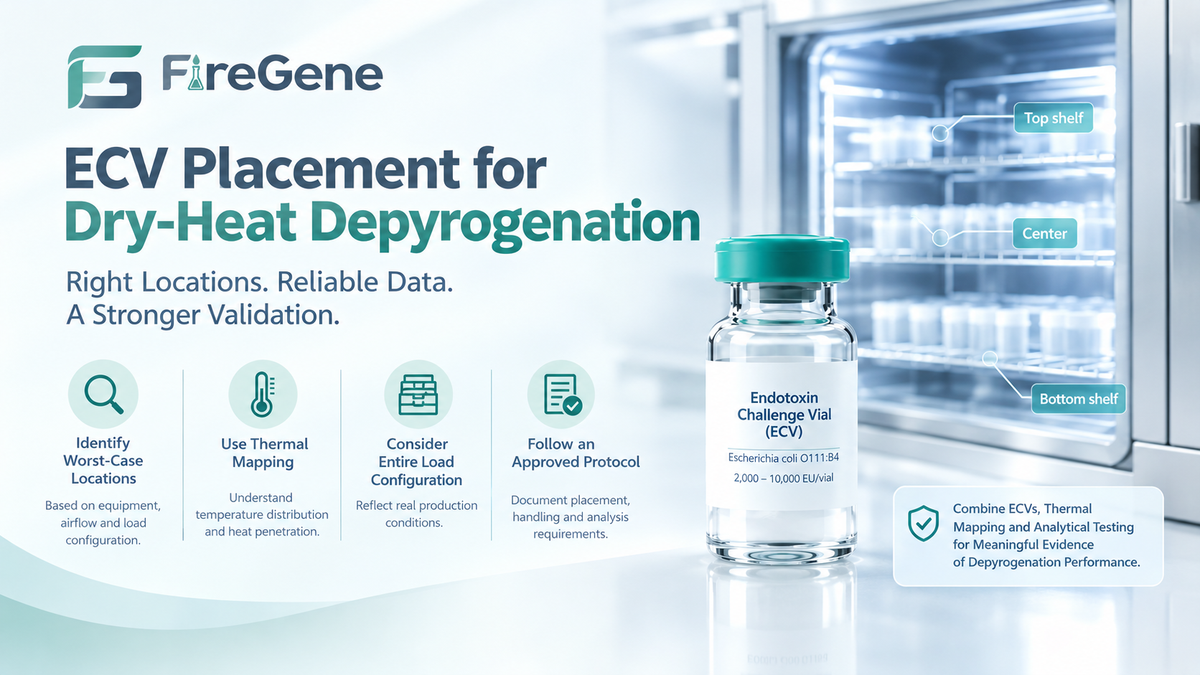
A dry-heat oven may reach its programmed temperature without exposing every part of a production load to identical thermal conditions. Airflow, equipment geometry, load density, and container arrangement can influence heat distribution and penetration.
For this reason, Endotoxin Challenge Vial (ECV) placement is an important consideration when evaluating dry-heat depyrogenation performance. A scientifically justified placement strategy helps laboratories assess the process under relevant challenging conditions rather than relying only on results from convenient locations.
I. Why ECV Placement Matters
An ECV contains a characterized bacterial endotoxin challenge that can be evaluated before and after a depyrogenation cycle.
Following heat exposure, residual endotoxin activity is measured and compared with an appropriate initial value or untreated control. The resulting data help determine whether the process achieved the reduction specified in the validation protocol.
However, a challenge study can provide meaningful evidence only when the placement strategy reflects the equipment and conditions being evaluated.
If ECVs are placed exclusively in locations that receive favorable thermal exposure, the study may not adequately assess the most challenging parts of the load.
II. Identify Relevant Worst-Case Locations
Potentially challenging locations depend on the equipment design, airflow, load arrangement, and operating conditions.
Areas considered during a placement assessment may include:
-
Locations identified as cold spots during thermal mapping.
-
Areas where airflow may be restricted by the load.
-
Regions affected by high load density or challenging container arrangements.
-
Positions associated with different zones of a depyrogenation tunnel.
-
Locations affected by changes in container size, mass, or orientation.
These are examples, not universal placement instructions. A worst-case location in one oven may not be the worst-case location in another.
The placement strategy should be supported by equipment characterization, thermal studies, load configuration assessments, and the intended scope of validation.
III. Use Thermal Mapping to Support Placement Decisions
Thermal mapping provides information about temperature distribution throughout equipment under specified operating conditions. Heat-penetration studies can provide additional information about how the load responds to those conditions.
Together, these data help validation teams identify locations and configurations that deserve particular attention.
The study plan should consider the relationship between equipment performance, load configuration, process parameters, and the intended validation claim.
ECV placement should not be selected solely because a position is easy to access or convenient to recover after processing.
For further technical context, see USP General Chapter 1228: Depyrogenation and General Chapter 1228.5: Endotoxin Indicators for Depyrogenation.
IV. Consider the Entire Load Configuration
The arrangement of containers can influence heat distribution and penetration. Validation should therefore consider whether the challenge study reflects the production configuration it is intended to represent.
Relevant factors may include:
-
Container size, mass, and geometry.
-
Spacing between containers.
-
Load density and arrangement.
-
Conveyor configuration in tunnel systems.
-
Maximum or otherwise challenging validated loading conditions.
-
Changes introduced by maintenance or equipment modification.
Where multiple production configurations are used, the validation strategy should identify which configurations are covered and whether additional evaluation is necessary.
Results from one load configuration should not automatically be assumed to represent all other configurations.
V. Handle and Process ECVs According to the Approved Protocol
Once the placement strategy has been justified, the validation team should document the locations and follow the approved procedure.
The protocol should identify the ECV product and lot, placement locations, process parameters, controls, recovery procedure, analytical method, and acceptance criteria.
The FireGene Endotoxin Challenge Vial, SKU FG-DNEVC002, is a lyophilized endotoxin preparation derived from Escherichia coli O111.
The product page lists a potency range of 2,000–10,000 EU/vial for this product and describes glass-vial packaging. Confirm the specific size, lot information, and handling requirements in the current product documentation.
Follow the approved procedure for processing, recovering, and measuring residual endotoxin. Do not assume that handling or recovery instructions for another supplier's challenge material are interchangeable.
VI. Measure Residual Endotoxin Reliably
Following the heat cycle, residual endotoxin activity must be evaluated using a suitable bacterial endotoxins test.
The method should have an appropriate working range for the expected residual activity. Sample preparation, dilution factors, recovery, and assay controls should be established and documented.
FireGene's Kinetic Chromogenic Endotoxin Test Kit provides quantitative endotoxin measurements within its specified working range. Suitability for a particular ECV study must be demonstrated under the actual sample preparation and validation conditions.
VII. Common ECV Placement Mistakes
Choosing convenient locations instead of justified locations
Placement decisions should be supported by equipment data and the study objectives.
Ignoring changes in load configuration
Changes in loading can affect heat distribution and may require an assessment of existing validation coverage.
Failing to document vial positions
Incomplete placement records can make results difficult to interpret and reproduce.
Treating temperature data as the only evidence
Temperature records support process evaluation, while ECV results provide separate information about endotoxin reduction. Both should be interpreted within the overall validation strategy.
Overlooking analytical controls
Poor recovery or unsuitable assay sensitivity can undermine a study even when the placement strategy is appropriate.
VIII. Frequently Asked Questions
Should ECVs always be placed at the coldest point?
Placement should be based on the approved validation strategy and relevant worst-case conditions identified through equipment characterization. No single placement rule applies to every system.
Can the same placement plan be used for every oven?
No. Placement depends on equipment design, airflow, load configuration, and study objectives.
Does ECV placement replace thermal mapping?
No. Thermal mapping and ECV challenge testing provide different types of evidence and should be integrated appropriately.
When should ECV placement be reassessed?
Reassessment should follow the site's qualification, change-control, and revalidation procedures. Significant equipment or load changes may require additional evaluation.
Conclusion
Appropriate ECV placement helps generate meaningful evidence during dry-heat depyrogenation validation. Thermal mapping, justified worst-case conditions, documented handling, and suitable residual endotoxin testing all contribute to an interpretable study.
Explore the FireGene Endotoxin Challenge Vial for dry-heat depyrogenation validation applications, and consult the relevant USP chapters and approved validation protocol when defining placement requirements.
FireGene Endotoxin Testing
Ready to run your endotoxin assay?
FireGene offers a complete endotoxin testing toolkit — from TAL reagents and CSE standards to pyrogen-free consumables and LAL reagent water. All products are aligned with USP <85>, EP 2.6.14, and JP 4.01.


