
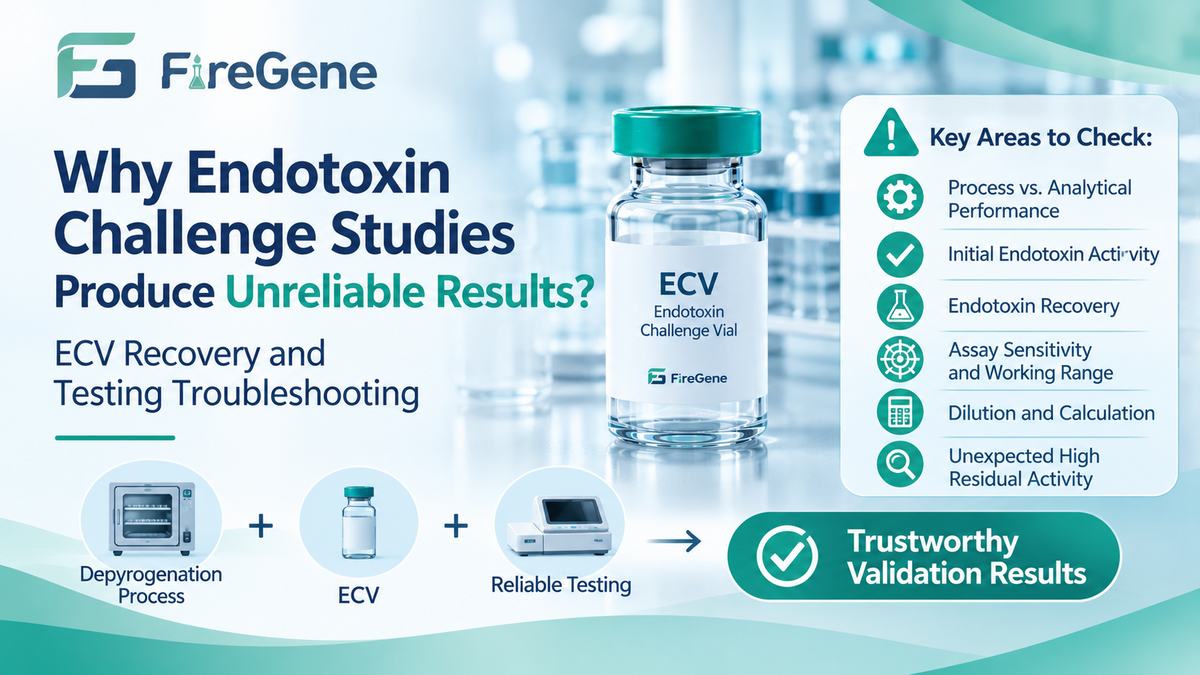
Endotoxin Challenge Vials (ECVs) help laboratories evaluate the performance of dry-heat depyrogenation processes. However, even when a heat cycle is completed as intended, the resulting data may be difficult to interpret if endotoxin recovery or analytical testing is not suitable.
Unexpectedly high residual activity, inconsistent control results, or an inability to demonstrate the required log reduction can have several causes. A structured investigation helps distinguish potential process issues from analytical limitations and sample-handling problems.
I. Separate Process Performance From Analytical Performance
An ECV study evaluates endotoxin reduction after a defined heat cycle. The final result, however, depends on both the process and the analytical procedure used to measure residual activity.
A result that does not meet the acceptance criteria should not automatically be attributed to the oven or tunnel. Likewise, an analytical issue should not be assumed merely because a result is unexpected.
A structured investigation should review:
-
Equipment and heat-cycle records.
-
ECV identity, lot documentation, and handling history.
-
Untreated-control recovery.
-
Sample preparation and dilution calculations.
-
Assay sensitivity and validated working range.
-
Control results and potential analytical interference.
-
Deviations from the approved procedure.
Document the investigation according to the applicable quality system. Repeating a test until a passing result is obtained does not, by itself, establish that the original result was invalid.
II. Verify the Initial Endotoxin Activity
The log reduction calculation depends on an appropriate initial value. An unsupported baseline can produce a misleading conclusion even when the arithmetic is correct.
Review the ECV's lot documentation and confirm that the value used in the calculation follows the approved protocol.
Where required, untreated controls can help establish the activity recovered through the selected preparation and analytical procedure.
The FireGene Endotoxin Challenge Vial, SKU FG-DNEVC002, has a listed potency range of 2,000–10,000 EU/vial for the specified product. The appropriate value for a validation calculation should be established according to the applicable lot documentation and study procedure.
Do not automatically assume that the midpoint of the potency range represents the actual recovered activity.
III. Evaluate Endotoxin Recovery
Measured endotoxin activity may be influenced by sample preparation, recovery conditions, and the characteristics of the test system.
Potential factors to investigate include:
-
Incomplete or inconsistent reconstitution.
-
Differences in mixing or handling.
-
Adsorption to sample-contact surfaces.
-
Contamination introduced during preparation.
-
Dilution errors or unsuitable sample conditions.
-
Analytical interference that affects the assay response.
If untreated controls show unexpectedly low recovery, the initial activity used in the calculation may require investigation.
Conversely, contamination introduced during preparation may increase the measured residual activity and make the process appear less effective than it actually is.
Use a validated recovery procedure and appropriate controls to distinguish these possibilities.
IV. Check Assay Sensitivity and Working Range
After a substantial reduction in endotoxin activity, the residual level may be much lower than the initial challenge.
For example, an initial recovered activity of 5,000 EU/vial corresponds to a residual activity of 5 EU/vial after a 3-log reduction.
The analytical procedure must be able to support the required conclusion at that residual level after accounting for reconstitution volume, dilution, and recovery.
If the expected result falls below the method's detection or quantification capability, the study may not establish the required reduction conclusively.
Quantitative methods such as kinetic chromogenic testing may be useful for evaluating residual endotoxin activity. The FireGene Kinetic Chromogenic Endotoxin Test Kit provides quantitative measurements within its specified working range. Its suitability for a particular ECV study must be established for the actual sample and intended analytical purpose.
For regulatory context, consult the FDA's current Guidance for Industry: Pyrogen and Endotoxins Testing.
V. Review Dilution and Calculation Errors
Dilution errors can affect residual endotoxin calculations and the resulting log reduction.
Confirm that dilution factors are documented and calculations are checked according to the laboratory's procedures. Initial and residual results must be expressed on a comparable basis.
For example, a residual result reported in EU/mL cannot be compared directly with an initial result reported in EU/vial without accounting for the relevant volume and dilution factors.
The calculation is:
LRV = log10 (Initial endotoxin activity / Residual endotoxin activity)
Use the initial and residual values established under the approved protocol.
If a result is below the analytical detection or quantification limit, handle it according to predefined, scientifically justified rules. Do not substitute zero for an undetectable result.
VI. Investigate Unexpectedly High Residual Activity
When residual endotoxin activity is higher than expected, review the process and analytical procedure together.
Process-related questions include:
-
Was the specified cycle completed?
-
Did the actual load match the approved configuration?
-
Were relevant thermal conditions achieved?
-
Were the challenge vials placed according to the protocol?
-
Have equipment maintenance or loading changes affected process performance?
Analytical questions include:
-
Were controls acceptable?
-
Was sample preparation performed correctly?
-
Were dilution factors applied correctly?
-
Could contamination or interference have affected the result?
-
Was the method suitable for the expected residual activity?
Do not assume that increasing temperature or exposure time is the appropriate corrective action before the cause has been investigated. Any change to a validated process should be supported by technical justification and the applicable change-control procedure.
VII. Improve Documentation and Reproducibility
A complete ECV validation record should include:
-
ECV product identification and lot information.
-
Initial-value selection and untreated-control results.
-
Equipment identification and cycle parameters.
-
Load configuration and ECV placement.
-
Sample recovery and preparation procedures.
-
Analytical method, dilution factors, and raw data.
-
Control acceptance and calculation results.
-
Deviations, investigations, and corrective actions.
Consistent documentation improves comparability between validation runs and helps identify recurring issues.
For additional technical context, see USP General Chapter 1228.5: Endotoxin Indicators for Depyrogenation.
VIII. Frequently Asked Questions
Why might untreated ECV controls show low recovery?
Potential explanations include incomplete recovery, handling variability, adsorption, or analytical problems. Review the validated procedure and control results before drawing conclusions.
Can a sensitive assay guarantee reliable residual endotoxin measurements?
No. Sensitivity is only one factor. Recovery, working range, sample preparation, controls, and method suitability also affect reliability.
Should a failed validation simply be repeated?
A repeat may be appropriate when justified by the investigation and quality procedures. The original result and its investigation should remain documented.
What if residual activity is below the detection limit?
Interpret the result according to the predefined analytical procedure. Do not automatically report zero or claim a specific reduction that the available data cannot substantiate.
Conclusion
Reliable ECV validation depends on both effective depyrogenation and trustworthy measurement of residual endotoxin activity. Reviewing the initial challenge value, recovery procedure, analytical range, controls, and calculations can help laboratories investigate unexpected results systematically.
Explore the FireGene Endotoxin Challenge Vial and Kinetic Chromogenic Endotoxin Test Kit for relevant product information. The suitability of each product for a specific validation study must be established according to the intended use and approved procedure.
FireGene Endotoxin Testing
Ready to run your endotoxin assay?
FireGene offers a complete endotoxin testing toolkit — from TAL reagents and CSE standards to pyrogen-free consumables and LAL reagent water. All products are aligned with USP <85>, EP 2.6.14, and JP 4.01.


