
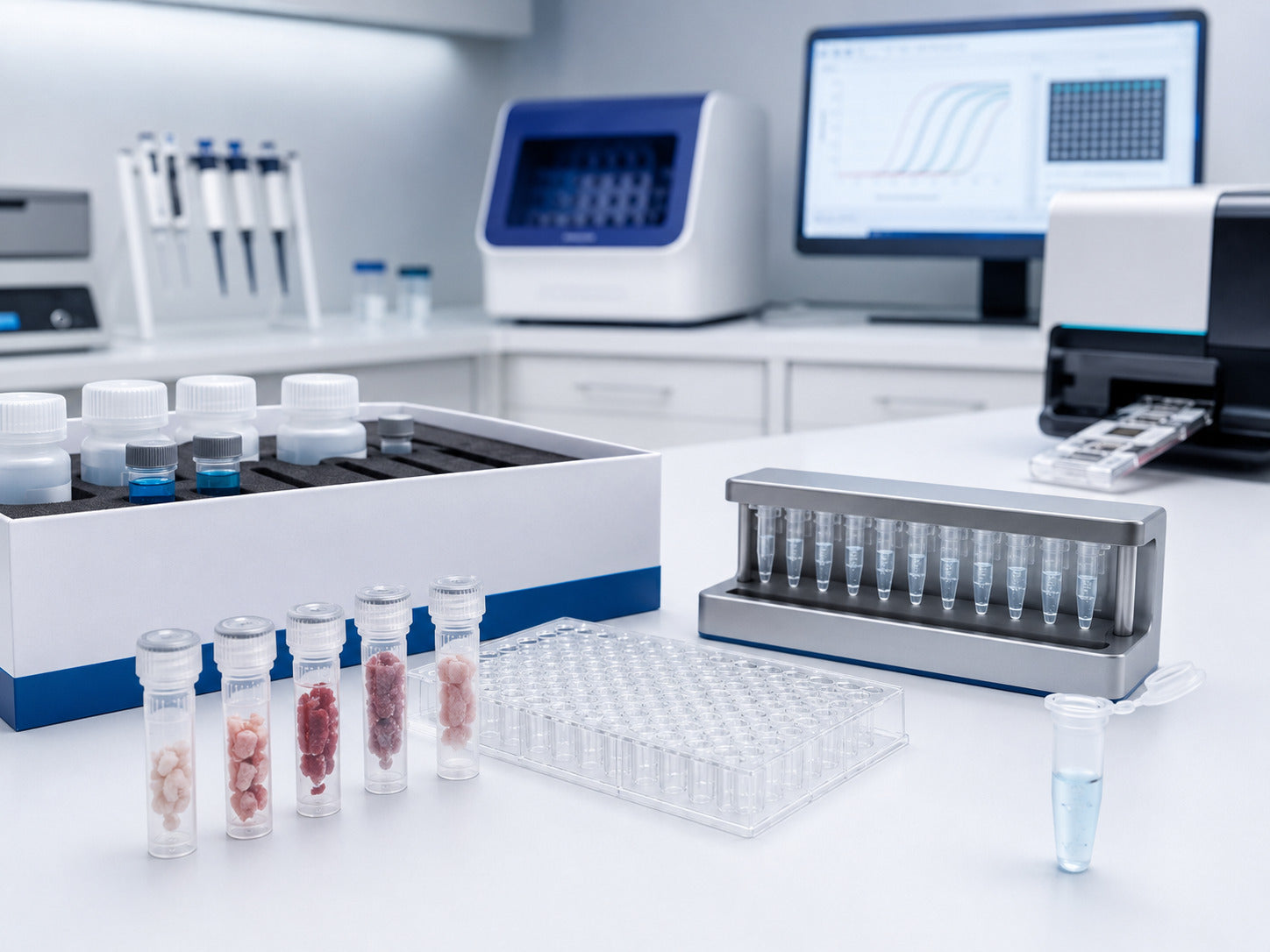
Choosing a tissue DNA extraction kit for PCR and NGS begins with the tissue type, preservation method, DNA-quality requirement and number of samples, not simply the lowest price per reaction. Fresh tissue, cryopreserved tissue and tissue stored in preservation solutions can differ in lysis efficiency, inhibitor load and DNA integrity. A kit that matches these variables helps laboratories create a more consistent workflow from sample preparation to amplification or sequencing. For routine total-DNA purification, magnetic-bead technology offers a practical combination of reproducibility, batch flexibility and potential automation. It can also reduce the centrifugation and transfer steps associated with many manual column workflows.
Quick product recommendation: For total DNA extraction from fresh tissue, cryopreserved tissue or tissue preserved in solutions such as RNAlater, consider the FireGene Tissue DNA Extraction Kit, SKU FG-0416-96. The current storefront lists a 96-reaction magnetic-bead kit, and the recovered DNA is documented for PCR, qPCR and next-generation sequencing workflows.
View or Order the Tissue DNA Extraction Kit | Submit a Bulk Inquiry or Sample Request
Quick Tissue DNA Kit Selection Guide
|
Sample or project requirement |
Recommended product route |
Why it fits |
Buyer action |
|
Fresh or cryopreserved research tissue |
Magnetic-bead purification for total tissue DNA |
View the 96-reaction kit |
|
|
Tissue stored in RNAlater or another documented preservation fluid |
Preserved tissue is listed as a compatible sample type |
Confirm preservation conditions |
|
|
DNA for PCR or qPCR |
Recovered DNA is documented for amplification workflows |
Confirm target and input needs |
|
|
DNA for NGS |
NGS and high-throughput sequencing are documented applications |
Match DNA QC to the library method |
|
|
Paraffin-embedded tissue sections |
FFPE-specific dewaxing and magnetic-bead workflow |
Choose the dedicated FFPE kit |
|
|
Gram-positive bacteria, yeast or fungi |
Includes a workflow for difficult-to-lyse microbial samples |
Select by organism and lysis requirement |
This table highlights an important purchasing principle: select by sample type first. Standard tissue, FFPE sections and microbial samples require different preparation and lysis strategies even when the downstream endpoint is PCR or NGS.

Why Tissue DNA Extraction Affects PCR and NGS Results
Tissue contains proteins, lipids, polysaccharides, pigments and other matrix components that can interfere with lysis, DNA binding or amplification. The challenge varies by organ, species, tissue mass and storage history. Fibrous tissue may require more complete disruption, fatty tissue can introduce additional carryover, and poorly preserved samples may already contain fragmented DNA before extraction begins. For PCR, the priority is amplifiable DNA with minimal inhibitor carryover. A sample can contain measurable DNA but still produce weak or inconsistent amplification if salts, ethanol, heme or other contaminants remain in the eluate.
NGS adds further considerations. Library preparation may require a defined input mass, compatible fragment profile and consistent sample-to-sample recovery. The required DNA integrity also depends on whether the project uses short-amplicon sequencing, hybrid capture, whole-genome sequencing or another library strategy. The extraction kit should therefore be selected alongside the intended library-preparation requirements.
Six Factors to Compare Before Ordering
1. Tissue type and preservation method
Confirm whether samples are fresh, frozen, cryopreserved or stored in a stabilization solution. Review the product documentation for the exact sample class rather than relying on a broad “tissue compatible” description.The FireGene kit lists fresh tissue, cryopreserved tissue and tissues preserved with fluids such as RNAlater. If the project uses an uncommon preservation reagent, archived material or a highly fibrous sample, discuss the workflow before committing to a large order.
2. Lysis and homogenization requirements
Successful purification begins with consistent disruption. Tissue pieces that remain incompletely homogenized can reduce recovery and increase variation across replicates. Before ordering, determine whether the laboratory already has a rotor-stator homogenizer, bead mill, grinding system or another suitable preparation method. The kit chemistry and the physical disruption method should be treated as one workflow. Standardize tissue mass, cutting or grinding, digestion and mixing during the pilot so that extraction performance can be compared fairly.
3. PCR, qPCR or NGS endpoint
For conventional PCR and qPCR, evaluate amplification consistency, inhibition and target-specific performance. For NGS, add the DNA quantity, integrity and purity metrics required by the selected library protocol. Avoid choosing a kit from a generic “high purity” claim alone. Define measurable acceptance criteria before the pilot, such as successful control amplification, an acceptable quantification range and library-preparation performance.
4. Magnetic beads versus spin columns
Both formats can produce useful DNA when the sample and protocol are appropriate. Their operational differences may influence the purchasing decision.
|
Consideration |
Magnetic-bead workflow |
Spin-column workflow |
|
Separation method |
Magnetic rack or compatible extractor |
Centrifugation or vacuum |
|
Batch processing |
Flexible for manual or scalable batches |
Often convenient for smaller manual batches |
|
Automation potential |
Generally easier to transfer to suitable platforms |
Platform options may be more limited |
|
Main equipment check |
Magnet, mixing and instrument compatibility |
Centrifuge, rotor and column capacity |
|
Handling focus |
Bead resuspension, wash removal and controlled drying |
Loading capacity and consistent centrifugation |
Format alone does not determine DNA yield or downstream success. The complete workflow—including tissue disruption, binding, washing and elution—must match the project.

5. Throughput and automation
Estimate reactions from the full project rather than the number of tissue samples alone. Include extraction controls, optimization samples, expected repeats and contingency stock. For automated processing, confirm the instrument model, magnetic-separation method, plate or tube format and batch size. The Tissue DNA Extraction Kit is documented as compatible with most automated nucleic-acid extraction instruments and pipetting workstations. Exact platform transfer and settings should still be confirmed before project-scale purchasing.
6. Total workflow cost
Compare the cost per usable sample, not only the kit price. Consumables, homogenization supplies, technician time, repeat extractions, QC and instrument time all affect the real project cost. A consistent workflow can provide commercial value when it reduces handling or repeat rates.
Recommended Tissue DNA Extraction Kit for PCR and NGS
The FireGene Tissue DNA Extraction Kit uses superparamagnetic particle purification to isolate total DNA from documented tissue inputs. The product description states that the workflow does not require phenol, chloroform or alcohol precipitation, helping simplify routine purification.
Product: FireGene Tissue DNA Extraction Kit
SKU: FG-0416-96
Current storefront format: 96 reactions
Method: Magnetic beads
Samples: Fresh tissue, cryopreserved tissue and tissues preserved in solutions such as RNAlater
Applications: PCR, qPCR, next-generation sequencing and high-throughput sequencing
Automation: Documented for compatible automated extraction instruments and pipetting workstations
Buying route: Add to Cart, Bulk Inquiry or Sample Request
Who Is This Kit Best Suited For?
This kit may be a practical option for research laboratories processing standard tissue samples that want a magnetic-bead workflow for PCR, qPCR or NGS. Its 96-reaction storefront format is especially relevant to planned batches, core facilities and laboratories comparing manual processing with compatible automation. Ordering note: The current storefront lists a 96-reaction kit under SKU FG-0416-96, while a different reaction count appears elsewhere in the product specifications. Confirm the required configuration, current pricing and project volume with FireGene before placing a larger order.
View the Tissue DNA Extraction Kit | Request Project Pricing or Technical Guidance

How to Evaluate a Tissue DNA Kit Before a Bulk Purchase
Use representative samples from the actual study, including the tissue types and preservation conditions most likely to challenge the workflow. A small pilot should assess:
- DNA recovery using a suitable quantification method;
- purity and evidence of inhibitor carryover;
- DNA integrity appropriate to the downstream method;
- PCR or qPCR consistency across replicates;
- NGS library yield and quality when sequencing is planned;
- hands-on time, batch time and repeat rate;
- performance across operators or instrument runs.
Spectrophotometric ratios can support QC, but they should not be the only acceptance criteria. Fluorometric quantification, gel or fragment analysis, amplification controls and library-specific metrics may provide more actionable evidence depending on the project.

Choose a Dedicated Kit for Different Sample Types
FFPE tissue sections
Formalin-fixed, paraffin-embedded tissue requires dewaxing and processing that a standard fresh-tissue workflow may not provide. For paraffin sections, consider the FireGene FFPE gDNA Extraction Kit, SKU FG-FG1103D-48. Its product page describes a xylene-free dewaxing formula, magnetic-bead purification and recovered gDNA for PCR, Sanger sequencing, NGS and gene-chip hybridization.
Gram-positive bacteria, yeast and fungi
Microbial cell walls may require stronger disruption than animal tissue. For difficult-to-lyse Gram-positive bacteria, mycobacteria, yeast, fungi or spores, evaluate the FireMag Gram-Positive Bacteria and Fungi DNA Extraction Kit, SKU FG-FG1108D01-48rxns. It combines mechanical disruption with magnetic-bead purification and is a better sample-specific route than treating microbial pellets as standard tissue.
Plasma cfDNA
If the intended analyte is cell-free DNA from plasma rather than genomic DNA from solid tissue, use a dedicated Plasma cfDNA Extraction Kit. The currently selectable 10-reaction format is documented for 1–4 mL plasma and downstream PCR, qPCR, chip detection and high-throughput sequencing.
Ordering Checklist
Prepare the following information before requesting availability, technical guidance or a customized quotation:
- tissue type, species and preservation method;
- approximate tissue mass and homogenization equipment;
- PCR, qPCR or specific NGS library workflow;
- required DNA quantity and integrity;
- number of samples, controls and expected repeats;
- manual magnetic rack or automated instrument model;
- preferred batch size and project timeline;
- current intended-use and documentation requirements.
This information helps distinguish a routine 96-reaction purchase from a workflow requiring platform guidance, larger-volume planning or sample-specific optimization.
FAQs
What is the best DNA extraction kit for tissue PCR?
The best kit matches the tissue type and removes inhibitors that affect amplification. For documented fresh, cryopreserved and RNAlater-preserved tissue, the FireGene Tissue DNA Extraction Kit provides a magnetic-bead workflow with recovered DNA intended for PCR and qPCR.
Can the same tissue DNA kit be used for NGS?
The product page lists next-generation and high-throughput sequencing as applications. Researchers should confirm that DNA quantity, integrity and purity meet the requirements of their specific library-preparation method.
Is a magnetic-bead kit suitable for high-throughput tissue DNA extraction?
Magnetic-bead workflows are generally well suited to scalable batch processing and compatible automation. Confirm the extraction platform, labware, mixing and magnetic-separation requirements before implementation.
Can a standard tissue DNA kit be used for FFPE samples?
A dedicated FFPE workflow is the better purchasing route because paraffin sections require dewaxing and fixation-aware processing. The FFPE gDNA Extraction Kit is specifically documented for paraffin section tissues.
How should extracted tissue DNA be quantified for PCR and NGS?
Use a method appropriate to the downstream application. Fluorometric quantification is often useful for DNA input, while amplification controls and integrity or fragment analysis can add relevant evidence for PCR and NGS workflows.
Conclusion
The right tissue DNA extraction kit should match the tissue matrix, preservation method, downstream assay and throughput plan. For standard fresh, cryopreserved and supported preserved tissues, a magnetic-bead kit offers a practical route to total DNA for PCR, qPCR and NGS. FFPE, microbial and plasma samples should be directed to their dedicated extraction products.
Planning tissue DNA extraction for PCR or NGS? Review the 96-reaction kit for routine processing, or submit your sample type, batch size and instrument details for project guidance.
View or Order the FireGene Tissue DNA Extraction Kit | Submit a Bulk Inquiry or Sample Request


