
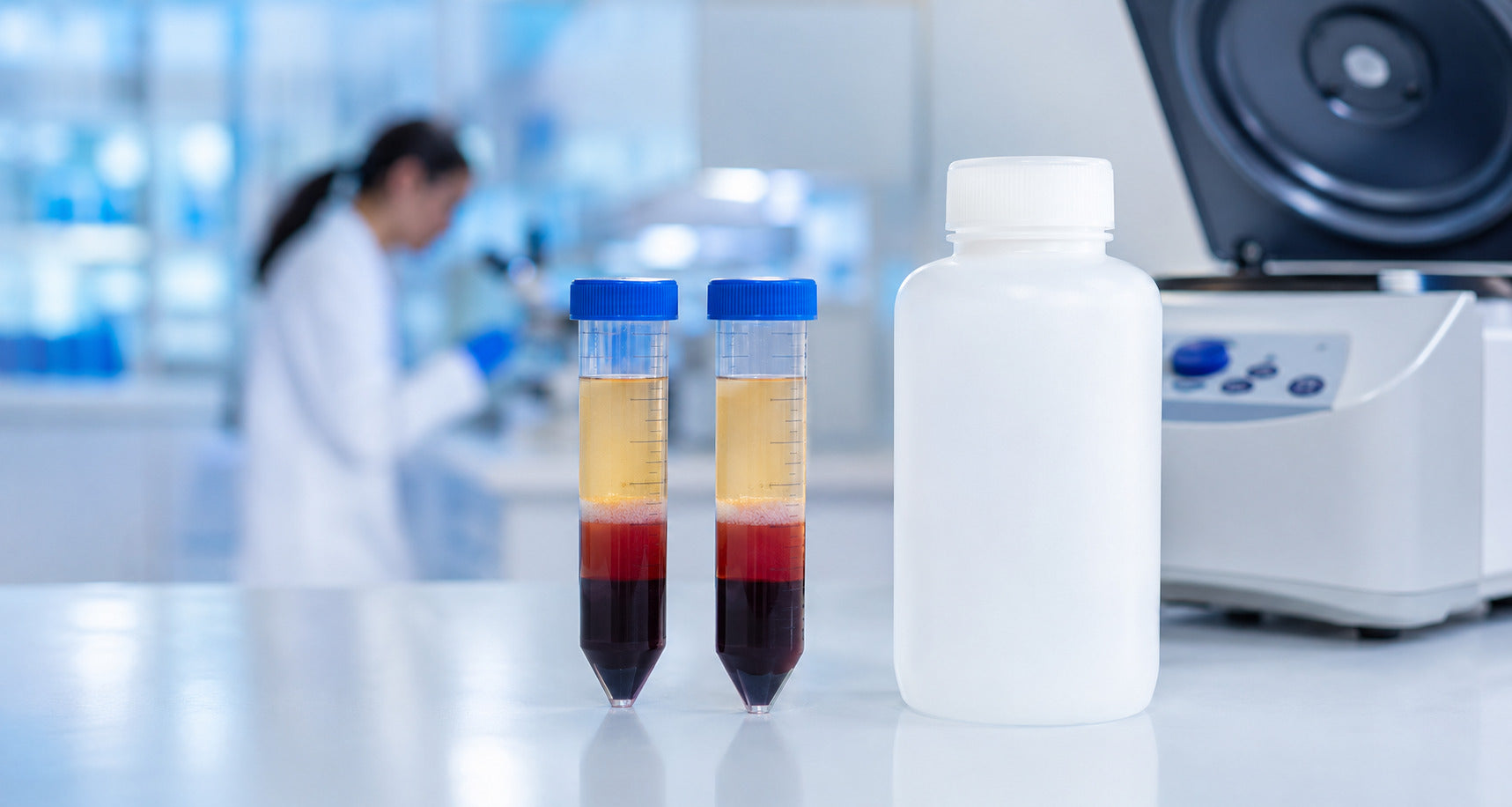
The best human PBMC isolation solution should match the blood sample, separation method, centrifuge setup, target cell population and downstream quality requirements for flow cytometry or single-cell sequencing. Before ordering, compare species specificity, blood handling, density-layer or sedimentation workflow, optional red blood cell removal, cell viability, impurity level, batch size and required companion reagents. FireGene offers the Human PBMC Isolation Solution for Lymphocyte Preparation for diluted human peripheral blood. Its documented density-layer workflow prepares lymphocyte single-cell suspensions for flow cytometry, single-cell sequencing, cell culture and related research assays.
For diluted human peripheral blood intended for flow cytometry, single-cell sequencing or cell culture, consider the FireGene Human PBMC Isolation Solution in the 100 mL format, SKU FG-BA3332-100. The documented workflow uses density-layer separation with horizontal centrifugation and supports optional RBC removal when required.
Planning human immune-cell isolation from peripheral blood?
Match the sample volume, centrifuge, target cell quality and downstream assay before selecting the workflow.
View or Order the Human PBMC Isolation Solution | Compare PBMC Isolation Products | Request Bulk Pricing, a Sample or Technical Guidance
Quick PBMC Workflow Selection Guide
|
Research requirement |
Selection priority |
Recommended product or action |
Buyer action |
|
Human peripheral-blood lymphocyte isolation |
Human-specific density-layer workflow |
Human PBMC Isolation Solution |
|
|
Flow-cytometry immunophenotyping |
Clean suspension, viability and controlled RBC background |
Human PBMC isolation with assay-specific QC |
Confirm panel and staining requirements |
|
Single-cell sequencing |
Viability, low debris, accurate count and suitable concentration |
Human PBMC isolation followed by suspension QC |
Validate capture-platform criteria |
|
Residual erythrocytes after separation |
Optional mammalian RBC-removal step |
Add only when required |
|
|
Dead cells or debris in the suspension |
Post-isolation cleanup |
Evaluate after PBMC QC |
|
|
Mammalian blood with a simpler sedimentation workflow |
Species and assay compatibility |
Compare workflow specifications |
|
|
Mouse peripheral blood |
Species-specific product |
Do not substitute the human product |
What Are PBMCs and Why Does Isolation Quality Matter?
Peripheral blood mononuclear cells include lymphocytes and monocytes. PBMC preparations support immune profiling, inflammation, infection, cancer, biomarker, culture and single-cell research. Residual erythrocytes, platelets, dead cells, debris or aggregates can change counts, complicate gating and reduce usable cells. Evaluate the complete sample-preparation workflow rather than separation medium alone.
Density-Layer Separation vs Sedimentation-Based Isolation
The two formats support different handling priorities.
|
Consideration |
Density-layer workflow |
Sedimentation-based workflow |
|
Sample loading |
Diluted blood is carefully layered |
Blood is gently mixed with the solution |
|
Primary separation |
Density interface after centrifugation |
Differential sedimentation and low-speed centrifugation |
|
Main buying priority |
Controlled layering and interface collection |
Simple handling and species compatibility |
|
Documented human product use |
Flow cytometry, single-cell sequencing and culture |
Universal product documents flow cytometry and culture |
|
Typical implementation need |
Horizontal centrifuge and careful aspiration |
Horizontal centrifuge and supernatant collection |
Choose according to the product documentation and downstream assay. A simpler loading method is not automatically the best option for every single-cell sequencing workflow, and purification format alone does not determine cell yield or quality.

Seven Factors to Compare Before Buying a Human PBMC Isolation Solution
1. Species and Sample Compatibility
Confirm that the product is intended for human peripheral blood; do not interchange human and mouse products without validation. The Human PBMC Isolation Solution documents compatibility with diluted human peripheral-blood samples. Record the anticoagulant, blood volume and collection-to-processing conditions. Request technical confirmation for a different input.
2. Separation Method and Centrifuge Requirements
The human workflow uses controlled density-layer separation with horizontal centrifugation. The product specifications list a separation step at 20°C, 700 ×g for 30 minutes, along with a horizontal centrifuge and cell counter as required instruments. Use those values only with the current product manual and the laboratory’s validated SOP. Confirm whether the centrifuge can deliver the required relative centrifugal force, temperature and rotor behavior. Brake settings, tube geometry, sample volume and interface handling can influence separation quality.
3. Cell Viability and Recovery
Measure total and viable-cell recovery with a validated counting method; neither recovery nor viability is sufficient alone. The manufacturer describes a high-viability, low-impurity output. Verify performance during initial workflow qualification with representative samples.
4. Purity and Red Blood Cell Background
Inspect the washed sample for erythrocytes, platelets and unwanted cells. The workflow supports optional RBC removal using catalog number BA3311. Use RBC lysis only when required and follow its dedicated protocol to protect target-cell quality.
5. Flow Cytometry Requirements
For flow cytometry, PBMC preparation should support reliable counts, staining and gating. Before ordering, define:
- Minimum viable-cell recovery
- Maximum acceptable debris and RBC background
- Surface-only or intracellular staining
- Number of colors and required controls
- Fresh, fixed or cryopreserved analysis
- Sorting or analysis-only workflow
- Required cell concentration and sample volume
Include viability dye, compensation controls, fluorescence-minus-one controls and appropriate biological controls according to the panel. The isolation product prepares cells; it does not replace assay-specific staining optimization.
6. Single-Cell Sequencing Requirements
Single-cell sequencing platforms commonly require strict input criteria for viability, debris, aggregates, concentration and total cell number. Exact limits depend on the instrument and library workflow. Confirm these before processing valuable samples.
Evaluate:
- Viability and live-cell count
- Cell-size distribution
- Doublets and aggregates
- RBC, platelet and debris background
- Final concentration and resuspension buffer
- Time between isolation and capture
- Need for dead-cell removal or anti-clumping treatment
The product page documents single-cell sequencing as an application; the final suspension must still meet the chosen capture platform’s criteria.
7. Pack Size, Batch Planning and Total Cost
The Human PBMC Isolation Solution is currently listed in a 100 mL format under SKU FG-BA3332-100; the base catalog number is FG-BA3332. The product page offers Add to cart and an inquiry route, while visible pricing may depend on the live storefront display. Calculate volume from the current protocol and blood input, including pilots, controls, repeats and donor variability. Budget for consumables, counting, optional RBC lysis and cleanup.
FireGene Human PBMC Isolation Solution for Flow Cytometry and Single-Cell Sequencing
The FireGene Human PBMC Isolation Solution for Lymphocyte Preparation provides a density-layer workflow for diluted human peripheral blood in a 100 mL pack.
Product Features to Review
- Designed for diluted human peripheral blood
- Density-based layered separation
- Horizontal-centrifugation workflow
- Optional RBC-removal step
- Documented flow cytometry, single-cell sequencing and cell-culture applications
- 4°C storage protected from light
- One-year documented shelf life
- Research-use-only designation
The specifications list PBS, FBS, low-adsorption tips, 15 mL tubes, a horizontal centrifuge and a cell counter as workflow requirements.
Who Is This Product Best Suited For?
The Human PBMC Isolation Solution may suit research laboratories preparing lymphocyte-rich suspensions from human peripheral blood for flow cytometry, single-cell sequencing, immune profiling or cell culture. Before ordering: Confirm anticoagulant, blood volume, processing time, centrifuge configuration and downstream cell-quality thresholds.
Ready to evaluate a human PBMC isolation workflow?
Review the 100 mL product or submit the planned blood volume, sample count and downstream assay for technical guidance. View or Order the Human PBMC Isolation Solution | Submit a Bulk Inquiry or Sample Request
General Human PBMC Isolation Workflow
Follow the current manual for exact ratios, centrifugation settings and handling. The documented workflow generally includes:
- Prepare the blood sample. Record anticoagulant, collection time, volume and storage history.
- Dilute the blood. Use the specified PBS-based preparation.
- Layer the sample. Add diluted blood carefully over the isolation solution without disturbing the interface.
- Centrifuge horizontally. Apply the validated temperature, force, time and brake settings.
- Collect the mononuclear-cell layer. Aspirate the interface while limiting contamination from adjacent layers.
- Apply optional RBC lysis. Use only when residual erythrocytes justify an additional step.
- Wash and resuspend. Remove residual separation medium and prepare cells in an assay-compatible buffer.
- Perform QC. Apply the acceptance criteria defined for the downstream assay.
Flow Cytometry vs Single-Cell Sequencing: Final QC Priorities
|
QC area |
Flow cytometry priority |
Single-cell sequencing priority |
|
Viability |
Reliable live/dead discrimination |
Meets capture-platform input criteria |
|
Cell count |
Enough events for the panel and rare populations |
Accurate viable-cell input for target recovery |
|
RBC background |
Supports clear counting and gating |
Reduces non-target background and concentration errors |
|
Debris |
Limits nonspecific events |
Supports cleaner capture and library preparation |
|
Aggregates |
Reduces coincident events and sorting issues |
Reduces doublets and clogging risk |
|
Final buffer |
Compatible with antibodies and staining |
Compatible with capture chemistry |
|
Timing |
Fits staining and acquisition schedule |
Minimizes delay before loading or preservation |
Use the table to set one assay-specific QC checkpoint after isolation and before staining or cell capture.

Related Products for a Complete PBMC Workflow
Red Blood Cell Lysis Kit
The Red Blood Cell Lysis Kit is an optional add-on for residual erythrocytes. The product page currently offers a selectable 100 mL kit under SKU FG-BA3311-100, while the components section also documents a 500 mL configuration. Ask FireGene about larger-volume availability and bulk pricing when planning multi-sample studies.
Dead Cell Debris and Impurities Removal Kit
The Dead Cell Debris and Impurities Removal Kit supports post-isolation cleanup when required. The product page currently shows a selectable 2-reaction option under SKU FG-BA3339-2rxns, while its kit-components section separately references 10- and 50-reaction configurations. Confirm the required format, current availability and project pricing before ordering.
Universal and Mouse PBMC Solutions
The Universal PBMC Isolation Solution supports mammalian anticoagulated blood using a sedimentation-based workflow documented for flow cytometry and cell culture. The Mouse PBMC Isolation Solution is the species-specific option for mouse peripheral blood. These are alternative starting workflows, not companion reagents for the human-specific product.

Ordering Checklist for Human PBMC Research
Prepare the following information before ordering or requesting guidance:
- Human PBMC product SKU FG-BA3332-100
- Anticoagulant and blood collection method
- Blood volume and number of samples
- Collection-to-processing interval
- Horizontal centrifuge model and rotor
- Desired viable-cell recovery and purity
- Flow-cytometry panel or single-cell platform
- Need for RBC lysis, debris removal or additional cleanup
Review the current intended-use statement before incorporating any product into a regulated or clinical workflow.
FAQs
What is the best method for isolating human PBMCs?
The appropriate method depends on species, sample type, centrifuge configuration and downstream assay. For diluted human peripheral blood, the FireGene Human PBMC Isolation Solution provides a documented density-layer workflow for preparing lymphocyte-rich single-cell suspensions for flow cytometry, single-cell sequencing and cell culture.
Can isolated PBMCs be used for flow cytometry?
Yes. The Human PBMC Isolation Solution documents flow cytometry as a downstream application. Match the isolated cells to the planned staining panel and event requirements.
Is the product suitable for single-cell sequencing?
The manufacturer lists single-cell sequencing among its applications. Verify the final suspension against the chosen platform’s input criteria.
Is red blood cell lysis always required?
No. It is an optional step when residual erythrocytes remain after PBMC isolation. Assess the suspension before adding more processing.
What equipment is required?
The documented workflow requires a horizontal centrifuge and cell counter, with PBS, FBS, low-adsorption tips and 15 mL tubes also listed. Follow the current manual for full requirements.
How should the human PBMC solution be stored?
The product specifications state 4°C protected from light, with a documented shelf life of one year. Follow the current product label upon receipt.
Select the Right Human PBMC Isolation Workflow
A strong PBMC workflow starts with the correct species and sample, followed by controlled separation and one downstream-assay QC checkpoint. The 100 mL Human PBMC Isolation Solution provides a documented density-layer route for diluted human peripheral blood.
Build a PBMC workflow around the downstream assay.
Review the Human PBMC Isolation Solution first, then select companion reagents according to the initial workflow plan.
View or Order the Human PBMC Isolation Solution | Explore PBMC Isolation Products | Submit a Bulk Inquiry or Sample Request


