
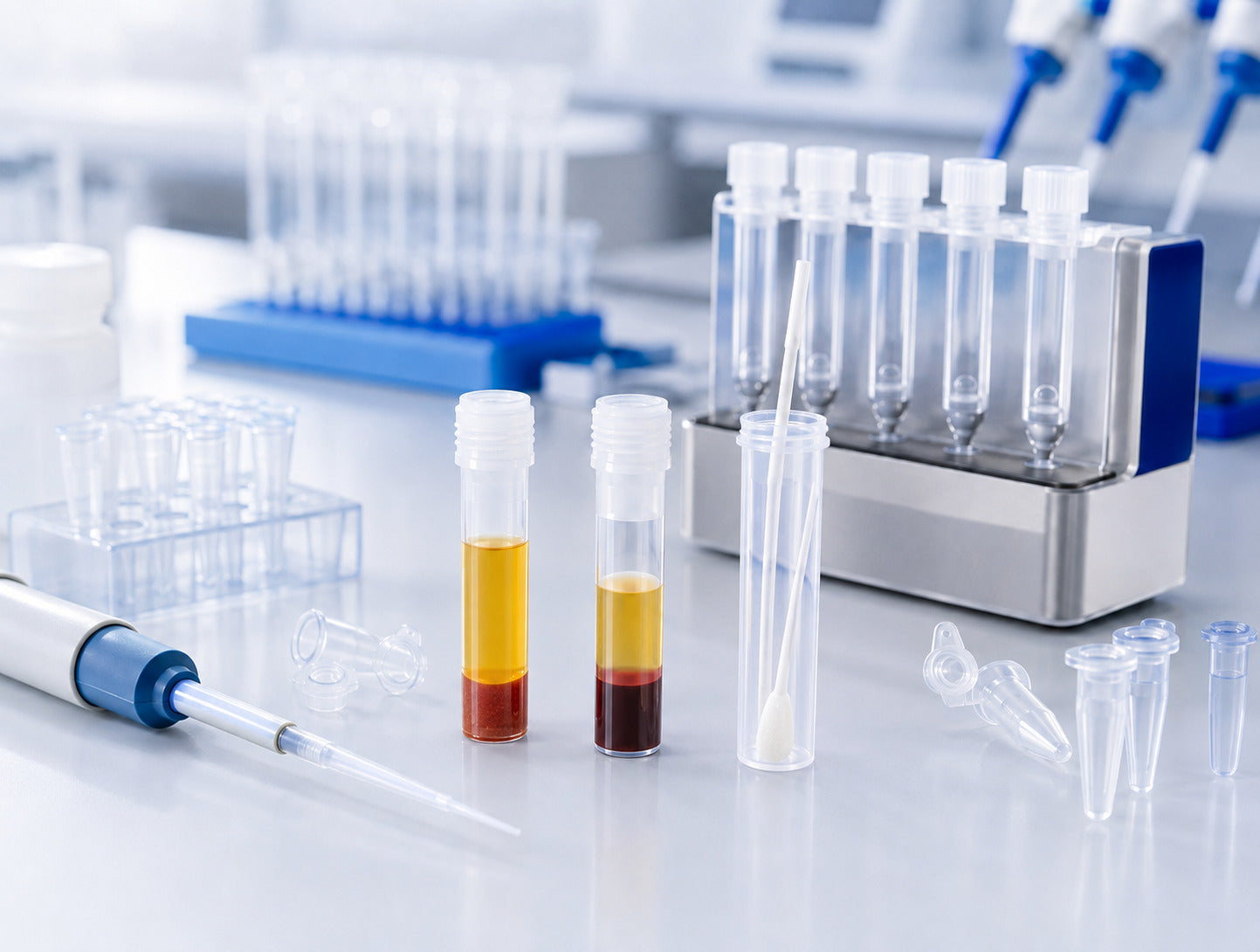
Recovering viral nucleic acids from plasma, serum and swab samples is not simply a matter of choosing any general-purpose DNA or RNA purification product. Viral targets may be present at low concentrations, RNA can degrade quickly, and sample matrices can carry salts, proteins, transport-media components or other substances that interfere with PCR and sequencing. The right kit must therefore match the specimen, target type, batch size and downstream assay. For laboratories that need one workflow for both viral DNA and viral RNA, a co-extraction kit can reduce purchasing complexity and help standardize sample preparation across mixed research projects. Magnetic-bead chemistry can also support batch processing and evaluation on compatible automated extraction platforms.
Quick product recommendation: For viral DNA/RNA co-extraction from plasma, serum, swab soaking fluid and other documented biofluids, consider the FireGene Viral DNA/RNA Isolation Kit in the currently selectable 10-reaction format, SKU FG-FG1107-10rxns. The documented magnetic-bead workflow takes less than 35 minutes and produces nucleic acid intended for PCR, RT-PCR, Sanger sequencing, NGS and gene-chip workflows.
Submit a Bulk Inquiry or Sample Request
Quick Viral DNA/RNA Kit Selection Guide
|
Research requirement |
Recommended option |
Why it fits |
Buyer action |
|
Co-extract viral DNA and RNA from plasma or serum |
One magnetic-bead workflow targets both nucleic-acid types |
Review the 10-reaction format |
|
|
Process viral nucleic acid from swab soaking fluid |
Swab soaking fluid is listed as a compatible sample type |
Confirm transport medium and input volume |
|
|
Run mixed DNA-virus and RNA-virus research projects |
Viral DNA/RNA co-extraction workflow |
Avoids separate DNA-only and RNA-only extraction purchases |
Qualify recovery for each target class |
|
Scale from a pilot to a larger batch |
Magnetic-bead workflow with automation potential |
Can be evaluated for compatible automated instruments |
Discuss throughput requirements |
|
Extract cfDNA rather than viral nucleic acid from plasma |
Designed for cell-free DNA from 1–4 mL plasma |
Select based on the analyte, not only the specimen |
The first buying decision should always be the analyte. Plasma can contain viral nucleic acid, host genomic DNA, cfDNA and RNA, but these targets do not automatically require the same extraction chemistry or input volume.
Why Plasma, Serum and Swab Samples Need Careful Kit Selection
Plasma and serum are protein-rich biofluids in which viral nucleic acid may be scarce. Hemolysis, delayed processing, repeated freeze-thaw cycles or unsuitable storage can further change sample quality. Swab workflows introduce different variables. Recovery can depend on swab material, collection quality, transport medium, soaking volume and the amount transferred into lysis. Some media can alter binding or amplification performance, so the words “swab compatible” should not be treated as universal compatibility with every collection device and transport formulation.
A suitable workflow should recover the required target class, remove downstream inhibitors, produce consistent eluate and fit the laboratory’s processing plan. These goals are more useful than choosing on yield language alone because host nucleic acids can contribute to a high total measurement.
Five Factors to Compare Before Ordering
1. Viral DNA, viral RNA or co-extraction
An RNA-only kit can be appropriate for a defined RNA-virus project, while a DNA-only workflow may suit a specific DNA virus. However, laboratories supporting multiple assays may benefit from a co-extraction product. One protocol for both target classes reduces the need to maintain separate extraction inventories and can simplify staff training.
2. Exact sample matrix
Do not select a kit based only on the phrase “viral sample.” Check whether the documentation lists plasma, serum, swab soaking fluid or the precise matrix used in the study, including the collection or transport medium.
The FireGene product specifications list serum, plasma, urine, cerebrospinal fluid, swab soaking fluid, culture-medium supernatant and other biofluid samples. Researchers using an unlisted or uncommon matrix should request technical guidance before ordering a project-scale quantity.
3. Magnetic beads versus spin columns
Both formats can work well when matched to the application. The operational differences often matter more during purchasing.
|
Consideration |
Magnetic-bead workflow |
Spin-column workflow |
|
Separation |
Magnetic rack or compatible instrument |
Centrifugation or vacuum |
|
Automation |
Generally easier to transfer to liquid-handling systems |
Often more manual |
|
Batch flexibility |
Suitable for small pilots and scalable batches |
Convenient for small or moderate manual batches |
|
Main equipment check |
Magnet, mixing and instrument compatibility |
Column capacity and centrifuge access |
|
Main handling risk |
Bead drying, carryover or inconsistent resuspension |
Membrane overloading or variable centrifugation |
Purification format alone does not determine sensitivity. Recovery depends on the complete kit and validated protocol.

4. Downstream application and controls
PCR and RT-PCR emphasize inhibitor removal and reproducible recovery, while NGS may add input-mass, fragment-quality and library-complexity requirements. Include suitable extraction, negative and inhibition controls, and qualify the workflow for its intended downstream method.
5. Throughput and automation
Calculate throughput from samples per batch, controls, repeats, deck capacity and operator time. “Automation compatible” is not the same as a ready-made protocol for every platform. For an automated project, provide the instrument model, magnetic-separation method, plate or tube format and intended batch size when requesting guidance. Review the current intended-use statement before incorporating any product into a regulated or clinical workflow.
Recommended Viral DNA/RNA Extraction Kit for Plasma, Serum and Swab Samples
The FireGene Viral DNA/RNA Isolation Kit (SKU FG-FG1107-10rxns) uses microspherical paramagnetic beads for co-extraction of viral DNA and RNA. According to the product page, the workflow covers lysis and binding, washing and elution in less than 35 minutes.
Product: FireGene Viral DNA/RNA Isolation Kit
SKU: FG-FG1107-10rxns
Current format: 10 reactions/kit
Method: Magnetic beads
Samples: Plasma, serum, swab soaking fluid and other documented biofluids
Workflow: Less than 35 minutes
Applications: PCR, RT-PCR, Sanger sequencing, NGS and gene chips
Buying route: Add to Cart, Bulk Inquiry or Sample Request
Who Is This Kit Best Suited For?
This product may be a practical choice for laboratories that process both DNA- and RNA-virus research samples, prefer a magnetic-bead workflow or want to evaluate transfer to a compatible automated extraction platform.
Ordering note: The current storefront lists a 10-reaction kit under SKU FG-FG1107-10rxns. Larger-scale reaction configurations are referenced elsewhere in the product documentation, so contact FireGene to confirm the appropriate format and project pricing for higher-throughput workflows.
View the Viral DNA/RNA Isolation Kit | Request Larger-Format Pricing or Technical Guidance
How to Match the Kit to Each Sample Type
Plasma
For plasma, clarify whether the project targets viral DNA/RNA or host-derived cfDNA. These are different buying requirements even though both begin with the same specimen type. If the target is cfDNA for PCR, chip detection or high-throughput sequencing, evaluate the FireGene Plasma cfDNA Extraction Kit instead. Its page currently presents a selectable 10-reaction format and specifies a magnetic-bead workflow for 1–4 mL plasma. It should not be positioned as a substitute for the viral co-extraction kit without application-specific evidence.
Serum
Serum contains abundant proteins and can vary with clotting and processing conditions. Standardize collection and storage across the study. When both viral DNA and RNA targets are possible, co-extraction can keep purification consistent.
Swab samples
For swabs, identify the anatomical collection site, swab material and transport medium. The product documentation specifically lists swab soaking fluid; compatibility with a particular proprietary medium should be confirmed rather than inferred.
Need Target-Specific MPXV Detection?
FireGene also offers an MPXV Real-Time PCR Detection Kit for supported sample types. This is a downstream detection product rather than a general viral nucleic-acid extraction kit.
Compare Workflow Cost, Not Kit Price Alone
The most economical option is not always the kit with the lowest unit price. Compare the complete cost per reportable sample, including extraction reagents, controls, consumables, technician time, repeat extractions and instrument use. A faster magnetic-bead workflow may provide additional value when it reduces manual handling or supports larger batches.
For project purchasing, calculate enough reactions for study samples, extraction controls, optimization runs, expected repeats and contingency stock. This provides a more realistic quotation request and helps the supplier recommend a suitable purchasing route without over- or underestimating the project requirement.
Ordering Checklist
Prepare the following information before requesting availability, technical guidance or project pricing:
- viral DNA, viral RNA or both;
- plasma, serum or exact swab/transport-medium combination;
- available sample input and preferred elution volume;
- number of samples, controls and expected repeats;
- manual magnetic rack or automated instrument model;
- target batch size and turnaround requirement;
- PCR, RT-PCR, Sanger sequencing, NGS or gene-chip endpoint;
- research, regulated or other intended-use requirements.
For a pilot, compare target recovery, amplification consistency, inhibition, repeat rate and hands-on time using representative samples. For NGS, also review library yield, target coverage and method-specific quality metrics.

FAQs
What is the best viral DNA/RNA extraction kit for plasma, serum and swabs?
The best kit matches the target type and sample matrix. For co-extraction from documented plasma, serum and swab soaking-fluid samples, the FireGene Viral DNA/RNA Isolation Kit provides a magnetic-bead workflow for both viral DNA and RNA.
Is a magnetic-bead kit better than a spin-column kit?
Not universally. Magnetic beads are often easier to scale and automate, while columns can be convenient for smaller manual batches. The specific chemistry, validated sample type and downstream performance matter more than format alone.
Is extracted viral nucleic acid suitable for NGS?
The FireGene product page lists NGS as an application. Laboratories should still qualify the extract against the library-preparation and sequencing-performance requirements of their particular method.
Conclusion
A strong purchasing decision begins with the analyte and sample matrix, then accounts for purification format, downstream application and throughput. For laboratories seeking viral DNA/RNA co-extraction from documented biofluids, the recommended magnetic-bead kit provides one workflow for both target classes.
Need viral DNA/RNA co-extraction for plasma, serum or swab samples? View the product or submit project details for pricing and technical guidance.
View or Order the FireGene Viral DNA/RNA Isolation Kit | Submit a Bulk Inquiry or Sample Request


