
1. The Hidden Factor Affecting Your Research Results
In many laboratories, experimental failure is often attributed to instrumentation, reagents, or data analysis pipelines. However, an increasing body of research indicates that sample quality prior to processing is one of the most critical determinants of success.
Tissue samples begin to degrade immediately after excision. Without proper preservation, researchers frequently encounter:
- Reduced cell viability
- RNA degradation and transcriptomic bias
- Loss of rare or fragile cell populations
- Poor reproducibility across experiments
For researchers actively searching for terms like “animal tissue storage kit supplier”, “tissue preservation solution for research”, or “purchase tissue storage kit for sample transport”, the core challenge is clear:
👉 How to maintain biological integrity between collection and analysis.
2. What Really Happens to Tissue After Collection
Once removed from the organism, tissue rapidly experiences:
- Hypoxia → triggers stress-response genes
- Metabolic imbalance → disrupts ATP production
- Enzymatic degradation → affects RNA/protein stability
- Cell apoptosis → reduces viable cell yield
Conventional methods such as PBS storage or ice transport do not actively prevent these processes. They merely slow them down—often insufficiently for modern applications like:
- Single-cell RNA sequencing (scRNA-seq)
- Flow cytometry
- Spatial transcriptomics
- Organoid culture
3. FireGene Solution: Designed for Real Research Workflows
The
🔗 https://firegene.com/products/animal-tissue-storage-kit-fg-ba3301
is specifically developed as a research-grade tissue preservation system, not just a temporary holding buffer.
Core Functional Design
- Stabilizes cellular microenvironment
- Reduces metabolic activity
- Maintains osmotic and ionic balance
- Minimizes apoptosis and degradation
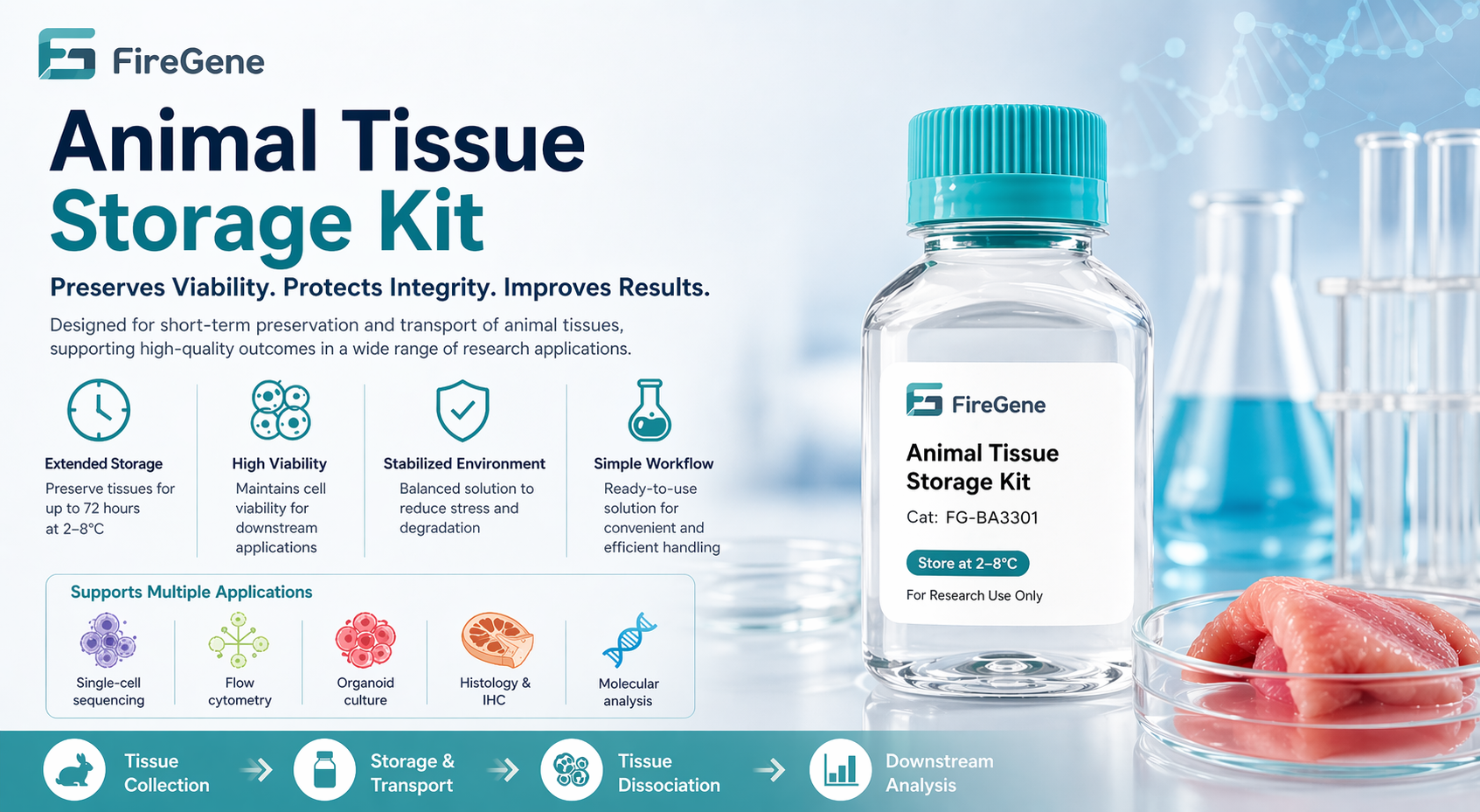
This enables short-term preservation at 2–8°C for up to 72 hours, without the complexity of cryopreservation.
4. Why Researchers Choose FireGene as a Tissue Storage Supplier
4.1 Extended Storage Flexibility
Up to 72 hours of preservation allows:
- Cross-site collaboration
- Sample shipment without urgency
- Flexible lab scheduling
4.2 High Cell Viability for Downstream Applications
Maintains strong performance for:
- Single-cell sequencing
- Immune cell profiling
- Cell culture workflows
👉 This directly improves data quality and reproducibility.
4.3 Broad Application Compatibility
Validated across multiple tissue types:
- Brain tissue
- Tumor samples
- Liver and metabolic tissues
- Immune organs
4.4 Simple, Ready-to-Use Workflow
No preprocessing required.
Standard Workflow:
Collection → Storage → Transport → Dissociation → Analysis
5. Integrated Workflow: From Tissue to Data
FireGene products are designed to function as a complete research workflow ecosystem:
Step 1 – Tissue Preservation
🔗 https://firegene.com/products/animal-tissue-storage-kit-fg-ba3301
Step 2 – Tissue Dissociation
🔗 https://firegene.com/products/mouse-brain-dissociation-kit-fg-ba3305
Step 3 – Cryopreservation (Optional)
🔗 https://firegene.com/products/universal-cell-freezing-kit-fg-ba3309
Step 4 – Quality Control
🔗 https://firegene.com/products/kinetic-chromogenic-endotoxin-test-kit
Explore Full Portfolio
👉 This end-to-end solution is especially valuable for labs seeking a single supplier for research reagents.
6. Competitive Insight: Why Storage Comes Before Dissociation
Many market solutions (e.g., dissociation kits or sequencing prep kits) focus on processing efficiency, but overlook input quality.
This creates a critical issue:
Even the best downstream workflow cannot recover from degraded starting material.
FireGene’s positioning is clear:
👉 Protect the sample first, then process it.
This upstream focus aligns with the growing emphasis on pre-analytical standardization in modern research.
7. Use Cases Across Research and Industry
7.1 Multi-Site Research Projects
Enable standardized sample handling across institutions
7.2 Single-Cell Sequencing
Preserve viable cells and transcriptomic integrity
7.3 Biobanking
Short-term stabilization before long-term storage
7.4 Drug Discovery
Ensure consistency across experimental batches
8. Buying Guide: How to Choose the Right Tissue Storage Kit
When planning to purchase a tissue preservation solution, consider:
Performance
- Does it maintain viability beyond 24–48 hours?
Compatibility
- Is it suitable for your tissue type and downstream assays?
Ease of Use
- Can it integrate into existing workflows?
Supplier Reliability
- Can the supplier support long-term research needs?
FireGene is designed to meet all these criteria while remaining cost-effective and scalable.
9. CTA Section
Looking for a Reliable Tissue Storage Supplier?
If your lab is currently:
- Searching for an animal tissue storage kit supplier
- Planning to purchase a tissue preservation solution
- Optimizing sample transport workflows
- Improving single-cell sequencing outcomes
👉 FireGene provides a practical, research-validated solution.
👉 Explore Product Details or Request a Quote
🔗 https://firegene.com/products/animal-tissue-storage-kit-fg-ba3301
FireGene, light your research with passion, innovation, and profession.


