
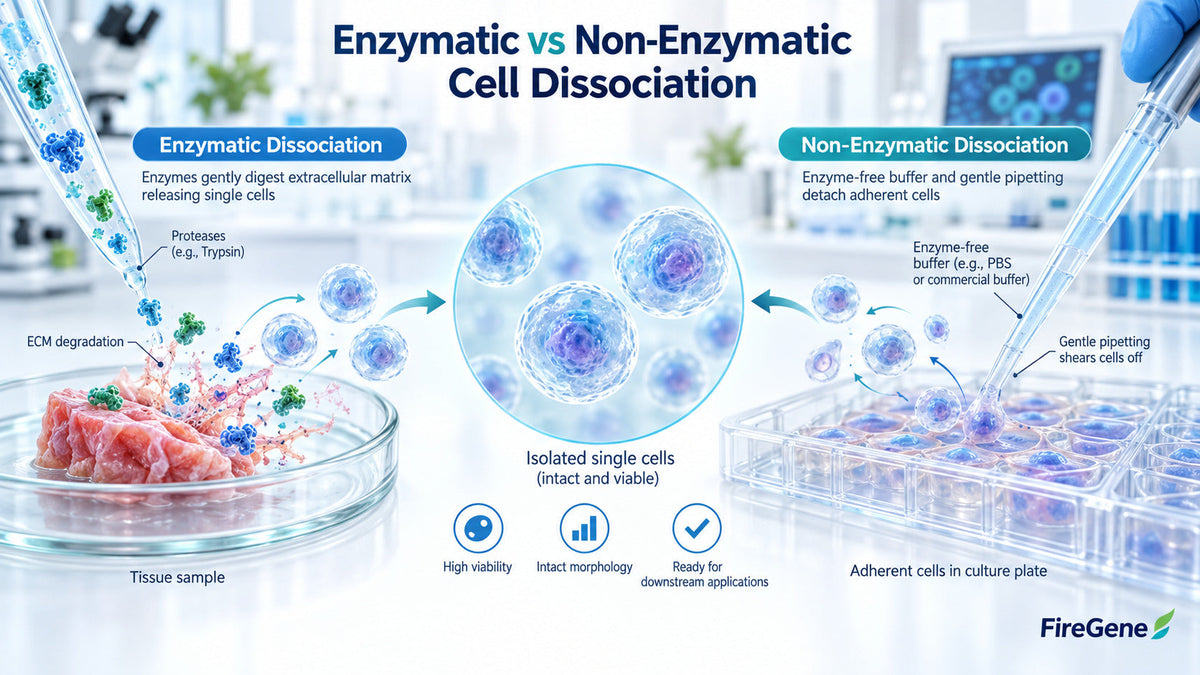
Enzymatic cell dissociation uses proteolytic or matrix-degrading enzymes to release adherent cells or disaggregate tissues efficiently. In contrast, non-enzymatic cell dissociation uses chelating buffers or gentle mechanical methods when preserving sensitive cellular characteristics is the main priority.
Both approaches can produce a useful cell suspension for cell counting, cell isolation, primary cell culture, flow cytometry and single-cell analysis. The best method depends on the starting material, attachment strength, extracellular matrix, target-cell sensitivity, required surface markers and downstream application. Researchers working with solid mammalian tissues can use the FireGene Multi Tissue Dissociation Kit to prepare high-quality single-cell suspensions. FireGene also offers complementary cleanup solutions for viable-cell enrichment, debris removal and aggregation management.
Enzymatic vs Non-Enzymatic Dissociation: Quick Comparison
|
Selection factor |
Enzymatic dissociation |
Non-enzymatic dissociation |
|
Main mechanism |
Proteolytic or matrix digestion |
Chelation, specialized buffers or mechanical processing |
|
Common use |
Adherent cultures and solid tissues |
Mainly adherent or gently attached cultured cells |
|
Processing efficiency |
Strong for dense attachment and tissue matrix |
Effective for suitable cell-culture applications |
|
Surface proteins |
Conditions require optimization |
Often selected to preserve sensitive epitopes |
|
Solid-tissue suitability |
Generally strong |
Usually limited as a standalone approach |
|
Main advantage |
Efficient release and tissue disaggregation |
Gentle cell detachment |
|
Best selection factor |
Tissue structure and cell recovery |
Cellular sensitivity and marker preservation |
What Is Cell Dissociation?
Cell dissociation is the process of separating attached cells or structured tissues into individual cells or small cellular units. The term covers cell detachment from culture vessels and tissue disaggregation for primary cell isolation. A successful protocol creates a uniform cell suspension while supporting cell integrity, viable-cell recovery and downstream performance.
Cell Detachment vs Tissue Dissociation
Cell detachment releases adherent cells from a culture flask, dish or plate. Trypsin, recombinant trypsin alternatives, EDTA and enzyme-free buffers are commonly considered for this application. Tissue dissociation processes the extracellular matrix and cell-to-cell connections within intact tissue. Collagenase, dispase and optimized multi-enzyme systems can help release primary cells from complex tissue structures.
Cell Dissociation vs Cell Isolation
Cell dissociation releases cells from a surface or tissue. Cell isolation separates a selected population from the resulting suspension. For example, tissue can first be enzymatically dissociated before immune cells are enriched through magnetic selection or cell sorting. Keeping these stages distinct supports a clearer experimental workflow.
What Is Enzymatic Cell Dissociation?
Enzymatic cell dissociation uses enzymes to process adhesion proteins or extracellular matrix components. It can efficiently detach cultured cells and convert solid tissue into a single-cell suspension.

Common Dissociation Enzymes
Trypsin
Trypsin is widely used for harvesting adherent cells in routine cell culture protocols. It cleaves proteins involved in cell-to-surface and cell-to-cell attachment. Researchers can control concentration, exposure time and temperature to support efficient detachment and consistent cellular recovery.
TrypLE-Type Reagents
TrypLE is a commercial family of recombinant cell-dissociation reagents. These products are commonly considered as alternatives to animal-derived trypsin for cultured adherent cells. Because TrypLE is a trademarked product family rather than a generic enzyme category, it should be described using its proper commercial context.
Collagenase and Dispase
Collagenase processes collagen-rich extracellular matrices and is commonly considered for primary cell isolation from solid tissues. Dispase can support gentler separation of tissues and epithelial structures. Enzyme selection should reflect tissue composition, desired populations and downstream marker requirements.
Multi-Enzyme Systems
Complex tissues contain multiple extracellular matrix components. An optimized enzyme combination can provide broader matrix processing than a single enzyme. The FireGene Multi Tissue Dissociation Kit uses an optimized enzyme blend and buffer system to generate single-cell suspensions from diverse mammalian tissues, including liver, lung, kidney, intestine, tumor, ovary, skin and lymphoid tissue.
Advantages of Enzymatic Dissociation
Enzymatic dissociation provides several benefits:
- Efficient release of adherent cells
- Effective processing of structured tissues
- Strong potential for viable-cell recovery
- Compatibility with multiple tissue types
- Scalable sample preparation
- Reproducible processing after optimization
When to Select an Enzymatic Protocol
Enzymatic dissociation is particularly useful when solid tissue has a structured extracellular matrix, cells are firmly attached, strong cellular recovery is required, or the downstream workflow needs a uniform single-cell suspension.
What Is Non-Enzymatic Cell Dissociation?
Non-enzymatic cell dissociation uses chelating agents, enzyme-free buffers or controlled mechanical processing instead of proteolytic enzymes. Chelating reagents such as EDTA reduce calcium- and magnesium-dependent adhesion. Gentle tapping or pipetting can then help release suitable adherent cells.
Advantages of Non-Enzymatic Dissociation
A non-enzymatic cell dissociation protocol can offer:
- Gentle detachment of suitable cultured cells
- Preservation of selected surface proteins
- Flexibility for receptor and signaling studies
- Straightforward integration into cell culture
- Controlled processing of sensitive populations
- Freedom from proteolytic enzyme exposure
When to Select a Non-Enzymatic Protocol
This method can be valuable when cells are lightly attached, surface epitopes are important for downstream analysis, protease exposure is being minimized, or an enzyme-free buffer has been validated for the cell type. For dense solid tissues, an enzymatic or combined method generally provides a more effective starting approach.

How to Select the Right Cell-Dissociation Method
Match the Method to the Starting Material
An adherent cell line, primary culture, organoid and solid tissue each have different structural characteristics. Begin by determining whether the workflow involves simple cell detachment or complete tissue disaggregation.
Consider Surface-Marker Preservation
Flow cytometry, immune profiling and cell sorting may rely on specific surface proteins. Researchers can confirm that the selected enzyme and exposure conditions are compatible with the markers being measured. A carefully optimized enzymatic method may preserve the required markers effectively, while a non-enzymatic method can provide an attractive option for particularly sensitive epitopes.
Define the Required Cell Recovery
Record more than cell viability percentage. A complete quality assessment includes:
- Total cell concentration
- Viable-cell concentration
- Cell viability
- Total viable-cell yield
- Aggregate frequency
- Target-cell recovery
For additional guidance, read the FireGene guide to measuring and improving cell viability after tissue dissociation.
Match the Method to the Downstream Application
Cell dissociation conditions can be selected according to whether cells will be used for:
- Cell counting
- Flow cytometry
- Primary cell culture
- Cell isolation
- Cell sorting
- Single-cell RNA sequencing
- Functional assays
- Drug-screening research

General Enzymatic Cell Dissociation Protocol
- Prepare the adherent culture or freshly collected tissue.
- Select a validated dissociation enzyme or enzyme blend.
- Prepare consistent tissue pieces when processing solid samples.
- Add the recommended volume of dissociation reagent.
- Incubate under controlled time and temperature conditions.
- Monitor cell release and tissue disaggregation.
- Apply gentle mechanical assistance when appropriate.
- Stop or dilute enzyme activity according to the protocol.
- Filter tissue-derived suspensions when required.
- Wash, resuspend and count the collected cells.

General Non-Enzymatic Cell Dissociation Protocol
- Remove the culture medium.
- Wash cells with the validated buffer.
- Add an enzyme-free dissociation solution.
- Incubate for the recommended duration.
- Observe cellular rounding and release.
- Apply gentle tapping or pipetting when appropriate.
- Collect the detached cells.
- Wash and prepare a uniform suspension.
- Measure viable cell density.
- Normalize the suspension for downstream use.
Exact reagent volumes, incubation times and temperatures should be selected from the reagent instructions and validated for the specific cell type.
Improve Cell-Suspension Quality After Dissociation
Cell harvesting is followed by filtration, washing and quality assessment. Some tissue-derived samples can benefit from additional cleanup before downstream analysis.
|
Sample condition |
FireGene solution |
Workflow value |
|
Diverse solid tissue |
Produces single-cell suspensions using an optimized enzyme system |
|
|
Meaningful dead-cell fraction |
Supports viable-cell enrichment |
|
|
Dead cells and tissue debris |
Prepares a cleaner suspension |
|
|
Cell aggregation |
Supports a uniform suspension |
An initial count followed by a post-cleanup count helps researchers measure changes in viable-cell concentration and recovery.
Frequently Asked Questions
Is enzymatic or non-enzymatic dissociation better?
Both methods offer distinct advantages. Enzymatic dissociation is generally effective for strong cell attachment and solid tissues. Non-enzymatic dissociation is useful for gentle detachment and preserving selected surface characteristics.
What is the difference between cell dissociation and tissue dissociation?
Cell dissociation is the broader process of separating attached cells. Tissue dissociation specifically converts structured tissue into individual cells or small cellular units.
Which enzymes are used for tissue dissociation?
Collagenase, dispase and multi-enzyme blends are commonly considered. The appropriate system depends on tissue structure, target cells and downstream requirements.
Does trypsin support cell harvesting?
Yes. Trypsin is widely used to detach adherent cells during routine cell harvesting. Standardized exposure conditions support consistent results.
Can non-enzymatic methods dissociate solid tissues?
Mechanical processing can support tissue disaggregation, but a non-enzymatic approach alone may offer limited matrix breakdown in dense tissues. A validated enzymatic or combined workflow can provide efficient cell release.
How is dissociation quality measured?
Researchers can record cell viability, viable-cell density, total viable yield, cellular dispersion, aggregate frequency, remaining tissue fragments and downstream assay performance.
Conclusion
Enzymatic and non-enzymatic cell dissociation protocols offer complementary ways to prepare cells for research. Enzymatic methods efficiently detach adherent cells and process complex tissue matrices, while non-enzymatic methods provide gentle cell detachment for suitable cultures. For solid-tissue workflows, FireGene supports dissociation and sample refinement with products for enzymatic tissue processing, viable-cell enrichment, debris removal and aggregation management. Explore FireGene tissue dissociation kits or contact the FireGene team to discuss a sample-preparation workflow aligned with your tissue and downstream application.


