
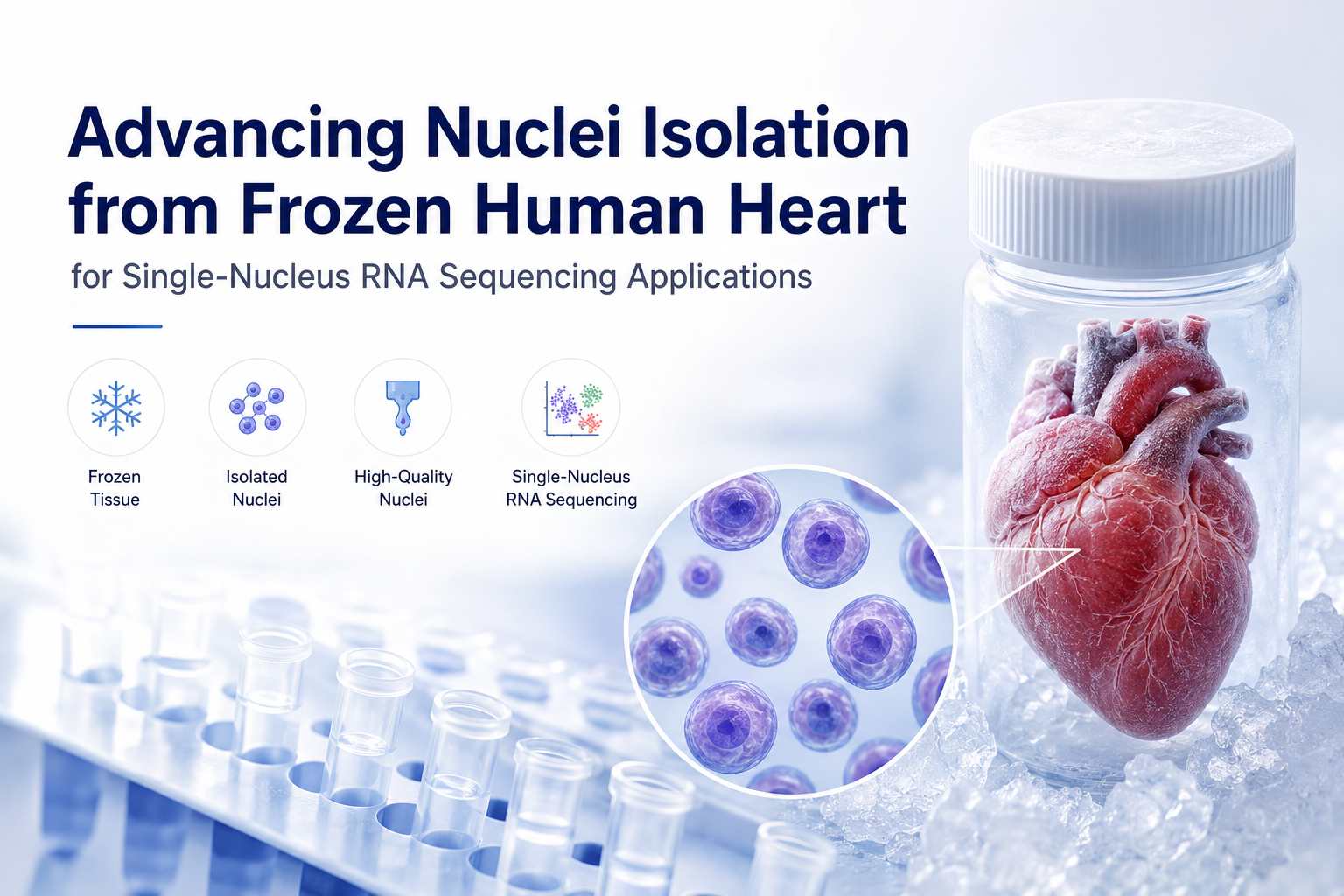
Advances in nuclei isolation from frozen human heart tissue help address the challenges created by its dense extracellular matrix and complex cardiac architecture. Modern methods use an optimized, multistep workflow involving controlled tissue disruption, filtration, debris removal, and nuclei purification to preserve nuclear integrity and RNA quality for single-nucleus RNA sequencing.
Nuclei isolation from frozen human heart tissue offers a practical and powerful path forward. Instead of needing fresh tissue, researchers can use frozen cardiac tissue to study gene expression, disease biology, cell-type diversity, and transcriptomic changes in human heart samples. With the right workflow, frozen tissue can support high-quality single-nucleus RNA sequencing applications and help expand the value of archived clinical and research specimens.
Why Frozen Human Heart Tissue Matters for snRNA-seq
Frozen tissue samples are valuable because they make human cardiac research more flexible. Fresh human heart tissue is not always available, and collection timing can be difficult to control. Frozen tissue allows researchers to use stored samples from biobanks, surgical collections, transplant programs, and disease studies.
Frozen Samples Expand Research Access
Single-nucleus RNA sequencing works well with frozen tissue because nuclei can often be recovered even when intact whole cells are difficult to preserve. This makes snRNA-seq useful for clinically relevant samples where fresh tissue processing is not possible.
Human Heart Samples Support Disease Research
Human heart tissue can be used to study heart failure, cardiomyopathy, ischemic injury, fibrosis, aging, and cardiac remodeling. By profiling nuclei from different cardiac cell types, researchers can better understand how gene expression changes in health and disease.
Transcriptomic Profiling from Archived Material
Frozen cardiac tissue can support transcriptomic profiling across patient groups, disease stages, and anatomical regions. This helps researchers compare gene expression patterns and identify cell-type-specific changes that may not be visible in bulk RNA sequencing.
Why Nuclei Isolation from Frozen Human Heart Tissue Is Challenging
The human heart is a strong, fibrous, and heterogeneous tissue. This makes nuclei isolation more complex than isolation from softer tissues.
Dense Extracellular Matrix
Cardiac tissue contains a dense extracellular matrix that gives the heart mechanical strength. During nuclei isolation, this structure can make tissue disruption difficult and may increase debris if homogenization is too harsh.
Complex Cardiac Architecture
The heart contains organized muscle fibers, vascular structures, connective tissue, and interstitial cells. This architecture requires careful mechanical disruption so nuclei can be released without excessive damage.
Heterogeneous Cell Composition
Human cardiac tissue includes cardiomyocytes, fibroblasts, endothelial cells, smooth muscle cells, immune cells, pericytes, and other cell populations. A good nuclei isolation workflow should preserve broad cell-type representation while reducing debris and damaged material.
Frozen Tissue Fragility
Frozen tissue is useful, but freeze-thaw handling must be controlled. Repeated thawing, warming, or aggressive processing can reduce nuclei quality and increase background RNA.
Single-Nucleus RNA Sequencing vs Single-Cell RNA Sequencing in Cardiac Tissue
Single-cell RNA sequencing usually depends on fresh tissue and intact viable cells. For heart tissue, this can be difficult because cardiomyocytes are large, fragile, and structurally complex.
Why snRNA-seq Is Useful for Human Heart
Single-nucleus RNA sequencing focuses on nuclei instead of whole cells. This makes it better suited for frozen tissue samples and difficult-to-dissociate tissues. It can also help capture cell types that may be underrepresented in whole-cell dissociation workflows.
Benefits for Cardiac Transcriptomics
Human cardiac tissue snRNA-seq can reveal cell-type-specific gene expression patterns. It can help researchers study cardiomyocytes, fibroblasts, vascular cells, immune cells, and disease-associated cell states in one workflow.

Overview of a Frozen Human Heart snRNA-seq Workflow
A strong single-nucleus RNA sequencing workflow starts before tissue disruption and continues through data analysis.
Frozen Tissue Selection
Select well-preserved frozen human heart tissue with clear sample history. Tissue region, storage conditions, ischemic time, disease context, and freeze-thaw history can all influence nuclei quality.
Cold Buffer Preparation
Prepare nuclei isolation buffer, wash buffer, cleanup reagents, tubes, filters, and centrifuge settings before removing tissue from storage. A prepared workspace helps reduce delays and supports RNA quality.
Controlled Homogenization
Frozen cardiac tissue should be disrupted gently but effectively. The goal is to release nuclei while limiting shear damage, foam, clumps, and excessive debris.
Sequential Cleanup
Frozen human heart tissue often benefits from multiple cleanup steps. These may include filtration, low-speed spins, washing, debris removal, and other nuclei purification steps depending on the protocol.
Nuclei QC and Loading
Before sequencing, nuclei should be checked for concentration, morphology, clumping, and debris. Clean, nuclei-dominant suspensions are more suitable for downstream single-nucleus RNA sequencing applications.
Step 1: Selecting Frozen Human Cardiac Tissue
Good nuclei isolation begins with good sample selection.
Choose the Right Cardiac Region
Many studies focus on the left ventricle because it is highly relevant to heart failure, hypertrophy, ischemic injury, and remodeling. However, other regions may also be useful depending on the research goal.
Avoid Repeated Freeze-Thaw Cycles
Repeated thawing can damage nuclei and increase ambient RNA. Keep tissue frozen until processing begins and work quickly once the sample is exposed.
Record Sample Metadata
Document tissue source, cardiac region, storage duration, disease status, collection method, and processing time. This information supports better interpretation of gene expression data.
Step 2: Preparing Buffers and Work Area
Preparation is one of the easiest ways to improve consistency.
Keep Everything Cold
Use pre-chilled tubes, buffers, tools, and centrifuge rotors. Cold handling helps preserve nuclear integrity and RNA quality.
Use RNase-Safe Conditions
Use clean, RNase-aware techniques. Add RNase inhibitors when required by the workflow and avoid unnecessary exposure to warm conditions.
Organize Before Thawing
Do not begin thawing or cutting frozen tissue until the workflow is ready. This reduces delays and improves reproducibility.
Step 3: Gentle Homogenization of Frozen Heart Tissue
Homogenization must be strong enough to release nuclei but gentle enough to preserve them.
Avoid Over-Homogenization
Too much force can damage nuclei and increase debris. Use controlled strokes or mechanical settings validated for frozen cardiac tissue.
Reduce Clumps and Foam
Foaming and clumps can affect counting, filtration, and platform loading. Use gentle pipetting and avoid vortexing nuclei suspensions.
Optimize for Fibrotic Tissue
Fibrotic or diseased cardiac tissue may require adjusted homogenization and cleanup conditions. A flexible but standardized approach helps maintain quality across sample types.
Step 4: Sequential Cleanup for High-Quality Nuclei
Sequential cleanup is especially helpful for frozen cardiac tissue because the heart can release extracellular matrix fragments, cytoplasmic material, and debris during disruption.
Remove Large Debris
Filtration helps remove tissue fragments and large particles. Gentle filtration supports cleaner nuclei suspension without excessive loss.
Reduce Cytoplasmic and Mitochondrial Background
Cleaner nuclei preparations can help reduce background signal and improve downstream transcriptomic profiling.
Balance Yield and Purity
The goal is not only to maximize nuclei number. The final preparation should also be clean enough for reliable sequencing. In many workflows, a balanced yield-purity approach gives the best result.
Step 5: Nuclei Counting and Quality Control
Quality control helps researchers decide whether a sample is ready for library preparation.
Check Nuclei Morphology
Microscopy can show whether nuclei are intact, round, and clean. It can also reveal clumps, debris, or damaged material.
Measure Nuclei Concentration
Accurate nuclei concentration helps with correct loading. Underloading may reduce recovered nuclei, while overloading may increase doublets or poor-quality data.
Review Debris and Clumping
Debris and clumps should be minimized before sequencing. If needed, additional gentle cleanup or filtration can improve sample quality.
Key Quality Metrics for Human Cardiac Tissue snRNA-seq
After sequencing, several metrics help evaluate data quality.
Genes Detected per Nucleus
A higher number of detected genes can indicate stronger library complexity, although values depend on sequencing depth, platform, and sample quality.
UMI Counts per Nucleus
UMI counts help estimate transcript capture. Consistent UMI profiles support better comparison between samples.
Mitochondrial Read Fraction
High mitochondrial read fraction may suggest lower sample quality, contamination, or damaged material. Filtering thresholds should match the platform and study design.
Cell-Type Representation
Human cardiac tissue contains multiple cell populations. Good nuclei isolation should support detection of key cardiac cell types without strong technical bias.
Common Problems in Frozen Human Heart Nuclei Isolation
Low Nuclei Yield
Low yield may occur due to incomplete homogenization, tissue loss, pellet loss, or overly strict cleanup. Optimize tissue input, homogenization, and recovery steps carefully.
High Debris
Dense extracellular matrix and fibrotic tissue can increase debris. Sequential cleanup and gentle filtration can improve suspension quality.
Nuclei Clumping
Clumping may come from released DNA, debris, or high concentration. Gentle resuspension and proper filtration help create a smoother nuclei suspension.
Damaged Nuclei
Damaged nuclei may result from sample warming, aggressive homogenization, or repeated freeze-thaw cycles. Cold handling and controlled processing help preserve nuclei quality.
Low Gene Detection
Low gene detection may reflect RNA degradation, poor nuclei integrity, high background, insufficient sequencing depth, or suboptimal library preparation. Strong QC before sequencing helps reduce this risk.
Troubleshooting Table for Frozen Human Heart Nuclei Isolation
|
Problem |
Possible Cause |
Practical Solution |
|
Low nuclei yield |
Incomplete homogenization |
Optimize gentle tissue disruption |
|
Damaged nuclei |
Over-homogenization or warming |
Keep samples cold and reduce shear |
|
High debris |
Dense cardiac ECM |
Use sequential cleanup and filtration |
|
Clumping |
Released DNA or debris |
Resuspend gently and filter carefully |
|
Poor gene detection |
Low RNA quality or high background |
Improve cold handling and nuclei QC |
|
Variable results |
Inconsistent workflow |
Standardize input, timing, and cleanup |
Applications of Human Cardiac Tissue snRNA-seq
Single-nucleus RNA sequencing applications in cardiac tissue are expanding quickly.
Heart Failure Research
snRNA-seq can help identify gene expression changes in cardiomyocytes, fibroblasts, endothelial cells, and immune populations during heart failure.
Cardiomyopathy Studies
Human cardiac tissue snRNA-seq can support studies of inherited or acquired cardiomyopathies by revealing cell-type-specific transcriptomic changes.
Fibrosis and Remodeling
Fibroblast activation, extracellular matrix remodeling, vascular changes, and inflammatory signaling can be studied with greater resolution.
Biomarker and Target Discovery
Cell-type-specific gene expression can support biomarker research and help identify pathways that may be relevant for future therapeutic studies.
FireGene Support for Nuclei Isolation and snRNA-seq Workflows
High-quality nuclei isolation is a key starting point for reliable single-nucleus RNA sequencing. For frozen human heart tissue, researchers benefit from workflows that protect nuclei integrity, reduce debris, and support consistent transcriptomic profiling.
FireGene supports research-use sample preparation workflows for nuclei isolation, tissue processing, cleanup, and sequencing-ready sample preparation. These workflow-focused solutions can help researchers work more confidently with complex tissues such as human cardiac tissue.
FAQs
What is nuclei isolation from frozen human heart tissue?
It is a sample preparation workflow that releases nuclei from frozen cardiac tissue so they can be used for single-nucleus RNA sequencing and transcriptomic profiling.
Why is single-nucleus RNA sequencing useful for frozen cardiac tissue?
Single-nucleus RNA sequencing is useful because it can profile frozen tissue samples without needing intact live cells. This makes it valuable for archived human heart specimens.
Why is human heart tissue difficult for nuclei isolation?
Human heart tissue is dense, fibrous, and heterogeneous. Its extracellular matrix, complex architecture, and large cardiomyocytes can make nuclei release and cleanup more challenging.
Can frozen human heart tissue be used for transcriptomic profiling?
Yes. With optimized nuclei isolation and quality control, frozen human heart tissue can support transcriptomic profiling and gene expression analysis.
What affects nuclei quality in frozen cardiac tissue?
Nuclei quality can be affected by tissue storage, freeze-thaw history, homogenization strength, cleanup quality, temperature control, and processing time.
How can nuclei yield be improved from frozen human heart samples?
Yield can be improved by using suitable tissue input, preparing reagents in advance, keeping samples cold, optimizing homogenization, reducing pellet loss, and using gentle cleanup steps.
What QC steps are needed before snRNA-seq?
Important QC steps include checking nuclei morphology, concentration, debris, clumping, and loading suitability before sequencing.
Which cardiac cell types can be studied with human heart snRNA-seq?
Human cardiac tissue snRNA-seq can help study cardiomyocytes, fibroblasts, endothelial cells, smooth muscle cells, immune cells, pericytes, and other cardiac cell populations.
Conclusion
Nuclei isolation from frozen human heart tissue is a valuable foundation for modern single-nucleus RNA sequencing applications. Although cardiac tissue is dense and structurally complex, a positive and well-planned workflow can improve nuclei recovery, sample cleanliness, and sequencing readiness.
By combining careful tissue selection, cold handling, gentle homogenization, sequential cleanup, filtration, nuclei QC, and thoughtful data analysis, researchers can use frozen human cardiac tissue for powerful transcriptomic profiling. This supports better gene expression analysis, deeper insight into cardiac disease biology, and more reproducible human heart snRNA-seq studies.


