
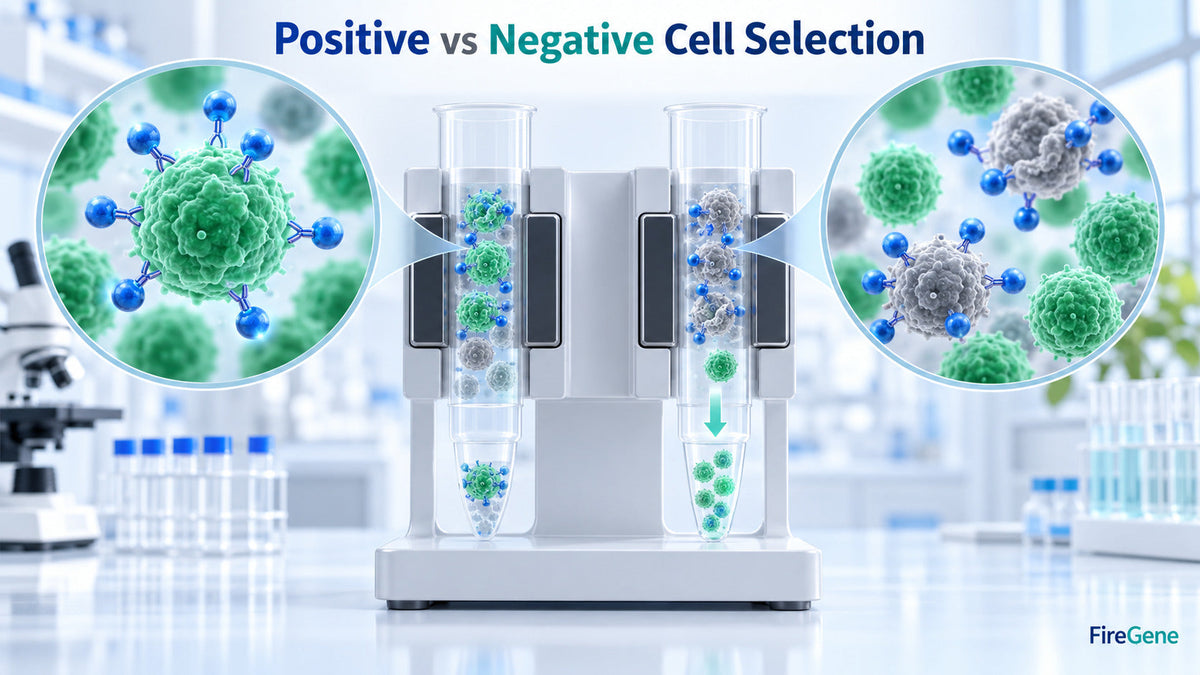
Positive selection directly captures cells expressing a chosen surface marker, while negative selection removes unwanted cells and leaves the target population comparatively untouched; the right cell isolation method depends on the desired purity, cell recovery, phenotype and downstream application.
Both selection techniques can produce enriched immune cell populations for cell sorting, flow cytometry, cell culture, single-cell sequencing and functional research. The most effective workflow begins before target-cell selection, however. A clean, viable and well-dispersed starting sample helps the selected method perform consistently. For blood-based immune cell isolation, researchers can first prepare peripheral blood mononuclear cells using the FireGene Human PBMC Isolation Solution. Additional FireGene sample-cleanup solutions can help manage dead cells, debris and cell aggregation before subsequent positive or negative cell selection.
FireGene Solutions for Pre-Selection Sample Preparation
|
Workflow requirement |
Relevant FireGene product |
Sample-preparation value |
|
Isolating PBMCs from human blood |
Prepares low-impurity mononuclear cell suspensions for immune-cell analysis |
|
|
Enriching viable cells |
Removes unwanted dead cells before selection or analysis |
|
|
Removing dead cells and debris |
Supports cleaner single-cell suspensions for downstream workflows |
|
|
Maintaining a uniform suspension |
Helps reduce aggregation during cell processing |
These FireGene products support sample preparation before target-cell selection. They are not positive- or negative-selection magnetic bead kits.
What Is Cell Isolation?
Cell isolation is the process of separating one cell population from a heterogeneous biological sample. The starting material may be whole blood, peripheral blood mononuclear cells, bone marrow, cultured cells or a dissociated tissue specimen.
Researchers use cell isolation techniques to enrich populations such as:
- CD4+ T cells
- CD8+ T cells
- B cells
- Natural killer cells
- Monocytes
- Dendritic cells
- Stem and progenitor cells
- Tumor-associated immune cells
An enriched population helps researchers study cellular phenotype, gene expression, activation, signaling, differentiation and response to experimental conditions with greater clarity.
Cell Isolation vs Cell Sorting
Cell isolation is a broad term covering methods used to enrich or separate cells. Cell sorting is one form of cell isolation and may involve magnetic separation, fluorescence-activated cell sorting, density-gradient centrifugation, filtration or other physical and biological techniques. Positive and negative selection commonly use antibodies that recognize surface markers. These antibodies are often combined with magnetic particles, allowing labeled and unlabeled populations to be separated in a magnetic field.
Cell-Isolation Selection Is Different from Thymic Selection
In this article, positive and negative selection describe laboratory cell-separation techniques. These terms are also used in immunology to describe T-cell development in the thymus, but that is a different biological process. Clarifying this distinction helps search engines and readers understand that the article focuses on isolating target cells from research samples.
How Does Positive Selection Work?
Positive selection isolates target cells by recognizing a surface antigen expressed on the desired population. An antibody specific to that marker is linked directly or indirectly to a separation particle, commonly a magnetic bead. When the prepared sample enters a magnetic separation device, labeled target cells are retained or moved in response to the magnetic field. Unlabeled cells are removed, and the enriched target population is then collected according to the system’s protocol. For example, CD4+ T-cell isolation may use an antibody directed against CD4. Cells expressing the selected marker are captured, producing an enriched CD4+ population.
Advantages of Positive Cell Selection
Positive cell selection provides several practical benefits:
- Direct enrichment of a clearly defined target population
- Strong specificity when a reliable marker is available
- Efficient isolation of relatively rare cell populations
- Straightforward marker-based workflow design
- High target-cell enrichment under optimized conditions
- Compatibility with many research applications
Because the method directly identifies the desired cells, it can be especially valuable when the target population has a well-characterized and consistently expressed surface marker.
When to Choose Positive Selection
Positive selection is a strong option when:
- A specific target-cell marker is known
- High enrichment is a central workflow goal
- The target population is relatively uncommon
- Directly labeled cells are suitable for downstream use
- The selected surface marker remains appropriate throughout processing
- The protocol includes an effective label-removal step when required
The target marker should represent the desired population accurately. Researchers may also assess whether antibody binding could influence the marker or cellular function relevant to their downstream experiment.

How Does Negative Selection Work?
Negative selection enriches target cells by labeling the cell populations that are not required. The labeled unwanted cells are retained or removed through magnetic separation, while the target cells remain in the unbound fraction. For T-cell isolation, a negative-selection antibody mixture may recognize markers found on B cells, monocytes, natural killer cells, granulocytes or other non-target populations. Removing these cells enriches the desired T-cell fraction without directly labeling the T cells. This approach is sometimes described as depletion because the workflow depletes unwanted populations rather than directly capturing the target cells.
Advantages of Negative Cell Selection
Negative cell selection offers valuable benefits for sensitive downstream workflows:
- Target cells remain comparatively untouched
- No target-specific antibody is directly attached to the final cells
- Multiple unwanted populations can be removed simultaneously
- Cell-surface receptors of interest remain available for later staining
- The method supports functional assays and cell culture
- It can preserve flexibility for downstream phenotyping
These features make negative selection appealing when researchers want an enriched population with minimal direct manipulation of the target cells.
When to Choose Negative Selection
Negative selection can be a suitable choice when:
- Untouched target cells are preferred
- The target marker will be studied after isolation
- Cell activation or receptor function is part of the experiment
- Downstream antibody staining requires accessible surface markers
- A validated depletion-marker panel is available
- Functional cell assays follow the isolation step
Performance depends on how comprehensively the antibody panel identifies unwanted cells. A well-designed depletion strategy can provide a useful combination of enrichment, recovery and downstream flexibility.

Positive Selection vs Negative Selection for Cell Isolation
|
Selection factor |
Positive selection |
Negative selection |
|
Cells directly labeled |
Target cells |
Unwanted cells |
|
Population collected |
Captured target cells |
Unlabeled target-cell fraction |
|
Primary marker requirement |
Marker on the target cells |
Markers on unwanted cell populations |
|
Target-cell status |
Directly labeled during separation |
Comparatively untouched |
|
Enrichment strategy |
Direct capture |
Depletion of non-target cells |
|
Rare-cell isolation |
Particularly useful with a distinct marker |
Depends on depletion panel and starting frequency |
|
Receptor availability |
Selected marker may remain occupied temporarily |
Target markers remain available |
|
Functional assays |
Suitable after method validation |
Often preferred for minimally manipulated cells |
|
Protocol design |
Focused on one or more target markers |
Requires a comprehensive exclusion panel |
|
Best choice |
Defined target and strong enrichment goal |
Untouched cells and downstream functional flexibility |
The best selection method balances purity, recovery, viability and biological relevance rather than focusing on one metric alone.

How to Choose Between Positive and Negative Selection
1. Define the Required Cell Purity
Purity describes the percentage of the final sample represented by the target population. Some experiments benefit from highly enriched cells, while others can work effectively with moderate enrichment. Positive selection can provide strong enrichment when the target has a distinct surface marker. Negative selection can also produce a high-quality population when the depletion panel covers the major unwanted cell types in the starting sample. The appropriate purity target should be established before choosing the method.
2. Consider Target-Cell Recovery
Recovery describes how many target cells remain after processing compared with the number present in the starting material. A method may deliver excellent purity while recovering fewer total cells, or it may maximize recovery with a slightly more heterogeneous final population.
For low-abundance populations, researchers should consider:
- Starting sample volume
- Expected target-cell frequency
- Minimum cell number required downstream
- Cell loss during washing and transfer
- Final viable-cell concentration
Recording both purity and recovery provides a more complete assessment of cell isolation performance.
3. Evaluate Surface-Marker Expression
Positive selection requires a marker that is sufficiently specific and consistently expressed on the target population. Marker density may vary between donors, cell states, disease models and experimental conditions. Negative selection relies on identifying unwanted populations. It is valuable when the target cells lack one unique marker or when researchers want to preserve target-cell receptors for later analysis.
4. Match the Method to the Downstream Application
For basic phenotyping, either selection method may be suitable after validation. Functional assays can benefit from untouched cells prepared through negative selection, particularly when receptor availability and natural cellular behavior are important. Positive selection can be highly effective when the target population must be isolated efficiently for molecular analysis, culture or additional purification.
Potential downstream applications include:
- Flow cytometry
- Single-cell RNA sequencing
- Cell culture
- Cytokine-response assays
- T-cell activation studies
- T-cell expansion
- Gene-expression analysis
- Proteomic analysis
- Drug discovery research
5. Consider Processing Time and Throughput
Workflow simplicity becomes increasingly important when processing multiple donors or large sample batches. Researchers can compare incubation time, wash steps, number of transfers and hands-on processing requirements. Standardizing these steps supports consistent results across operators and experimental days.
Positive vs Negative Selection for Specific Immune Cells
T-Cell Isolation
T-cell isolation is one of the most common applications of immune cell separation. Positive selection can directly capture cells expressing CD3, CD4 or CD8. Negative selection can remove non-T cells and produce an untouched T-cell fraction. For T-cell activation and expansion studies, researchers often consider how direct antibody binding may relate to the receptor or function being investigated. Negative selection can preserve flexibility, while positive selection offers direct enrichment of a defined T-cell subset.
CD4+ T-Cell Selection
CD4+ T cells can be enriched through direct CD4-positive selection or through depletion of non-CD4 populations. Direct selection is useful when a clearly defined CD4+ population is required. Negative selection is valuable when researchers want CD4+ cells without target-bound isolation antibodies. The ideal method depends on required purity, available cell numbers and the planned phenotypic or functional analysis.
Monocyte Isolation
Monocytes can be positively selected using markers such as CD14 or enriched by removing other blood-cell populations. Positive selection provides direct enrichment, while negative selection supports preparation of comparatively untouched monocytes. Because monocytes can respond to handling conditions, gentle sample processing, appropriate temperature control and efficient workflow timing help maintain sample quality.
Other Immune Cell Populations
B cells, natural killer cells and dendritic-cell subsets may also be isolated by positive or negative selection. Each population benefits from a marker strategy aligned with the starting material and biological question. For complex panels, researchers can consider sequential enrichment, multiparameter cell sorting or combined isolation techniques.
Why Starting-Sample Quality Matters
Competitor comparisons often focus on selection beads and target markers. However, the starting sample can influence purity, recovery and repeatability before the selection reagents are introduced.
PBMC Isolation Before Target-Cell Selection
Human peripheral blood contains red blood cells, granulocytes, platelets and mononuclear cells. Density-based PBMC preparation creates a practical starting population for subsequent immune cell isolation. The FireGene Human PBMC Isolation Solution is designed to isolate lymphocytes and PBMCs from diluted human peripheral blood. The workflow uses controlled layered separation and horizontal centrifugation, followed by mononuclear-cell collection, optional red blood cell management, washing and resuspension. The prepared cells are suitable for research workflows including flow cytometry, single-cell sequencing, cell culture and immune-cell profiling.
Dead-Cell Removal Before Selection
A viable starting suspension supports efficient antibody binding, separation and downstream analysis. When a PBMC or tissue-derived sample contains a substantial dead-cell fraction, a cleanup step can enrich viable cells before target-cell selection. The FireGene Dead Cell Removal Solution uses a density-based layered separation workflow for single-cell suspensions prepared from mammalian tissues. It supports cleaner sample backgrounds for cell counting, flow cytometry, culture and single-cell sequencing.
Debris Management
Tissue-derived immune cell samples can contain extracellular material, apoptotic bodies and tissue fragments. The FireGene Dead Cell Debris Removal Kit is designed to remove dead cells and debris while enriching intact viable cells. This preparation step can help researchers present a cleaner suspension to the subsequent selection system.
Aggregation Control
Individual cells interact more consistently with isolation antibodies and separation particles than large aggregates. Uniform suspensions also support accurate counting, staining and sample loading. The FireGene Anti-Clumping Agent can support single-cell suspension quality during sample processing. Compatibility should be confirmed for the selected cell type and downstream assay.
A Practical Immune Cell Isolation Workflow
- Define the target population: Identify the desired cell type, relevant markers and required final purity.
- Prepare the starting sample: Isolate PBMCs from human peripheral blood or dissociate the relevant tissue.
- Assess sample quality: Record cell concentration, viability, visible debris and aggregation.
- Apply cleanup when beneficial: Remove dead cells, debris or residual unwanted material.
- Select the isolation strategy: Choose positive selection for direct target capture or negative selection for untouched-cell enrichment.
- Optimize cell concentration: Follow the selected separation system’s recommended input range.
- Perform the separation: Keep incubation, mixing and wash conditions consistent.
- Evaluate the final population: Measure viable-cell recovery, purity and concentration.
- Proceed to downstream analysis: Prepare cells for flow cytometry, culture, activation, expansion or sequencing.
Documenting each stage makes it easier to identify the conditions that provide the best balance of enrichment and recovery.

Frequently Asked Questions
What is the main difference between positive and negative selection?
Positive selection labels and captures the target cells directly. Negative selection labels and removes unwanted populations, leaving the target cells comparatively untouched.
Is positive selection more pure than negative selection?
Positive selection can provide strong enrichment when the target population has a specific and consistently expressed marker. Negative selection can also achieve excellent enrichment when the depletion panel effectively covers unwanted cells.
Which method is better for T-cell isolation?
The best method depends on the experiment. Positive selection is useful for direct enrichment of CD3+, CD4+ or CD8+ cells. Negative selection is often used when untouched T cells and accessible surface receptors are important.
Does negative selection activate T cells?
Negative selection avoids directly labeling the target T cells, making it attractive for activation and functional studies. Researchers should still validate the complete processing workflow for their particular assay.
Can cell culture follow positive selection?
Yes. Positively selected cells can be used for culture when the isolation system and labeling approach are compatible with the intended experiment.
Should PBMCs be isolated before T-cell selection?
PBMC isolation provides a concentrated mononuclear-cell starting population and is commonly performed before T-cell separation from human peripheral blood. The exact workflow depends on the selected isolation system.
Should dead cells be removed before target-cell selection?
Dead-cell removal can be valuable when the starting sample contains a substantial nonviable fraction. Researchers can compare viable-cell recovery before and after cleanup to determine the best workflow for their sample.
What metrics should be reported after cell isolation?
Useful metrics include final purity, viable-cell recovery, total cell concentration, viability percentage, processing time and performance in the intended downstream assay.
Conclusion
Positive and negative selection are complementary cell isolation techniques. Positive selection provides direct capture of a defined target population, while negative selection enriches comparatively untouched target cells by removing unwanted populations.
Whichever method is selected, high-quality starting material provides a strong foundation. FireGene supports the pre-selection workflow with solutions for human PBMC isolation, viable-cell enrichment, debris removal and aggregation control. Explore FireGene PBMC isolation products or contact FireGene to discuss a sample-preparation workflow for your immune-cell research.


