
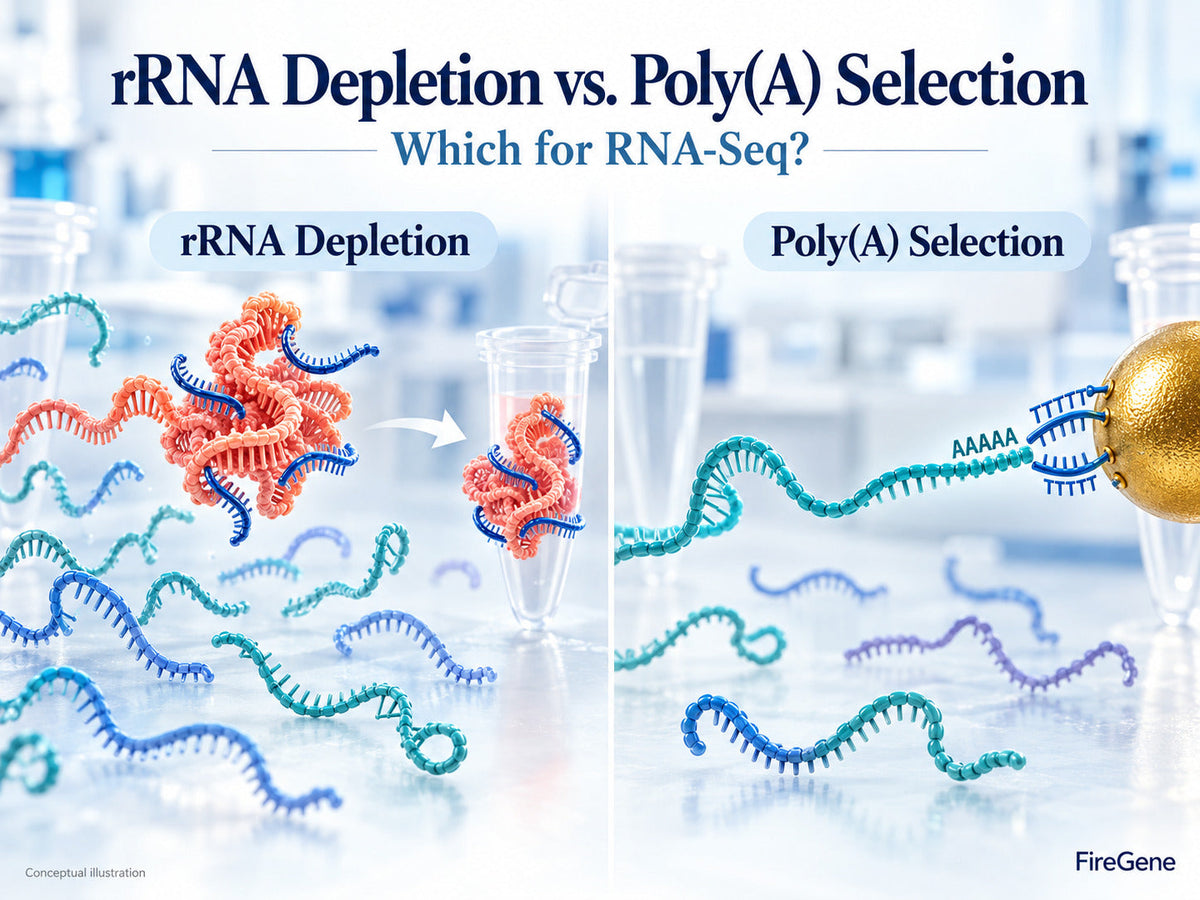
Choose poly(A) selection for suitable intact eukaryotic RNA when polyadenylated gene expression is your main target, and evaluate rRNA depletion for broader transcript coverage, non-polyadenylated targets, or compatible degraded-RNA workflows. The best approach matches your research question, organism, RNA quality, and library-preparation requirements. Both methods help direct sequencing toward informative RNA populations. Poly(A) selection enriches transcripts carrying poly(A) tails, while rRNA depletion targets specified ribosomal RNA sequences for removal. FireGene’s Cell RNA Extraction Kit, Tissue RNA Extraction Kit, and FFPE RNA Extraction Kit support upstream sample preparation. Combine extraction with a compatible selection or depletion method and a qualified RNA-Seq library workflow.
Quick Answer: Start with three questions: Which transcripts matter? What organism are you studying? What is the condition of your RNA? These answers guide enrichment chemistry, product compatibility, and sequencing planning.
Related FireGene Products for RNA-Seq Sample Preparation
A suitable RNA extraction method provides the starting material for downstream selection, depletion, and library preparation.
|
FireGene product |
Intended preparation stage |
What to confirm before ordering |
|
Total RNA extraction from cultured cells |
Cell input, current format, DNase procedure, and downstream input requirements |
|
|
RNA extraction from supported tissue samples |
Tissue compatibility, preparation instructions, and expected RNA characteristics |
|
|
Total RNA extraction from paraffin sections |
Section requirements, recovered fragment quality, and library-kit compatibility |
FireGene’s cell and FFPE product pages list next-generation sequencing among downstream applications. Selection or depletion and sequencing-library construction remain separate workflow stages. firegene.com
What Is Poly(A) Selection?
Poly(A) selection enriches RNA molecules carrying polyadenylated tails, commonly through hybridization to oligo-dT attached to magnetic beads. This approach concentrates the library input on polyadenylated transcripts. It supports many eukaryotic gene-expression studies and can capture polyadenylated noncoding RNAs alongside coding mRNA.
When Poly(A) Selection Fits
Poly(A) selection for RNA-Seq is a practical option when your samples meet the kit’s integrity requirements and your main targets are polyadenylated transcripts. For protein-coding gene-expression studies, enriching this population can concentrate sequencing reads on relevant exonic regions. Confirm the recommended input amount, integrity criteria, and downstream library compatibility before choosing a product. Poly(A) capture and oligo-dT priming during reverse transcription are distinct workflow steps.
What Is rRNA Depletion?
rRNA depletion reduces specified ribosomal RNA populations while retaining a broader pool of other transcripts. Depending on the product, sequence-specific probes support enzymatic removal or affinity-based separation. Some workflows perform depletion after conversion to cDNA. The retained population can include polyadenylated transcripts, non-polyadenylated transcripts, and precursor RNA.
Why Species Compatibility Matters
Effective rRNA removal depends on the product’s target coverage and compatibility with your organism. Check whether the depletion system addresses relevant cytoplasmic and mitochondrial rRNA. For bacterial or mixed-species samples, review coverage for each organism of interest. Sequence-matched probes are an important purchasing consideration, particularly for non-model organisms.
rRNA Depletion vs. Poly(A) Selection: Comparison
|
Selection factor |
Poly(A) selection |
rRNA depletion |
|
Main mechanism |
Captures polyadenylated RNA |
Targets specified rRNA sequences |
|
Transcript focus |
Polyadenylated coding and noncoding transcripts |
Broader retained RNA population |
|
Research fit |
Polyadenylated gene-expression targets |
Broader transcriptome questions and non-polyadenylated targets |
|
RNA quality |
Assess against capture-kit requirements |
Evaluate formulations qualified for the sample condition |
|
Organism considerations |
Relevant polyadenylated target biology |
Appropriate probe or target coverage |
|
Sequencing allocation |
Often concentrates reads on annotated exons |
Distributes reads across more RNA classes |
|
Purchasing checks |
Input, capture chemistry, and library compatibility |
Species, depletion targets, input, and library compatibility |
Comparative research has demonstrated higher exonic coverage with poly(A) selection and broader transcript-feature capture with rRNA depletion in specific experimental settings. Interpret these findings according to the sample and analysis goal.

Which Method Matches Your Research Question?
The best RNA-Seq library preparation method begins with a defined biological endpoint.
Protein-Coding Gene Expression
For suitable eukaryotic RNA and a primary focus on polyadenylated coding transcripts, poly(A) selection offers a focused starting point. Define the genes, expression range, and statistical comparisons needed for the study. These requirements help determine sequencing allocation and replicate planning.
Noncoding RNA and Transcript Structure
For broader transcriptome analysis, rRNA depletion can support the assessment of additional RNA classes and precursor transcripts. Specify the actual targets. Many long noncoding RNAs are polyadenylated and may also be captured through poly(A) selection. For splicing or transcript-structure questions, consider read configuration, coverage, and strandedness alongside enrichment chemistry.
Bacterial RNA Sequencing
For bacterial RNA-Seq, evaluate organism-compatible rRNA depletion or another qualified enrichment approach. Standard eukaryotic poly(A) selection is generally unsuitable for broadly capturing bacterial mRNA. Species-specific coverage therefore belongs near the top of the buying checklist. For mixed samples, assess both host and microbial depletion requirements.

Choosing rRNA Depletion for Degraded RNA and FFPE Samples
Fragmented samples benefit from a workflow designed around their condition. rRNA depletion for degraded RNA is useful to evaluate because selection targets specified RNA sequences rather than requiring capture through a poly(A) tail. For FFPE RNA, combine suitable extraction with documented depletion and library-preparation compatibility.
Assess RNA Quality With Relevant Measurements
RNA integrity measurements and fragment-distribution information help characterize the available sample. For fragmented material, DV200 describes the percentage of RNA fragments longer than 200 nucleotides. Interpret it alongside input quantity and the selected library kit’s requirements. Use product-specific acceptance criteria rather than one universal threshold. Explore FireGene’s FFPE RNA extraction guide when planning upstream preparation.

Does Total RNA-Seq Capture Every RNA Type?
“Total RNA-Seq” describes a broad workflow category. Actual representation depends on extraction, depletion targets, library chemistry, and size-selection settings. For example, studying short RNAs may require specialized library preparation. Confirm the supported RNA classes and fragment range when microRNA or other small-RNA targets matter. Likewise, strandedness is a separate library-design property. Review it independently when overlapping or antisense transcripts are relevant.
Compare Sequencing Depth and Total Project Cost
Compare cost according to the experiment’s informative output. Include extraction, enrichment or depletion, library preparation, QC, sequencing, and analysis. A focused mRNA study and a broader transcriptome study may require different sequencing allocations.
A practical planning calculation is:
Estimated reads needed = desired informative reads ÷ expected informative-read fraction
For illustration, obtaining 20 million informative reads would require approximately:
- 28.6 million reads at a 70% informative fraction.
- 40 million reads at a 50% informative fraction.
These hypothetical values explain the calculation. Define “informative” consistently and estimate the fraction using relevant pilot data.
Run a Representative Pilot Before Scaling
A pilot connects product specifications with your sample and research endpoint.
|
Pilot measurement |
What it helps assess |
|
Input quantity and fragment profile |
Starting-material suitability |
|
Residual rRNA reads |
Depletion or enrichment performance |
|
Exonic, intronic, and intergenic distribution |
Representation relative to the research goal |
|
Gene-body coverage |
Coverage across transcripts |
|
Strandedness |
Agreement with the intended library design |
|
Target detection and complexity |
Useful biological information recovered |
|
Pilot measurement |
What it helps assess |
|
Input quantity and fragment profile |
Starting-material suitability |
|
Residual rRNA reads |
Depletion or enrichment performance |
|
Exonic, intronic, and intergenic distribution |
Representation relative to the research goal |
|
Gene-body coverage |
Coverage across transcripts |
|
Strandedness |
Agreement with the intended library design |
|
Target detection and complexity |
Useful biological information recovered |
Use representative samples and consistent analysis settings. Balance preparation batches across experimental groups. Maintaining a consistent selection strategy supports clearer interpretation of biological comparisons.

What to Request Before Ordering
Share your organism, sample type, RNA input, quality measurements, transcript targets, and intended sequencing platform.
Ask for:
- Supported species and RNA classes.
- Qualified input amounts and integrity ranges.
- Cytoplasmic, mitochondrial, and globin target coverage where relevant.
- Included modules and separately required reagents.
- Downstream library compatibility.
- Current pricing, pack sizes, availability, and documentation.
For blood samples, discuss globin depletion separately from rRNA depletion.
Why Choose FireGene for Upstream RNA Preparation?
FireGene provides RNA extraction options for cultured cells, tissues, and FFPE samples, helping researchers match upstream preparation to the source material. Review the Cell RNA Extraction Kit or FFPE RNA Extraction Kit, then share downstream input requirements when requesting product information.
Request RNA Extraction Pricing and Compatibility Details
Frequently Asked Questions
Is rRNA depletion better than poly(A) selection?
Each approach supports different priorities. Choose according to transcript targets, organism, sample quality, and qualified workflow performance.
Can poly(A) selection capture lncRNA?
It can capture polyadenylated lncRNAs. Assess the polyadenylation characteristics of your particular targets.
Is rRNA depletion suitable for FFPE samples?
Products qualified for fragmented or FFPE RNA can support these applications. Confirm input requirements and downstream compatibility.
Does rRNA depletion capture all small RNAs?
Capture depends on the complete library workflow. Review size-selection settings and use specialized preparation when required.
Can I combine both methods within one study?
Plan comparisons carefully because selection chemistry affects transcript representation. Keep method differences balanced and account for them during study design and analysis.
Conclusion
Choose rRNA depletion vs. poly(A) selection by matching transcript targets, organism, RNA quality, and sequencing requirements. A representative pilot helps establish informative coverage and practical project costs. Start with suitable extraction, select compatible enrichment chemistry, and verify the resulting libraries against your research goals.
Explore FireGene RNA Preparation Products or request pricing and workflow documentation to plan your upstream RNA preparation.


