
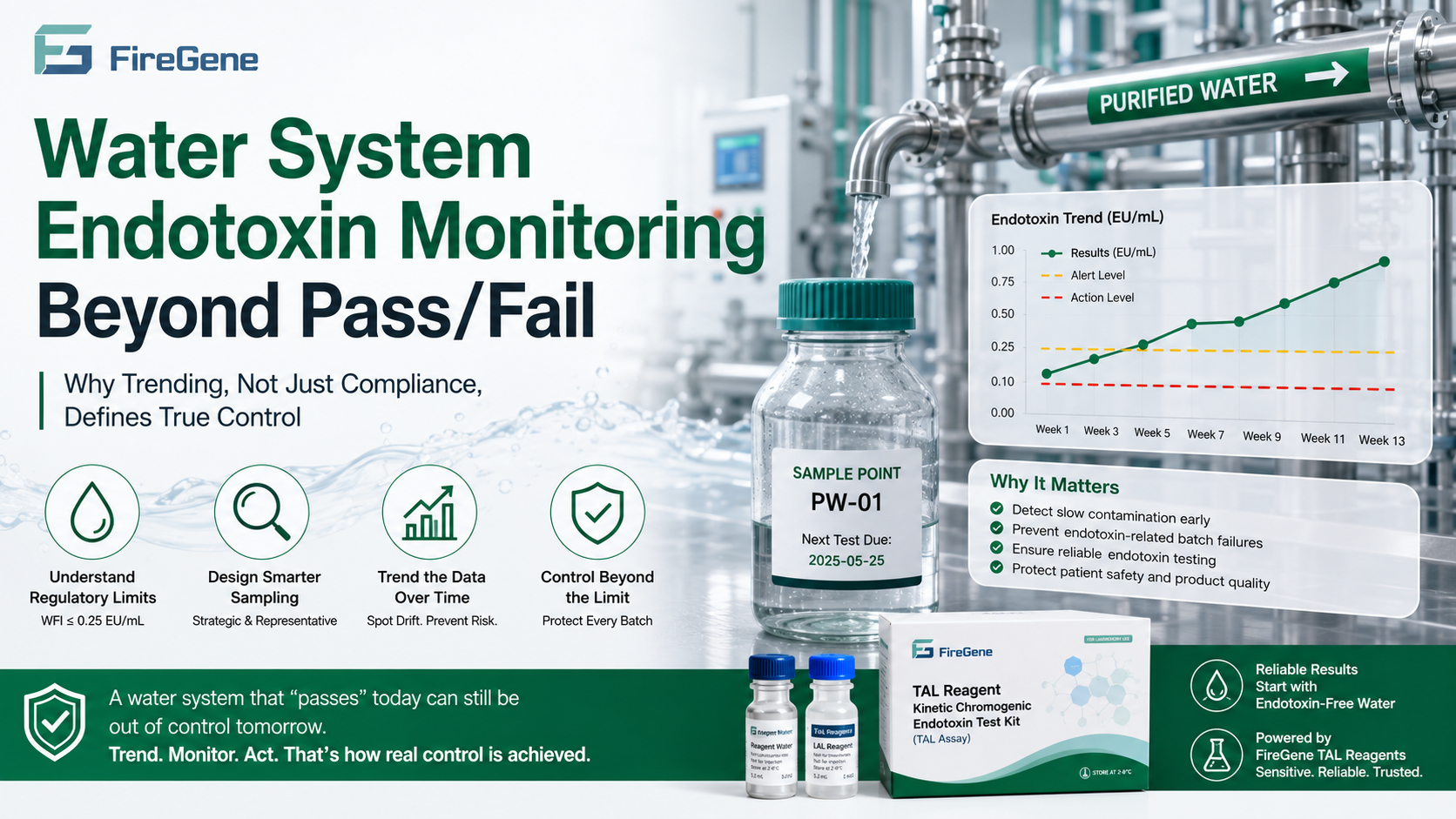
When a water system passes its routine endotoxin specification, many laboratories move on without a second thought. The result is within limits, the batch is released, and the quality record closes—until the next sampling point produces a number that is also within limits, but quietly higher than the last.
Individual results that stay below the specification limit can still tell a story of slow, progressive contamination. A water system that "passes" today is not the same as a water system that is under control. The difference lies not in any single data point, but in the trend those points form over weeks and months.
Water is, after all, the most ubiquitous material in pharmaceutical manufacturing. It is used for cleaning, formulation, dilution, steam generation, and as a raw material in its own right. It is also one of the most frequent sources of bacterial endotoxin in the laboratory and the production environment. Yet water system endotoxin monitoring is often reduced to a checkbox—a single value compared against a single limit—when it should be treated as a continuous process of risk assessment.
This article examines how to build a water system endotoxin monitoring program that goes beyond pass/fail. It covers the regulatory expectations for water for injection (WFI) and purified water (PW), how to design an effective sampling strategy, how to establish and use alert and action levels, and why trending—not specification compliance—is the true measure of control.
Why Water Systems Are the Most Critical Source of Endotoxin in the Laboratory
Every endotoxin testing workflow depends on water. Reconstituted TAL/LAL reagents, sample dilutions, standard curves, and rinsing of equipment all require water that is endotoxin-free. When the water system itself becomes a contamination source, the impact is not limited to one test—it propagates through every assay, every dilution, and every result.
Reliable endotoxin testing is only as reliable as the water that flows into it.
This is why laboratory water is one of the most frequently overlooked sources of endotoxin contamination. A reagent that fails a positive control, a standard curve that drifts between runs, or a series of marginally elevated results can all trace back to water that looked clean but was not endotoxin-free.
Gram-negative bacteria thrive in water. Given warmth, nutrients (even trace organics), and stagnation, organisms such as Pseudomonas, Burkholderia, and Ralstonia colonize pipe interiors, valve crevices, and dead legs, forming biofilms that shed endotoxin continuously or in bursts. The contamination is invisible, does not alter the water's appearance, and may persist for weeks before any single sample exceeds the specification.
Understanding this biology is essential: water system endotoxin control is not a static test. It is an ongoing battle against microbial establishment.
Understanding Water Types: WFI, PW, and Their Regulatory Endotoxin Limits
Not all pharmaceutical water carries the same regulatory expectations. The compendial framework distinguishes water grades by their intended use and the quality controls applied to them.
Water for Injection (WFI)
WFI is the highest-grade pharmaceutical water, used for the most critical applications—parenteral formulations, sterile irrigation, and other routes where endotoxin directly reaches the patient. The principal pharmacopoeias converge on a strict endotoxin limit:
- USP <85>: WFI endotoxin limit is ≤ 0.25 EU/mL
- Ph. Eur. 2.6.14: WFI endotoxin limit is ≤ 0.25 IU/mL
- JP 4.01: aligned with the same threshold
Because the limit is so low, WFI monitoring requires a method with sufficient sensitivity. The kinetic chromogenic method, with detection limits as low as 0.001 EU/mL, is particularly well suited to WFI, providing quantitative results with the dynamic range needed to track values well below the specification.
Purified Water (PW)
Purified water is used for non-parenteral applications—cleaning, equipment rinsing, oral formulations, and as feed for some systems. Unlike WFI, purified water does not carry a single compendial endotoxin limit in all monographs. However, this does not mean endotoxin is irrelevant.
When PW is used in processes that ultimately affect endotoxin-sensitive products—such as final rinsing of parenteral equipment, or as a diluent upstream of a sterile step—monitoring becomes a risk-based expectation. The limit is established by the manufacturer based on intended use, and regulators expect to see the rationale documented.
The absence of a compendial limit is not permission to stop monitoring. It is an instruction to define your own limit, based on risk, and defend it.
Water for Endotoxin Testing (LAL Reagent Water)
Separately from WFI and PW, every endotoxin testing laboratory needs water that is specifically qualified as endotoxin-free for reagent reconstitution and sample dilution. This water—often called LAL reagent water—is not the same as WFI. It must be tested to confirm it does not contribute background to the assay, and it must be stored and handled under conditions that prevent recontamination.
Endotoxin Is Not Microbial Contamination: What That Means for Water Monitoring
A common misconception is that a passing bioburden or sterility result guarantees endotoxin-free water. It does not. Endotoxin is a cell-wall component of dead gram-negative bacteria—it persists long after the organism is killed by sanitization, heat, or filtration.
This distinction has direct implications for water system monitoring:
- A microbial count of zero does not mean endotoxin is absent. Heat-sanitized or UV-treated water can be microbiologically sterile yet still contain endotoxin from lysed cells.
- Endotoxin is heat-stable. Standard pasteurization or thermal sanitization kills bacteria but does not destroy endotoxin.
- Biofilm disruption—such as after a sanitization cycle—can release a burst of endotoxin from dead cells, producing an elevated result even when the system "looks clean."
This is the same principle that explains why a product can pass sterility testing yet fail endotoxin testing. Sterility and endotoxin are independent quality attributes, and water systems must be monitored for both, independently.
Designing an Effective Water Sampling Strategy
A monitoring program is only as representative as its sampling plan. Sampling the wrong point, at the wrong frequency, or with contaminated technique produces data that looks valid but misses the real risk.
Sampling Point Selection
Water systems are not uniform. Contamination does not distribute evenly; it concentrates where flow slows, stagnates, or where surfaces are difficult to sanitize. An effective sampling plan includes:
- Points of use (POU): the most distal outlets from the generation system, where the water is actually used in production.
- Return loop sampling: the end of the recirculating loop, which reflects the cumulative condition of the entire system.
- Post-generation and post-sanitization points: to verify that the generation and distribution systems are performing as expected.
- Stagnant or low-flow areas: dead legs, unused branches, and valve crevices where biofilm is most likely to establish.
Each critical point should be documented on a sampling map, and the rationale for each point's inclusion should be defensible during inspection.
Sampling Frequency
Frequency should match the risk of the water grade and its use:
- WFI: typically monitored at each point of use at defined intervals—often daily or per batch, with comprehensive loop sampling at a minimum frequency (e.g., weekly).
- PW used in endotoxin-sensitive processes: monitored at a risk-based frequency, typically weekly or biweekly per point.
- After any system disturbance: sanitization, maintenance, filter change, or repair should trigger additional sampling to verify return to a controlled state.
Sample Volume and Container Requirements
The sample volume must be sufficient for the intended test and for a retain. For kinetic chromogenic testing in a 96-well format, small volumes (1–2 mL) suffice for routine analysis, but laboratories should collect enough to allow for repeat testing and investigation.
Containers must be endotoxin-free. This is non-negotiable. A sample collected in a container that contributes endotoxin invalidates the result entirely. Use only containers certified as pyrogen-free, or glassware that has been depyrogenated under validated conditions.
The most sophisticated analytical method cannot rescue a sample collected in a contaminated container.
Sampling Technique
Sampling technique is a frequent source of false positives. Analysts should:
- Flush the outlet for a defined period before collecting, to clear any endotoxin that accumulated at the point of use.
- Avoid touching the container interior or rim with gloves, hands, or the outlet itself.
- Cap the container immediately after collection.
- Transport samples promptly and test within the validated hold time—endotoxin is stable, but microbial growth in the sample can elevate results over time if bioburden is present.
Alert and Action Levels: Why Specification Limits Are Not Enough
The specification limit for WFI (0.25 EU/mL) is a hard boundary: exceed it, and the water fails. But operating a system that only ever produces results at 0.24 EU/mL is not good control—it is a system on the verge of failure that no one has noticed.
This is where alert and action levels come in. They are proactive thresholds, set below the specification limit, designed to detect deterioration before it becomes a compliance event.
The Difference Between Specification, Alert, and Action Levels
|
Level |
Purpose |
Typical Basis |
|
Specification limit |
Hard pass/fail boundary |
Compendial (e.g., 0.25 EU/mL for WFI) |
|
Action level |
Trigger immediate investigation and corrective action |
Set below specification, based on historical data |
|
Alert level |
Signal early drift; increase monitoring scrutiny |
Set below action level, based on historical data |
The specification limit tells you whether the water is acceptable today. Alert and action levels tell you whether the system is trending toward a problem tomorrow.
How to Establish Alert and Action Levels
Alert and action levels should not be arbitrary. They are derived from the system's own historical performance, typically using one of these approaches:
- Statistical method: after collecting sufficient baseline data (commonly 30–100 consecutive in-specification results), calculate the mean and standard deviation. Set the alert level near the 95th percentile (mean + 2σ) and the action level near the 99th percentile (mean + 3σ).
- Percentile method: for non-normally distributed data (common with low-level endotoxin results that cluster near the detection limit), use the 95th and 99th percentiles directly.
- Fixed multiplier: some laboratories use a fixed fraction of the specification limit (e.g., alert at 50%, action at 75%) as a starting point before sufficient historical data exists, then refine statistically.
These levels must be reviewed periodically. As a system ages, as sanitization frequency changes, or as production load shifts, the baseline performance changes—and so should the thresholds that detect drift.
Trending: Seeing the Drift Before the Failure
If alert and action levels are the thresholds, trending is the practice that makes them meaningful. A single elevated result is an event. A series of results that creep upward—each still within specification—is a trend. And trends, not single events, are how water systems typically fail.
Why Single-Point Results Mislead
Consider two weeks of WFI data:
- Week 1: 0.01 EU/mL
- Week 2: 0.03 EU/mL
- Week 3: 0.08 EU/mL
- Week 4: 0.15 EU/mL
Every result is within the 0.25 EU/mL specification. A pass/fail review sees four passing results. A trend review sees a fifteen-fold increase in four weeks—and a system that will exceed its limit within two more sampling cycles if no action is taken.
The specification limit asks whether the water is acceptable. The trend asks whether the system is under control. These are different questions, and both must be answered.
Statistical Process Control for Endotoxin Data
Effective trending relies on tools borrowed from statistical process control:
- Control charts (Levey-Jennings or individual-moving range): plot each result against the mean and control limits derived from historical data. Points outside the control limits, or runs of consecutive points on one side of the mean, signal non-random variation.
- Moving averages: smooth short-term fluctuation to reveal the underlying direction.
- Run rules: apply established rules (e.g., seven consecutive points trending upward, or a single point above the action level) to distinguish random noise from systematic change.
For systems where endotoxin results cluster at or near the detection limit, trending can be challenging—the data may be "left-censored." In these cases, laboratories should record the actual calculated value even when below the quantitative limit, rather than defaulting to "not detected," so that small directional changes remain visible.
Actionable Trend Review
Trending only helps if someone acts on it. The review process should define:
- Who reviews the trend and how often.
- What constitutes a trend trigger (e.g., two consecutive results above the alert level, or any result above the action level).
- What action each trigger requires—increased sampling, an investigation, sanitization, or a formal corrective and preventive action (CAPA).
Integrating AI-assisted risk assessment into trend review is increasingly common, allowing laboratories to flag subtle patterns—micro-drifts, seasonal effects, or correlations with sanitization events—that might escape manual review.
Common Causes of Out-of-Specification Endotoxin Results in Water Systems
When a water system endotoxin result exceeds the specification or action level, the cause is usually one of a small set of recurring failures. Understanding these in advance accelerates investigation and shortens the time the system remains in an uncontrolled state.
Sampling and Handling Errors
- Contaminated container: the most common cause of a false OOS. A non-pyrogen-free container, or one opened and exposed to laboratory air, introduces endotoxin unrelated to the water system.
- Insufficient flush: failing to clear the outlet allows endotoxin that accumulated at the point of use to enter the sample.
- Excessive hold time: if bioburden is present in the sample, microbial growth during storage can elevate endotoxin before testing.
Biofilm Formation
Biofilm is the single greatest biological threat to water system endotoxin control. Once established in a pipe, valve, or filter housing, a biofilm sheds endotoxin continuously and can release large bursts during flow changes or after partial sanitization. Systems with dead legs, low-flow sections, or infrequent sanitization are most vulnerable.
The danger of biofilm is that it is difficult to eradicate once established. Routine sanitization that controls planktonic bacteria may not penetrate an established biofilm, leading to a cycle of marginal results, temporary improvement after cleaning, and recurrence.
System Design and Maintenance Gaps
- Dead legs and unused branches: sections of pipe with no flow that become microbial reservoirs.
- Inadequate recirculation velocity: flow below the turbulent threshold allows biofilm adhesion.
- Filter integrity failure: a compromised final filter can allow organisms (and their endotoxin) downstream.
- Sanitization frequency gaps: intervals that were adequate at one production load may become insufficient as usage changes.
Reagent and Method Issues
Sometimes the water is fine and the test is the problem. Reagent contamination, expired TAL/LAL reagents, inadequate standard curve performance, or analyst technique errors can all produce elevated results that do not reflect the true condition of the system. These are explored in detail in the guide to why kinetic chromogenic assays fail.
Investigating an OOS Endotoxin Result: A Structured Approach
A structured investigation distinguishes a true system failure from an analytical artifact. The investigation should proceed in phases, from the least disruptive to the most.
Phase 1: Laboratory Investigation
First, rule out the test itself:
- Verify reagent performance: check the standard curve, negative control, and positive product control from the original run.
- Review reagent and water qualifications: confirm the LAL reagent water, CSE, and consumables were within expiry and specification.
- Repeat the test on the retained sample, if available, using fresh reagents.
- If the repeat is within specification, the original result may reflect a sampling or handling error rather than a system event—but this conclusion must be justified, not assumed.
Phase 2: Sampling Investigation
If the laboratory investigation does not resolve the result, examine the sampling:
- Was the container certified endotoxin-free?
- Was the outlet flushed adequately before collection?
- Was the sample held within the validated hold time?
- Were there any deviations in sampling technique or environmental conditions?
Resampling at the same point, with a new container and strict technique, helps isolate a sampling cause from a system cause.
Phase 3: System Investigation
If sampling is ruled out, the water system itself becomes the subject:
- Sample additional points—upstream and downstream of the original point—to localize the contamination.
- Review recent sanitization, maintenance, and operational changes.
- Inspect the system for dead legs, low-flow areas, and integrity failures.
- Increase sampling frequency at affected and adjacent points until the system is demonstrably back in control.
Phase 4: Corrective and Preventive Action
Once a root cause is identified, corrective action addresses the immediate event (e.g., increased sanitization, replacement of a compromised component), and preventive action addresses the systemic condition that allowed it (e.g., revised sanitization frequency, design changes, enhanced trend monitoring).
The goal of an OOS investigation is not to invalidate a failing result. It is to understand why the system produced that result and prevent its recurrence.
Choosing the Right Method for Water System Monitoring
Method selection for water system endotoxin testing is governed by the sensitivity required and the operational needs of the laboratory.
Gel-Clot vs. Kinetic Chromogenic for Water Samples
Gel-clot methods are qualitative—pass or fail—and have historically been used for routine water monitoring where the question is simply "does this water exceed the limit?" They are simple, robust, and require minimal equipment. For laboratories testing large numbers of water samples at low complexity, gel-clot remains a valid and economical choice.
Kinetic chromogenic methods are quantitative and offer the sensitivity and dynamic range needed for effective trending. Because the value— not just pass/fail—feeds directly into control charts and trend analysis, kinetic chromogenic is the preferred method for systems where trending is a regulatory or operational expectation.
You cannot trend what you do not quantify. For water systems where drift detection matters, a quantitative method is not a luxury—it is the only data structure that supports it.
Method Sensitivity Requirements
For WFI, the test sensitivity (λ) must be adequate to measure meaningfully below the 0.25 EU/mL limit. With a kinetic chromogenic assay at λ = 0.005 EU/mL, the maximum valid dilution (MVD) for WFI is:
MVD = endotoxin limit / λ = 0.25 / 0.005 = 50
This provides ample range to quantify results well below the specification, giving trend data even when the system is performing far better than the limit requires. The principles behind MVD calculation and method validation are covered in the step-by-step guide to validating an endotoxin test method under USP <85>.
Practical Checklist for Water System Endotoxin Monitoring
Use this checklist to evaluate whether your water system monitoring program is built for control, not just compliance:
✔ Every point of use is mapped, with a documented rationale for inclusion. ✔ Sampling frequency matches the water grade and its risk to the end product. ✔ Containers are certified endotoxin-free; reusable glassware is depyrogenated under validated conditions. ✔ Outlets are flushed for a defined period before sample collection. ✔ Hold times are validated and samples are tested within them. ✔ Alert and action levels are established from historical data, not assumed. ✔ Alert and action levels are reviewed at least annually. ✔ Results are plotted on control charts and reviewed for trends, not just pass/fail. ✔ A defined trend trigger exists (e.g., two consecutive results above alert level). ✔ OOS investigations follow a phased, documented structure. ✔ Sanitization frequency is reviewed against trend data, not a fixed schedule. ✔ LAL reagent water is qualified independently and tested for background contribution.
How FireGene Supports Reliable Water System Endotoxin Testing
Effective water system monitoring depends on reagents and consumables that introduce no endotoxin of their own. FireGene provides a complete portfolio aligned with the requirements of USP <85>, EP 2.6.14, and JP 4.01:
- Kinetic Chromogenic TAL Assay Kits — for quantitative, high-sensitivity water monitoring with the dynamic range needed for trending.
- Gel-Clot TAL Assay Kits — for qualitative routine pass/fail monitoring at high sample volume.
- Control Standard Endotoxin (CSE) — for standard curve calibration and method qualification.
- Endotoxin Assay Water — qualified for reagent reconstitution and dilution, tested to confirm no background endotoxin contribution.
- Pyrogen-Free Consumables — certified endotoxin-free tubes and accessories that eliminate container-introduced contamination.
Explore the full range of endotoxin assay reagents and kits to build a water monitoring workflow you can trust from sample to result.
Frequently Asked Questions
What is the endotoxin limit for WFI? Water for injection has a compendial endotoxin limit of ≤ 0.25 EU/mL (USP <85>) or ≤ 0.25 IU/mL (Ph. Eur. 2.6.14, JP 4.01).
Does purified water have an endotoxin limit? Purified water does not carry a single compendial endotoxin limit in all monographs. When PW is used in endotoxin-sensitive processes, the manufacturer must establish and document a risk-based limit.
What is the difference between an alert level and an action level? An alert level signals early drift and prompts increased monitoring scrutiny; it does not by itself indicate a failure. An action level triggers a formal investigation and corrective action. Both are set below the specification limit and derived from historical system performance.
How often should I sample my water system for endotoxin? Frequency depends on the water grade and risk. WFI is typically monitored daily or per batch at points of use, with comprehensive loop sampling at least weekly. PW used in endotoxin-sensitive applications is monitored at a risk-based frequency, commonly weekly or biweekly.
Can a water system pass sterility testing but fail endotoxin testing? Yes. Endotoxin is a component of dead gram-negative bacteria and is heat-stable. Water can be microbiologically sterile—zero viable organisms—and still contain endotoxin from previously lysed cells.
Should I use gel-clot or kinetic chromogenic for water monitoring? Gel-clot is suitable for routine pass/fail monitoring. Kinetic chromogenic is preferred when trending is required, because it provides quantitative results that feed directly into control charts and drift detection.
Conclusion
A water system that meets its endotoxin specification is not necessarily a water system under control. The specification is a boundary; control is a trajectory. The laboratories that avoid compliance events are not the ones that test most often—they are the ones that read their data as a trend, set thresholds that catch drift before it becomes failure, and investigate the system, not just the result.
Effective water system endotoxin monitoring rests on three pillars: a sampling strategy that reaches the real risk points, alert and action levels derived from the system's own history, and a trending practice that makes direction visible. When these are in place, endotoxin monitoring becomes what it should be—not a checkbox, but an early warning system that protects every product and every patient downstream.
FireGene provides the reagents, standards, and consumables that make reliable water system endotoxin monitoring possible. All products are aligned with USP <85>, EP 2.6.14, and JP 4.01—so that the data you trend is data you can trust.


