
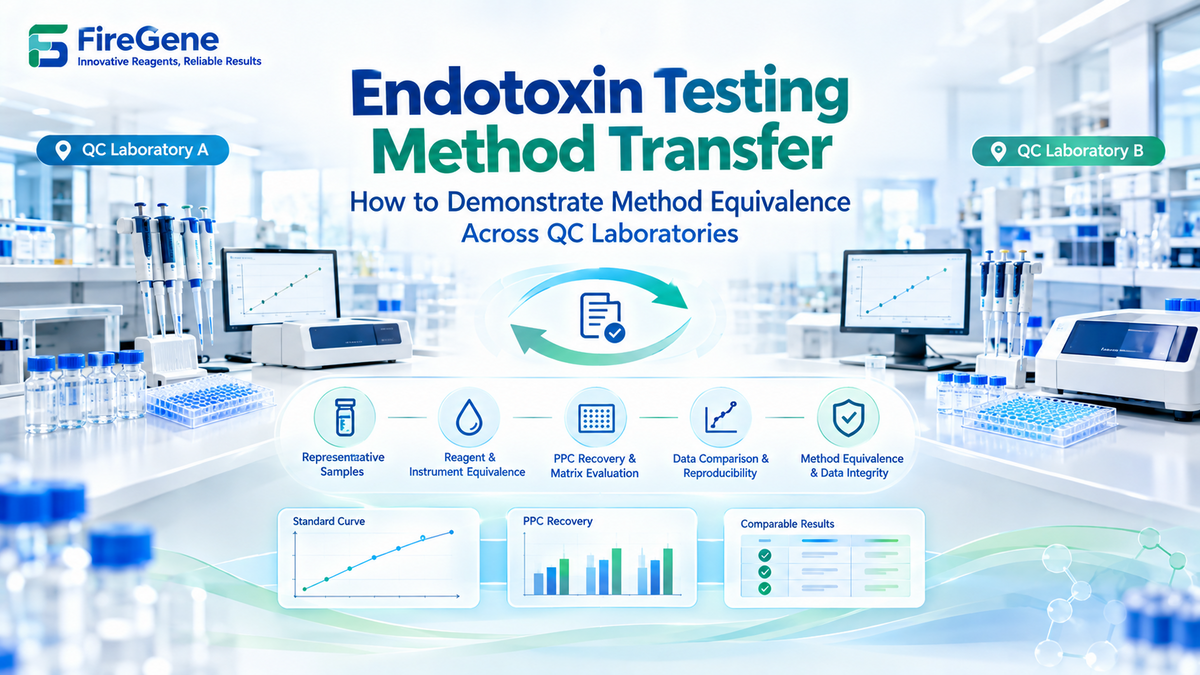
Introduction: Why Endotoxin Method Transfer Is More Complicated Than Moving an SOP
Pharmaceutical and biopharmaceutical companies increasingly operate across multiple QC laboratories.
A company may develop an endotoxin testing method at one site and later transfer it to:
- A manufacturing-site QC laboratory
- A central quality-control laboratory
- A second testing facility
- A contract testing laboratory
- A CDMO
- A regional laboratory
- A new laboratory following manufacturing expansion
At first glance, endotoxin method transfer may appear straightforward.
The receiving laboratory receives the SOP, purchases the same endotoxin reagent, follows the same dilution procedure, and begins testing.
But identical written procedures do not automatically produce identical analytical performance.
Two laboratories can use the same endotoxin testing method and still obtain different results because of differences in:
- Analysts
- Pipettes
- Microplate readers
- Incubation equipment
- Water quality
- Labware
- Reagent preparation
- Sample handling
- Dilution technique
- Temperature control
- Timing
- Data-processing software
- Product matrix
- Environmental conditions
This is why endotoxin method transfer should be treated as a controlled analytical comparability exercise, rather than simply an SOP handoff.
The objective is not necessarily to force two laboratories to produce numerically identical results.
The objective is to demonstrate that the transferred method remains fit for its intended purpose under the receiving laboratory's actual conditions of use.
This principle is consistent with the current regulatory direction. FDA's March 2026 Pyrogen and Endotoxins Testing: Questions and Answers guidance discusses transitions between BET methods and emphasizes comparison of methods, including sensitivity, inhibition/enhancement, spiked product samples, and representative product samples.
1. What Is Endotoxin Testing Method Transfer?
Endotoxin testing method transfer is the documented process used to establish that an existing endotoxin testing procedure can be successfully implemented by another qualified laboratory.
The transfer may involve the same analytical technology:
Laboratory A
Kinetic chromogenic assay
↓
Laboratory B
Kinetic chromogenic assay
Or it may involve a change in analytical technology:
Existing method
Gel-Clot
↓
New method
Kinetic Chromogenic
A method transfer can therefore involve different levels of complexity.
Same method, different laboratory
This is generally focused on demonstrating that the receiving laboratory can reproduce the established procedure using its own:
- Analysts
- Instruments
- Reagents
- Consumables
- Environmental controls
- Sample-handling practices
Same product, different endotoxin assay technology
This is more complex because the analytical response mechanism may change.
For example:
Gel-Clot
Endpoint clot formation
versus
Kinetic Chromogenic
Time-dependent color development
FDA's current guidance specifically discusses transitions between BET methods and recommends comparing the methods to verify equivalence, including evaluation of detection capability and inhibition/enhancement.
2. Why Can the Same Endotoxin Method Produce Different Results?
A common assumption is:
Same kit + same SOP = same result.
In practice, endotoxin testing is more sensitive to laboratory execution than this equation suggests.
Consider a kinetic chromogenic assay.
The analytical result can depend on:
Sample preparation
↓
Endotoxin extraction/accessibility
↓
Reagent preparation
↓
Reaction temperature
↓
Pipetting accuracy
↓
Reaction timing
↓
Optical measurement
↓
Standard curve
↓
Calculated endotoxin concentration
A small difference at any stage can affect the final result.
For example, one laboratory may prepare dilutions precisely while another introduces small pipetting differences.
One laboratory may use a properly qualified microplate reader while another has a different optical configuration.
One analyst may start the reaction immediately after reagent addition while another introduces a systematic delay.
None of these differences necessarily means that the assay is fundamentally defective.
They demonstrate why method transfer needs to evaluate the complete analytical system.
3. Method Transfer Is Not the Same as Method Validation
This distinction is important.
Method validation asks whether an analytical procedure demonstrates appropriate performance characteristics for its intended application.
Method transfer asks whether an established analytical procedure can be successfully implemented at another laboratory.
The two activities are related but not identical.
A laboratory should not assume that because Method A was fully validated at Laboratory 1, Laboratory 2 can automatically use it without verification.
The receiving laboratory still needs to demonstrate that it can perform the method correctly under its own conditions.
This is especially important for complex pharmaceutical matrices.
FireGene's guide on How to Validate an Endotoxin Test Method provides a broader framework for method performance, while a transfer protocol should focus specifically on demonstrating successful implementation at the receiving site.
4. Step 1: Define the Scope of the Transfer
Before laboratory work begins, define exactly what is being transferred.
A transfer protocol should identify:
- Product or material
- Product concentration
- Sample matrix
- Endotoxin specification
- Applicable endotoxin limit
- Test method
- Reagent type
- Reagent sensitivity
- Sample dilution
- MVD, where applicable
- Number of samples
- Number of analysts
- Instruments
- Acceptance criteria
- Data-analysis approach
- Responsibilities of sending and receiving laboratories
The scope should also identify whether the transfer is:
- Site-to-site
- Analyst-to-analyst
- Instrument-to-instrument
- Method-to-method
- Vendor-to-vendor
- Manual-to-automated
- Traditional lysate method to recombinant reagent method
This matters because the scientific risk of each transfer is different.
A simple transfer between two laboratories using the same validated procedure may require a different study design from a transition between fundamentally different assay technologies.
5. Step 2: Confirm the Endotoxin Method and Its Intended Use
Before comparing results, both laboratories need to agree on what the method is actually intended to measure.
This sounds obvious, but ambiguity at this stage can create major problems later.
For example, are both laboratories testing:
- The same drug substance?
- The same drug product?
- The same concentration?
- The same formulation?
- The same sample preparation?
- The same dilution?
- The same endotoxin limit?
- The same reporting units?
A method transfer should never compare two results that were generated under materially different sample conditions without documenting those differences.
The current USP framework continues to emphasize proper application of bacterial endotoxin tests, including preparatory requirements, labware qualification, product positive controls, interference, routine testing, OOS investigations, and the use of recombinant reagents.
6. Step 3: Qualify the Receiving Laboratory Before Comparing Results
A transfer study should not be used as a substitute for basic laboratory qualification.
The receiving laboratory should already have appropriate controls for:
Analysts
Analysts should be appropriately trained in:
- Endotoxin testing
- Pipetting
- Sample dilution
- Reagent preparation
- Equipment operation
- Data interpretation
- OOS/OOT procedures
Equipment
Depending on the assay, this may include:
- Incubators
- Water baths
- Microplate readers
- Pipettes
- Timers
- Temperature monitoring equipment
- Software used for kinetic data analysis
Labware
Endotoxin testing requires suitable endotoxin-controlled consumables.
Tubes, plates, pipette tips, dilution vessels, and other contact materials can become sources of analytical contamination.
FireGene's Pyrogen-Free Vials can be incorporated into sample-handling workflows where qualified endotoxin-free containers are required.
Water
Water quality is another critical variable.
Water may be used for:
- Reagent preparation
- CSE reconstitution
- Sample dilution
- Negative controls
- Serial dilution
FireGene's Endotoxin Assay Water is designed for applications including endotoxin standard preparation, CSE reconstitution, sample dilution, and negative controls.
The objective is to ensure that differences observed during transfer reflect the method or laboratory—not uncontrolled contamination from basic testing materials.
7. Step 4: Establish Reagent Equivalence
Reagent differences can introduce variability even when the analytical principle is unchanged.
A transfer protocol should document:
- Reagent manufacturer
- Product number
- Lot number
- Sensitivity
- Expiration date
- Storage conditions
- Preparation procedure
- Reconstitution conditions
- Calibration information
This becomes particularly important when a laboratory is transitioning from one reagent source to another.
For traditional TAL/LAL-based methods, the reagent itself is a critical component of the analytical system.
For recombinant methods, additional method-specific considerations may apply.
FDA's 2026 guidance notes that sponsors using recombinant reagents should verify that the assay method is suitable for its intended purpose.
FireGene's Control Standard Endotoxin (CSE) can be used as part of controlled sensitivity checks, interference studies, and positive-control workflows.
8. Step 5: Use Representative Samples—Not Only Easy Samples
One of the most important principles in method transfer is sample selection.
Testing only simple aqueous samples may produce an impressive-looking transfer package while failing to demonstrate whether the method works for the actual product.
Representative samples should reflect the real analytical challenge.
Depending on the product, this may include:
- Different manufacturing batches
- Different concentrations
- Different formulations
- Historical positive samples
- Samples close to the endotoxin specification
- Samples representing known matrix challenges
- Spiked samples
- Routine production samples
FDA's guidance specifically notes that spiked product samples can be used when comparing BET methods and that field samples known to be positive may also be useful for method comparison.
This is an important point:
A transfer study should challenge the method—not simply confirm that the easiest samples behave similarly.
9. Step 6: Evaluate Positive Product Control Recovery
Positive Product Control (PPC) recovery is particularly important during endotoxin method transfer.
Why?
Because the receiving laboratory may handle the same product differently.
Suppose Laboratory A obtains acceptable recovery:
Known endotoxin spike
↓
Product matrix
↓
Acceptable recovery
But Laboratory B obtains poor recovery.
The immediate conclusion should not be:
“Laboratory B's instrument is wrong.”
Potential causes could include:
- Sample dilution
- Reagent preparation
- Product pH
- Temperature
- Pipetting
- Endotoxin adsorption
- Matrix inhibition
- Matrix enhancement
- Sample preparation
- Hold time
This is why PPC data should be reviewed alongside the actual sample results.
FireGene's Endotoxin Recovery Studies Explained provides additional background on recovery experiments and their role in evaluating product-matrix effects.
10. Step 7: Evaluate Matrix Interference at the Receiving Laboratory
Matrix interference is one of the biggest reasons an endotoxin method that works well in one setting can behave differently in another.
Potential interfering components include:
- Proteins
- Lipids
- Surfactants
- Chelating agents
- High salt concentrations
- Preservatives
- Organic solvents
- Extreme pH
- Complex excipients
The result can be:
Inhibition
The sample suppresses the endotoxin response.
This can create a falsely low result.
Enhancement
The sample increases the apparent response.
This can create a falsely high result.
The receiving laboratory should therefore confirm that the established dilution strategy remains appropriate under its actual testing conditions.
FireGene's Endotoxin Testing Sample Preparation Guide provides practical guidance on dilution, interference, recovery, and sample preparation.
11. Step 8: Compare the Standard Curves—But Do Not Stop There
For kinetic chromogenic endotoxin testing, standard-curve performance is an important part of transfer assessment.
The receiving laboratory should evaluate:
- Standard response
- Curve linearity
- Replicate consistency
- Reaction time
- Background
- Standard concentration range
- Acceptance criteria
- Curve-fitting approach
However, a passing standard curve does not automatically prove successful product-method transfer.
Why?
Because the standard curve contains a controlled endotoxin standard.
The pharmaceutical product contains the actual matrix.
These are analytically different situations.
A laboratory can therefore have:
Acceptable standard curve
Poor product recovery
at the same time.
This is why standard-curve performance, PPC recovery, and product results should be interpreted together.
For laboratories using kinetic chromogenic testing, FireGene's Kinetic Chromogenic Endotoxin Test Kit provides a quantitative endotoxin testing approach using 405 nm optical detection.
12. Step 9: Control Analyst-to-Analyst Variability
Endotoxin testing is highly dependent on controlled technique.
Even experienced analysts can introduce variability through:
- Pipetting speed
- Pipette positioning
- Mixing technique
- Reagent handling
- Timing
- Sample vortexing
- Tube inversion
- Plate loading order
- Temperature exposure
- Reaction initiation
During method transfer, it can therefore be useful to include more than one analyst where appropriate.
The objective is not to create unnecessary complexity.
It is to determine whether the receiving laboratory can perform the method consistently rather than relying on the performance of a single highly experienced analyst.
This becomes particularly relevant when the method will eventually be used for routine QC testing by multiple analysts.
13. Step 10: Compare Instruments and Data-Processing Systems
Instrument differences are often underestimated.
Two microplate readers may both operate at 405 nm but still differ in:
- Optical configuration
- Temperature control
- Reading interval
- Plate positioning
- Software algorithms
- Calibration
- Detection sensitivity
- Data-processing settings
For kinetic assays, these differences can influence reaction-time measurements and calculated concentrations.
The transfer protocol should therefore document:
- Instrument model
- Software version
- Reading wavelength
- Temperature
- Reading interval
- Plate type
- Calculation model
- Curve-fitting method
- Acceptance criteria
If the receiving laboratory uses a different reader, the study should specifically address whether the change affects analytical performance.
14. Same Method Does Not Mean Same Numerical Result
One of the most important concepts in method transfer is that analytical equivalence does not necessarily mean identical numbers.
Suppose Laboratory A reports:
0.12 EU/mL
and Laboratory B reports:
0.15 EU/mL
A difference exists.
But that difference alone does not prove that the transfer failed.
The correct questions are:
- Were both results generated within the validated range?
- Were PPC recoveries acceptable?
- Were controls acceptable?
- Were sample preparation procedures equivalent?
- Was the difference within predefined acceptance criteria?
- Is the difference analytically meaningful?
- Does it affect the product specification decision?
- Is there a systematic bias?
- Is the difference reproducible?
The transfer protocol should define these questions before the study begins.
This prevents laboratories from deciding after seeing the data what constitutes an acceptable transfer.
15. How to Design a Practical Endotoxin Method Transfer Study
A practical transfer study can be organized into several layers.
Layer 1: System suitability
Confirm:
- Reagent performance
- Standard curve
- Negative control
- Positive controls
- Instrument performance
Layer 2: Product suitability
Confirm:
- PPC recovery
- Dilution strategy
- Matrix interference
- Sample preparation
Layer 3: Inter-laboratory comparison
Compare:
- Same samples
- Same endotoxin challenge
- Same or equivalent reagents
- Same analytical procedure
- Defined replicate structure
Layer 4: Routine reproducibility
Where appropriate, evaluate:
- Multiple analysts
- Multiple days
- Multiple batches
- Normal laboratory operating conditions
This layered approach helps distinguish method problems from laboratory implementation problems.
16. Should the Sending and Receiving Laboratories Test the Same Samples?
Whenever practical, paired testing can provide valuable information.
A useful design may involve:
Same product batch
↓
Split into controlled aliquots
↓
Laboratory A
and
Laboratory B
↓
Same or equivalent testing procedure
↓
Compare results
This reduces the possibility that differences are caused by sample heterogeneity.
For challenging products, representative field samples can be particularly useful because they demonstrate whether the two laboratories behave similarly under realistic conditions.
FDA's guidance specifically recognizes the value of spiked product samples and field samples when comparing BET methods.
17. What Should Happen When Transfer Results Do Not Match?
A difference between laboratories should trigger an investigation—not an immediate conclusion that one laboratory is wrong.
A structured investigation should review:
Sample
- Same batch?
- Same concentration?
- Same storage?
- Same hold time?
- Same container?
Reagent
- Same lot?
- Same sensitivity?
- Correct storage?
- Correct preparation?
Water
- Appropriate endotoxin level?
- Correct preparation?
- Correct storage?
Labware
- Endotoxin-controlled?
- Same type?
- Same supplier?
- Same plate?
Equipment
- Calibration?
- Temperature?
- Wavelength?
- Software?
- Reading interval?
Analyst
- Training?
- Pipetting?
- Timing?
- Sample preparation?
Product matrix
- Inhibition?
- Enhancement?
- Adsorption?
- Dilution effects?
FireGene's 15 Common Mistakes That Cause Endotoxin Testing Failures provides a useful troubleshooting framework for many of these analytical failure modes.
18. Method Transfer and Kinetic Chromogenic Testing
Kinetic chromogenic assays can offer advantages during laboratory transfer because the method produces quantitative data rather than relying only on an endpoint interpretation.
However, quantitative output does not eliminate transfer risk.
The receiving laboratory still needs to control:
- Standard preparation
- Reaction timing
- Temperature
- Plate handling
- Optical measurement
- Curve fitting
- Dilution
- Matrix effects
Kinetic data can actually make transfer investigations more informative because laboratories can examine more than the final endotoxin concentration.
They can also compare:
- Reaction time
- Curve shape
- Replicate behavior
- Standard response
- Baseline
- Sample kinetics
This can help identify whether two laboratories are experiencing a similar analytical process or whether one laboratory has a systematic shift.
19. Method Transfer When Moving From Gel-Clot to Kinetic Chromogenic
A particularly important scenario is the transition from a qualitative or semi-quantitative endpoint approach to a quantitative kinetic method.
For example:
Existing laboratory
Gel-Clot
↓
Receiving laboratory
Kinetic Chromogenic
This should not be treated as a simple instrument replacement.
The laboratories are using different analytical response mechanisms.
A comparison should consider:
- Detection capability
- Product matrix
- Sensitivity
- Dilution
- PPC recovery
- Positive samples
- Negative samples
- Near-limit samples
- Reproducibility
- Reporting units
FDA's guidance specifically states that when transitioning between BET methods measuring the same entity, comparison should be used to verify equivalence, with detection capability and inhibition/enhancement among the important considerations.
For laboratories considering such a transition, FireGene's Gel-Clot vs. Kinetic Chromogenic Assay comparison provides additional background on the differences between the two approaches.
20. Method Transfer During Manufacturing Scale-Up
Method transfer often occurs at the same time as manufacturing expansion.
For example:
Development laboratory
↓
Pilot manufacturing
↓
Commercial manufacturing
↓
Multiple QC laboratories
As the manufacturing network expands, the analytical method may need to move with it.
This creates an important quality consideration:
The analytical method should remain consistent enough that changes in reported endotoxin levels can be distinguished from genuine changes in manufacturing performance.
This is particularly important for long-term data trending.
If the testing laboratory changes, the reagent changes, or the assay technology changes, historical results may no longer be directly comparable without appropriate evaluation.
FireGene's Endotoxin Testing Trend Analysis discusses why laboratories should consider method changes when interpreting long-term endotoxin trends.
21. Method Transfer and Data Integrity
A successful transfer is not only about laboratory results.
The associated documentation should also be controlled.
Transfer records should normally allow reviewers to understand:
- What method was transferred
- From which laboratory
- To which laboratory
- Which product was tested
- Which samples were used
- Which reagents were used
- Which instruments were used
- Which analysts participated
- What acceptance criteria were predefined
- What deviations occurred
- How results were calculated
- Whether investigations were required
- Whether the transfer was accepted
For kinetic methods, electronic data should also be traceable.
This includes:
- Raw absorbance data
- Standard-curve data
- Sample calculations
- Audit trails where applicable
- Software version
- Method parameters
- Final reported results
A transfer should be reproducible not only scientifically, but also documentarily.
22. Common Mistakes During Endotoxin Method Transfer
Mistake 1: Treating the SOP as the Entire Transfer
An SOP describes how to perform the method.
It does not automatically demonstrate that the receiving laboratory can perform it successfully.
Mistake 2: Using Only Negative Samples
Negative samples cannot adequately challenge matrix interference or demonstrate equivalence near the relevant analytical range.
Mistake 3: Ignoring PPC Recovery
A similar final result does not necessarily prove that the product matrix behaved appropriately.
Mistake 4: Changing Multiple Variables at Once
Changing the reagent, instrument, analyst, dilution, and sample preparation simultaneously makes investigation much more difficult.
Mistake 5: Comparing Different Product Lots
Differences may reflect sample variability rather than laboratory performance.
Mistake 6: Ignoring Water and Consumables
A contaminated tube, tip, vial, or dilution water can affect an otherwise well-controlled assay.
Mistake 7: Assuming the Same Reader Settings Are Enough
Kinetic assays can be sensitive to temperature, reading interval, software, and instrument configuration.
Mistake 8: Defining Acceptance Criteria After Testing
Acceptance criteria should be scientifically justified and defined in the protocol before results are reviewed.
Mistake 9: Treating Small Numerical Differences as Automatic Failure
The significance of a difference depends on the predefined criteria, method performance, product specification, and analytical context.
Mistake 10: Forgetting Historical Comparability
A laboratory change can create an apparent trend shift even when the manufacturing process has not changed.
23. A Practical Endotoxin Method Transfer Checklist
Before starting the transfer:
- Define the scope
- Identify the product and matrix
- Confirm the endotoxin limit
- Confirm the analytical method
- Confirm reagent sensitivity
- Define sample selection
- Define acceptance criteria
- Qualify the receiving laboratory
- Confirm equipment suitability
- Confirm endotoxin-controlled consumables
- Confirm water quality
- Establish the PPC strategy
During the transfer:
- Use representative samples
- Control sample handling
- Document reagent lots
- Document analyst identity
- Document instrument configuration
- Monitor standard curves
- Evaluate PPC recovery
- Record deviations
- Compare replicate performance
- Review raw data
After the transfer:
- Evaluate predefined acceptance criteria
- Investigate unexpected differences
- Document conclusions
- Approve the receiving laboratory
- Update controlled procedures
- Establish routine monitoring
- Consider the impact on historical trend data
24. How FireGene Endotoxin Testing Solutions Can Support Method Transfer
A successful endotoxin method transfer depends on more than one reagent.
It requires a controlled analytical workflow.
Depending on the application, a laboratory may need:
TAL/LAL Reagent
For the selected endotoxin detection method.
Control Standard Endotoxin
For standard preparation, sensitivity checks, and positive-control or interference studies.
Endotoxin Assay Water
For dilution, standard preparation, CSE reconstitution, and negative controls.
Pyrogen-Free Vials and Consumables
For minimizing contamination during sample preparation and handling.
Kinetic Chromogenic Testing
For laboratories requiring quantitative endotoxin results and kinetic data.
FireGene's Endotoxin Assay Reagents and Kits collection brings these components together into a broader endotoxin-testing workflow.
The important principle is that each component should be qualified and controlled according to the intended application.
25. The Bigger Picture: Method Transfer Is Part of Endotoxin Control
Endotoxin testing is often viewed as a single laboratory event:
Sample → Assay → Result
But reliable pharmaceutical endotoxin testing is better understood as a complete analytical system:
Sample
↓
Sampling
↓
Container
↓
Water
↓
Dilution
↓
Reagent
↓
Reaction
↓
Instrument
↓
Data Analysis
↓
Result
↓
Trend
When the method moves from one laboratory to another, every stage of this system needs to remain controlled.
That is why method transfer should not be reduced to simply sending an SOP and confirming that the receiving analyst can obtain a result.
The real question is:
Can the receiving laboratory generate scientifically comparable and reliable endotoxin data under its actual conditions of use?
That is the standard a robust transfer study should be designed to demonstrate.
Conclusion
As pharmaceutical manufacturing becomes increasingly distributed across development sites, manufacturing facilities, CDMOs, and specialized QC laboratories, endotoxin testing methods increasingly need to move with the product.
A successful transfer requires more than identical SOPs.
It requires controlled sample selection, qualified analysts, suitable equipment, endotoxin-controlled consumables, appropriate reagents, PPC recovery, matrix evaluation, predefined acceptance criteria, and meaningful comparison of analytical performance.
The goal is not necessarily to make every laboratory produce exactly the same numerical result.
The goal is to demonstrate that the endotoxin testing method remains fit for purpose, reproducible, scientifically defensible, and reliable at the receiving laboratory.
For pharmaceutical QC teams, treating endotoxin method transfer as a structured analytical comparability exercise can reduce uncertainty, strengthen data continuity, and provide greater confidence when testing moves across laboratories.
In an increasingly data-driven quality environment, the question is no longer simply:
“Can the new laboratory perform the endotoxin test?”
The more important question is:
“Can the new laboratory generate results that we can confidently interpret alongside the data produced by the original laboratory?”
That is the real objective of a successful endotoxin testing method transfer.
FireGene Endotoxin Testing
Ready to run your endotoxin assay?
FireGene offers a complete endotoxin testing toolkit — from TAL reagents and CSE standards to pyrogen-free consumables and LAL reagent water. All products are aligned with USP <85>, EP 2.6.14, and JP 4.01.


