
Introduction
Medical devices play a critical role in modern healthcare, from disposable syringes and infusion sets to cardiovascular catheters, surgical instruments, implants, and ophthalmic devices. Although these products differ significantly in design and intended use, they share an important quality consideration: controlling bacterial endotoxin contamination.
Endotoxins are lipopolysaccharide (LPS) components associated with the outer membrane of Gram-negative bacteria. They can trigger inflammatory and pyrogenic responses when introduced into the human body. Importantly, endotoxins may remain present after bacteria have been killed or removed, meaning that a device can be sterile without necessarily being free of endotoxin.
For medical device manufacturers, this creates a distinct analytical challenge. Unlike testing a liquid pharmaceutical product directly, medical device endotoxin testing frequently requires extracting endotoxin from the device or its product-contact surfaces before measuring it.
The reliability of the result depends on more than the sensitivity of the endotoxin reagent. Extraction efficiency, device geometry, surface materials, extraction volume, sample handling, and assay interference can all influence the final measurement.
The applicable endotoxin acceptance criterion also depends on the device's intended use and the tissues or fluids it contacts. A device contacting the cardiovascular system may have different requirements from one contacting cerebrospinal fluid or the intraocular environment.
The FDA's March 2026 guidance, Pyrogen and Endotoxins Testing: Questions and Answers, discusses FDA's current thinking on USP <85>, USP <161>, and AAMI ST72, including endotoxin testing approaches and recommendations for appropriate components and finished products.
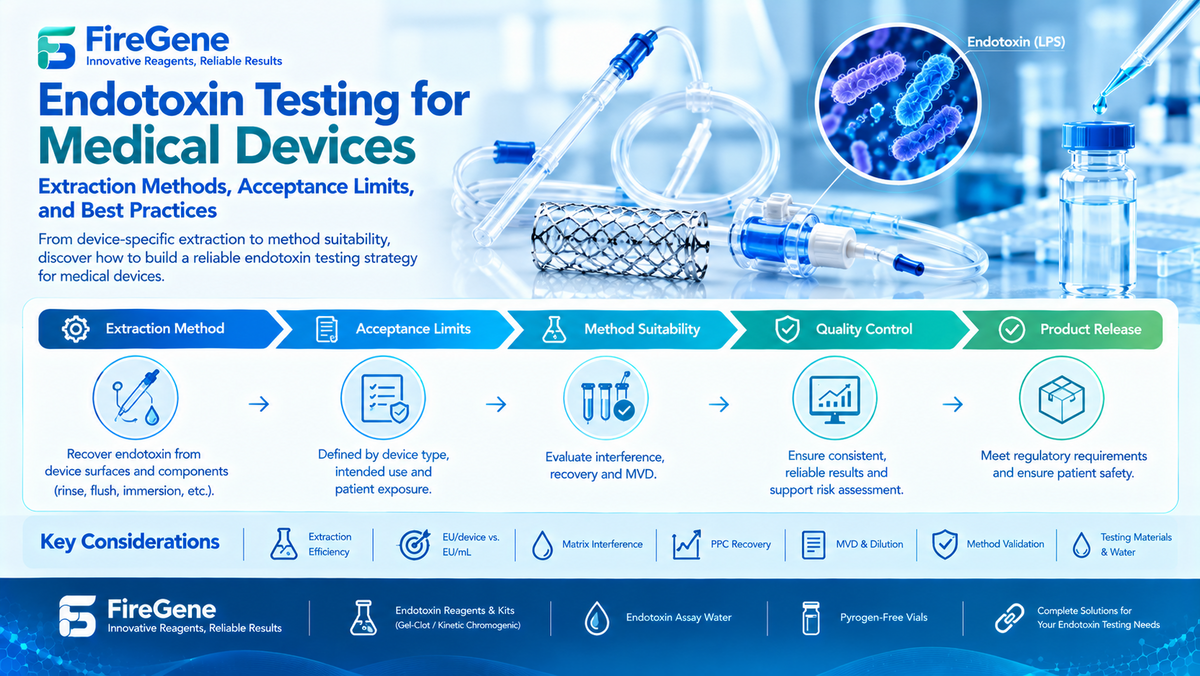
This guide explains how manufacturers and QC laboratories can approach medical device endotoxin testing, from selecting an extraction strategy to interpreting results and establishing a robust testing workflow.
1. Why Medical Device Endotoxin Testing Is Different
Pharmaceutical solutions can often be sampled and tested directly after suitable preparation. Medical devices, however, may contain complex surfaces, internal channels, joints, coatings, porous materials, and multiple components that make contamination more difficult to recover.
Consider several common device types:
-
Infusion sets and catheters: Endotoxin may be present on internal surfaces that contact fluids.
-
Cardiovascular devices: Endotoxin control is particularly important because of direct or indirect contact with the cardiovascular system.
-
Implants: Product geometry, surface area, material properties, and extraction conditions can affect the amount of endotoxin recovered.
-
Ophthalmic devices: Devices contacting the intraocular environment may require particularly stringent, product-specific controls.
-
Surgical instruments: Reusable instruments require appropriate cleaning and reprocessing controls, while applicable endotoxin requirements depend on intended use and regulatory context.
The testing objective is not simply to determine whether endotoxin exists in the extraction liquid. It is to determine whether the analytical result adequately represents the endotoxin associated with the device under the defined extraction conditions.
This distinction makes extraction method development an essential part of the overall testing strategy.
For background on why endotoxin detection requires a different approach from microbial testing, see FireGene's article, Endotoxin Testing vs. Bioburden Testing: Why They Are Not Interchangeable in Pharmaceutical QC.
2. How Device Contact and Intended Use Affect Endotoxin Limits
There is no single endotoxin limit that automatically applies to every medical device.
The appropriate acceptance criterion depends on factors such as:
-
Intended use
-
Route of exposure
-
Contact with blood or the cardiovascular system
-
Contact with cerebrospinal fluid
-
Contact with the intraocular environment
-
Whether the device is implanted
-
Applicable compendial requirements and FDA recommendations
USP <161> addresses bacterial endotoxin and pyrogen testing for transfusion and infusion assemblies and similar medical devices within its scope. Other device types may be subject to different requirements or product-specific recommendations.
The FDA's Pyrogen and Endotoxins Testing: Questions and Answers discusses medical device testing and explains that the applicable limit depends on the device's intended use and the body system or tissue it contacts.
Manufacturers should therefore establish the applicable limit before finalizing their extraction and analytical procedures.
EU/mL vs. EU/device
These units describe different things.
EU/mL expresses endotoxin concentration in the liquid being tested.
EU/device expresses the amount of endotoxin attributed to an individual device, based on the defined extraction and calculation procedure.
When a device is extracted into a known volume, the measured concentration can be used to calculate the amount recovered from the device.
A simplified relationship is:
Recovered endotoxin (EU/device) = Measured concentration (EU/mL) × Extraction volume (mL)
If additional dilution factors apply, they must also be included in the calculation.
For example, if an extract measures 0.10 EU/mL and the applicable extraction volume is 10 mL, the recovered amount is 1.0 EU per device, assuming no additional dilution factor and that the extraction represents one device.
This example illustrates the unit conversion only. It does not establish an acceptance limit or prove that the extraction procedure recovers all endotoxin present.
A laboratory must compare the result with the applicable device-specific criterion and follow the relevant test procedure.
For more background on choosing appropriate sensitivity levels, see FireGene's Endotoxin Testing: Sensitivity, LOD, LOQ, and MVD Explained.
3. Choosing an Appropriate Endotoxin Extraction Method
Extraction is one of the most important steps in medical device endotoxin testing.
The extraction procedure should be suitable for the device's material, shape, accessible surfaces, and intended use. The laboratory should also consider whether the extraction liquid can be tested reliably using the selected endotoxin assay.
Common extraction approaches include the following.
Rinse or Flush Extraction
Rinse extraction may be appropriate for devices with accessible surfaces or internal fluid pathways.
A defined volume of extraction fluid is passed through or over the relevant surfaces. This approach can be useful for devices such as tubing, catheters, and fluid-transfer components.
Important considerations include:
-
Extraction volume
-
Flow path and contact time
-
Whether all relevant surfaces are reached
-
Potential retention of liquid inside the device
-
The suitability of the extraction fluid
-
Consistency between tested units
A rinse procedure should not automatically be assumed to recover endotoxin from every surface equally well. The procedure needs an appropriate scientific justification.
Immersion Extraction
For some devices, immersion may provide a practical way to expose external surfaces to the extraction fluid.
The device is placed in a defined volume of extraction medium under specified conditions.
Potential variables include:
-
Surface area exposed
-
Extraction volume
-
Temperature
-
Contact time
-
Agitation, if applicable
-
Material compatibility
-
Device configuration
Immersion may not adequately represent endotoxin associated with inaccessible internal surfaces or complex assemblies. Where those surfaces are relevant, an alternative or additional extraction strategy may be needed.
Extraction of Complex or Multi-Component Devices
Some medical devices contain several materials or components with different surface properties.
Examples include assemblies containing polymers, metals, elastomers, coatings, and adhesives.
The manufacturer should evaluate whether the selected extraction method adequately represents the relevant components. If disassembly is required, the procedure should define which parts are extracted and how the results are attributed to the tested device or assembly.
The best extraction procedure is not necessarily the one that produces the highest result or the lowest result. It is the procedure that is scientifically justified, sufficiently reproducible, and appropriate for the device and applicable testing requirements.
4. Extraction Efficiency: The Often-Overlooked Variable
A sensitive assay cannot measure endotoxin that never reaches the test solution.
Suppose endotoxin is present on a device surface but only a portion is recovered during extraction. The measured result may underestimate the amount associated with the device.
Extraction performance can be influenced by:
-
Surface material and finish
-
Device geometry
-
Surface area
-
Endotoxin adsorption
-
Extraction-fluid composition
-
Extraction time and temperature
-
Agitation or flushing conditions
-
The location of the contamination
For this reason, laboratories should distinguish between assay recovery and device extraction recovery.
Assay recovery evaluates how well the analytical method detects an endotoxin spike under the selected test conditions.
Extraction recovery evaluates how effectively endotoxin can be removed from the device and transferred into the extraction liquid.
These are related but different questions.
A PPC result may demonstrate that the extract does not significantly interfere with the assay, but it does not automatically prove that the extraction procedure recovers endotoxin from every relevant device surface.
Where required by the applicable method or regulatory expectations, extraction performance should be assessed separately and documented.
For further information on analytical recovery, see FireGene's Endotoxin Recovery Studies Explained: How to Design, Perform, and Interpret Recovery Experiments.
5. Preventing Interference in Medical Device Extracts
After extraction, the resulting liquid may contain substances released from the device.
Potential extractables include polymer additives, processing residues, lubricants, coating components, and other material-related substances. Depending on their chemical properties and concentrations, these substances may affect endotoxin assay performance.
Two major forms of interference should be considered.
Inhibition
Inhibition occurs when the sample condition suppresses the endotoxin response, potentially producing a falsely low result.
Enhancement
Enhancement occurs when the sample condition increases the assay response, potentially producing a falsely high result.
The presence and magnitude of interference depend on the device material, extraction procedure, extraction medium, and selected assay.
A laboratory should not assume that an extraction fluid is suitable simply because it is commonly used for other devices.
Instead, the suitability of the actual extract should be evaluated.
Useful variables to investigate may include:
-
pH
-
Ionic strength
-
Extractables from device materials
-
Extraction-fluid composition
-
Dilution
-
Contact time
-
Sample storage conditions
FireGene's Endotoxin Testing Sample Preparation: A Practical Guide to Dilution, Interference, Recovery, and Reliable Results explains how sample conditions and matrix effects can affect endotoxin measurements.
6. Why Positive Product Control Recovery Matters
A Positive Product Control (PPC) contains a known endotoxin spike added to the test sample or extract under the conditions specified by the applicable procedure.
The PPC helps determine whether the extract interferes with endotoxin detection.
A simplified workflow is:
-
Prepare the device extract according to the defined procedure.
-
Prepare the test sample and PPC as required by the selected method.
-
Perform the endotoxin assay.
-
Evaluate recovery against the applicable acceptance criteria.
-
Investigate unacceptable recovery before relying on the result.
Poor PPC recovery may indicate inhibition or another problem with the analytical conditions. Excessive recovery may indicate enhancement or other assay-related issues.
Possible contributing factors include extract composition, pH, dilution, reagent performance, preparation errors, and contaminated testing materials.
The laboratory should investigate the cause rather than simply adjusting the dilution until a passing result is obtained.
If dilution is used to reduce interference, the selected conditions must remain consistent with the applicable method and required analytical sensitivity.
FireGene's How to Validate an Endotoxin Test Method: A Step-by-Step Guide for USP <85> Compliance provides further information on inhibition/enhancement, PPC recovery, and method suitability.
7. Selecting an Appropriate Endotoxin Test Method
The selected assay should be suitable for the device extract, the required sensitivity, and the intended testing purpose.
Gel-Clot Testing
Gel-clot testing determines whether a sample produces a clot under defined reaction conditions. Depending on the method, it can provide a qualitative or semi-quantitative result.
It may be suitable when the required decision can be supported by the selected gel-clot sensitivity and the method is demonstrated to be appropriate for the extract.
Explore FireGene's Gel-Clot Endotoxin Test Kit for product information and available sensitivity options.
Kinetic Chromogenic Testing
Kinetic chromogenic testing measures color development over time and provides quantitative endotoxin results when performed using a suitable validated or qualified procedure.
It can be useful when laboratories need to evaluate:
-
Extract concentration
-
Multiple dilution levels
-
PPC recovery
-
Standard-curve performance
-
Method reproducibility
-
Trends across manufacturing lots
FireGene's Kinetic Chromogenic Endotoxin Test Kit is a 96-well quantitative assay with 405 nm detection and a listed analytical range of 0.005–10 EU/mL.
The kit is designated Research Use Only. It should not be represented as FDA-authorized for medical device release testing. Manufacturers must establish that any selected reagent and procedure meet the requirements applicable to their device and intended use.
For additional technical background, read FireGene's The Ultimate Guide to Kinetic Chromogenic Endotoxin Assays.
8. Controlling Water, Vials, and Other Testing Materials
Testing materials can become a source of contamination or analytical variability if they are not appropriately controlled.
Important materials include:
-
Extraction fluid
-
Sample tubes
-
Pipette tips
-
Vials
-
Microplates
-
Endotoxin standards
-
Dilution containers
Water used for endotoxin testing must be suitable for the intended procedure. Ordinary laboratory water should not be assumed to be appropriate for low-level endotoxin analysis.
FireGene's Endotoxin Assay Water is designed for applications such as negative controls, standard dissolution and dilution, and sample preparation in bacterial endotoxin testing workflows.
Pyrogen-Free Vials can support endotoxin standard preparation, serial dilution, and related laboratory workflows.
These products support analytical preparation; they do not replace the need to qualify the complete test procedure or establish the suitability of a device extraction method.
9. A Practical Workflow for Medical Device Endotoxin Testing
A structured workflow helps laboratories connect the extraction procedure with the final analytical result.
Step 1: Define the Device and Its Intended Use
Document the device type, intended use, relevant contact surfaces, and applicable regulatory or compendial requirements.
Step 2: Establish the Applicable Acceptance Criterion
Determine the appropriate limit for the device and its intended use. Do not apply a generic pharmaceutical endotoxin limit without confirming that it is relevant to the device.
Step 3: Select the Extraction Strategy
Choose rinse, flush, immersion, or another justified approach based on the device design and relevant surfaces.
Step 4: Define Extraction Conditions
Specify extraction volume, time, temperature, agitation or flow conditions, and any required device preparation.
Step 5: Evaluate Extraction Performance
Where required, assess whether the procedure adequately recovers endotoxin from relevant surfaces and components.
Step 6: Assess Assay Suitability
Evaluate inhibition/enhancement and PPC recovery in the actual device extract.
Step 7: Confirm Sensitivity and Calculations
Verify that the assay can demonstrate compliance with the applicable limit. Include extraction volume and dilution factors when converting EU/mL to EU/device.
Step 8: Establish Routine Controls
Define sampling, controls, acceptance criteria, documentation, and result review.
Step 9: Trend Results
Review results across lots and manufacturing periods to identify unexpected changes or recurring contamination patterns.
This workflow should be adapted to the specific device, applicable standards, and regulatory expectations rather than treated as a universal procedure.
10. Common Mistakes in Medical Device Endotoxin Testing
Mistake 1: Applying the same limit to every device.
The acceptance criterion depends on intended use and relevant body contact.
Mistake 2: Treating EU/mL as equivalent to EU/device.
Concentration must be interpreted alongside the extraction volume and applicable dilution factors.
Mistake 3: Assuming the extraction recovers all endotoxin.
Extraction performance may vary with material, geometry, and procedure.
Mistake 4: Treating PPC recovery as proof of extraction efficiency.
PPC evaluates assay interference under the test conditions; it does not automatically establish recovery from device surfaces.
Mistake 5: Ignoring extractables.
Substances released from the device may affect the endotoxin assay.
Mistake 6: Diluting without considering analytical sensitivity.
Dilution may reduce interference but can also make it harder to demonstrate compliance with the applicable limit.
Mistake 7: Using unsuitable water or containers.
Testing materials can introduce contamination or variability.
Mistake 8: Relying exclusively on final testing.
Supplier qualification, process controls, cleaning, and component controls can help prevent contamination before the final test.
11. Building a Lifecycle Endotoxin Control Strategy
Reliable medical device endotoxin control begins before the device reaches the final QC laboratory.
A lifecycle approach may include:
-
Supplier qualification and incoming material controls
-
Manufacturing environment and process controls
-
Appropriate cleaning and reprocessing procedures
-
Control of product-contact surfaces
-
Defined extraction procedures
-
Analytical method suitability
-
Finished-device testing, where applicable
-
Investigation of atypical or out-of-specification results
-
Routine data trending
For reusable devices, cleaning and reprocessing deserve particular attention. Removing visible residue or reducing viable microorganisms does not automatically demonstrate that endotoxin has been adequately controlled.
For additional information on cleaning-related endotoxin risks, see FireGene's Endotoxin Testing During Cleaning Validation: How to Design Rinse Sampling, Acceptance Criteria, and Routine Monitoring.
Trend analysis can also help identify gradual changes in incoming materials, manufacturing practices, extraction performance, or testing procedures. FireGene's Endotoxin Testing Trend Analysis: How QC Laboratories Can Detect Problems Before an OOS Result explores how historical data can support early investigation.
Conclusion
Medical device endotoxin testing requires a coordinated approach to device-specific extraction, analytical sensitivity, sample recovery, and result interpretation.
The critical questions are not limited to whether endotoxin is detected. Laboratories must also understand whether the extraction procedure represents the relevant device surfaces, whether the extract interferes with the assay, and whether the final result can be compared meaningfully with the applicable acceptance criterion.
A robust strategy connects:
Intended Use → Applicable Limit → Extraction Method → Extraction Performance → Assay Suitability → PPC Recovery → Result Calculation → Routine Monitoring
The central principle is that reliable medical device endotoxin testing depends on both the extraction procedure and the analytical method.
By establishing scientifically justified extraction conditions, controlling test materials, evaluating assay interference, and maintaining an appropriate lifecycle control strategy, manufacturers can improve the reliability and interpretability of endotoxin results.
For laboratories evaluating endotoxin testing reagents and supporting materials, FireGene's Endotoxin Assay Reagents and Kits collection provides an overview of relevant products for research and analytical-development workflows.
Regulatory note: This article is intended for technical education. It does not establish a universal endotoxin limit or replace the current applicable USP chapters, FDA recommendations, device-specific requirements, or a manufacturer's regulatory assessment.
FireGene Endotoxin Testing
Ready to run your endotoxin assay?
FireGene offers a complete endotoxin testing toolkit — from TAL reagents and CSE standards to pyrogen-free consumables and LAL reagent water. All products are aligned with USP <85>, EP 2.6.14, and JP 4.01.


