
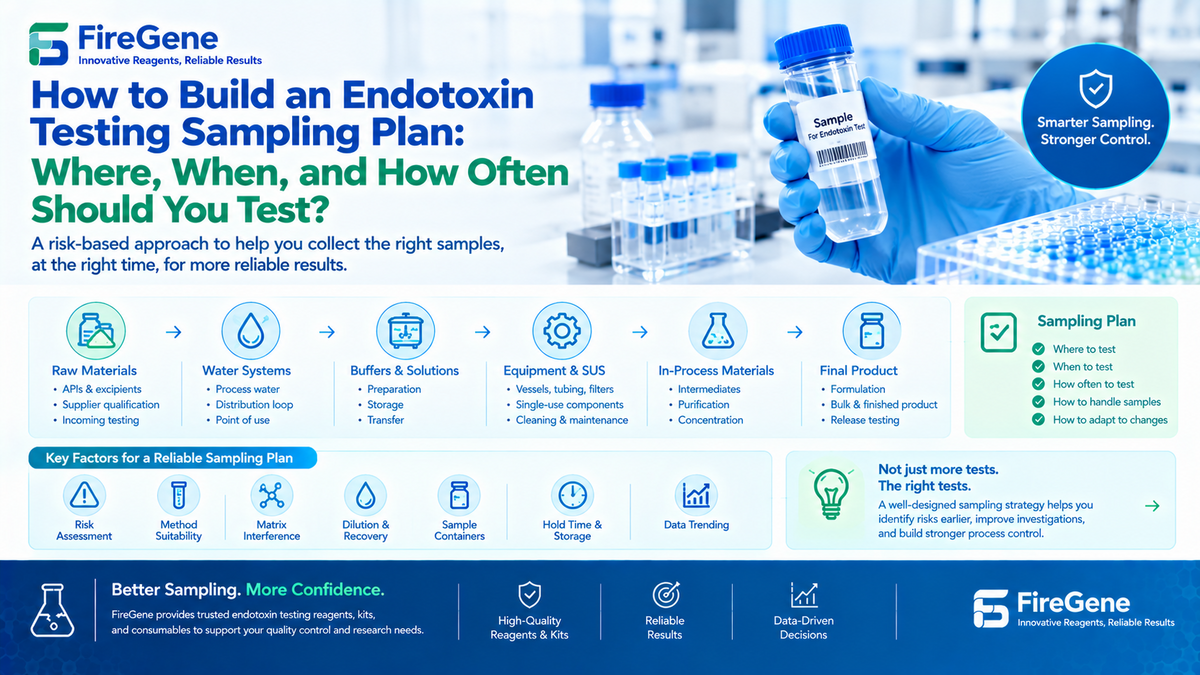
Introduction: Endotoxin Testing Is Only as Good as the Sampling Plan Behind It
A laboratory can have a highly sensitive endotoxin assay, qualified instruments, trained analysts, and well-controlled reagents—and still generate misleading data if the sampling strategy is poorly designed.
This is because endotoxin testing does not evaluate an entire manufacturing process directly.
It evaluates a specific sample collected at a specific location and time.
That creates an important question:
Does the sample actually represent the endotoxin risk of the process or product?
Consider a manufacturing process in which endotoxin could potentially enter through:
- Raw materials
- Process water
- Buffers
- Equipment
- Single-use components
- Transfer lines
- Process intermediates
- Storage containers
- Final formulation
If the laboratory only tests the finished product, it may confirm the final endotoxin status—but have very little information about where contamination entered the process.
On the other hand, testing every material at every stage may create unnecessary analytical workload without improving process understanding.
The solution is a risk-based endotoxin testing sampling plan.
A well-designed plan should answer five fundamental questions:
- What should be tested?
- Where should samples be collected?
- When should samples be collected?
- How frequently should testing be performed?
- How should samples be handled to preserve the integrity of the result?
This article provides a practical framework for designing that strategy.
1. What Is an Endotoxin Testing Sampling Plan?
An endotoxin testing sampling plan defines how samples are selected and collected for bacterial endotoxin testing throughout a laboratory or manufacturing process.
It may include:
- Sampling locations
- Sampling stages
- Sampling frequency
- Sample quantities
- Sampling containers
- Sample storage conditions
- Testing time points
- Test methods
- Acceptance criteria
- Retest or investigation procedures
- Data trending requirements
The purpose is not simply to increase the number of endotoxin tests.
The purpose is to generate representative and actionable information.
A good sampling plan should help answer:
Where is endotoxin risk highest?
Where could contamination enter?
Which process stages provide the most useful information?
How can an endotoxin excursion be detected before it becomes a final-product problem?
This makes sampling design part of the overall contamination-control strategy rather than a separate laboratory activity.
2. Why Sampling Location Matters
Endotoxin contamination is not necessarily distributed uniformly throughout a manufacturing process.
For example, imagine a process with the following sequence:
Raw Material → Buffer Preparation → Purification → Concentration → Formulation → Final Product
An endotoxin result from the final product tells you about the final product.
It does not automatically tell you:
- Whether endotoxin entered through raw materials
- Whether a buffer introduced contamination
- Whether a process vessel contributed endotoxin
- Whether contamination occurred during transfer
- Whether a purification step removed or concentrated endotoxin
This is why sampling location matters.
A useful sampling plan should focus on critical control points, especially locations where endotoxin could be introduced, accumulated, concentrated, or removed.
3. Start With an Endotoxin Risk Map
Before deciding how often to test, map the process.
A simple risk map can follow the material from beginning to end:
Supplier Materials
↓
Water
↓
Buffer Preparation
↓
Equipment / Single-Use Components
↓
Process Step
↓
Intermediate
↓
Purification
↓
Bulk Material
↓
Final Formulation
↓
Finished Product
At each stage, ask:
Can endotoxin enter here?
Can endotoxin increase here?
Can endotoxin be removed here?
Can the material become more concentrated here?
Can the sample become analytically more difficult here?
This exercise can reveal important sampling points that may not be obvious from the final-product perspective.
FireGene's existing discussion of endotoxin risk assessment throughout the pharmaceutical manufacturing lifecycle provides a useful foundation for this type of process-level thinking.
4. Raw Materials: Should They Be Included?
Raw materials are one of the earliest potential sources of endotoxin.
Examples include:
- Active pharmaceutical ingredients
- Excipients
- Salts
- Sugars
- Amino acids
- Proteins
- Biological materials
- Process-specific reagents
Not every raw material necessarily requires identical endotoxin testing.
A risk-based approach can consider:
- Supplier qualification
- Material origin
- Manufacturing process
- Historical endotoxin performance
- Intended use
- Quantity used
- Contact with the final product
- Potential downstream removal
For critical materials, endotoxin information may be obtained through:
- Supplier CoA
- Supplier qualification
- Incoming testing
- Periodic verification
- Risk-based lot testing
FireGene's article on endotoxin testing for raw materials and excipients provides additional background on this upstream control strategy.
5. Water Systems: A High-Value Sampling Point
Water deserves special consideration because it is used throughout pharmaceutical and biopharmaceutical manufacturing.
Water may be involved in:
- Buffer preparation
- Cleaning
- Rinsing
- Dilution
- Formulation
- Equipment preparation
- Analytical testing
A water system can therefore influence multiple downstream operations.
Potential sampling locations may include:
- Generation point
- Storage system
- Distribution loop
- Points of use
- Critical manufacturing locations
The exact sampling design should be based on the facility's validated water monitoring program and risk assessment.
The important principle is:
Do not evaluate water endotoxin quality only at the source if the water is distributed through a complex system.
A distribution system can introduce additional variables.
Trending water endotoxin results over time can also provide useful early-warning information.
6. Buffer Sampling: Test the Buffer or Test the Process?
Buffers are another important consideration.
A buffer may be:
- Prepared in-house
- Purchased as a concentrate
- Prepared from raw materials
- Stored before use
- Transferred through equipment
- Used across multiple process stages
The sampling plan should therefore consider both the buffer itself and the role of the buffer in the process.
For example, a buffer used early in purification may have a different risk profile from a formulation buffer that directly contacts the final drug substance.
Sampling decisions may consider:
- Preparation batch
- Storage duration
- Hold time
- Transfer path
- Contact with product
- Historical results
- Downstream removal capability
The goal is not necessarily to test every buffer every time.
The goal is to identify the buffers where endotoxin monitoring provides meaningful process information.
7. Equipment and Single-Use Components
Manufacturing equipment can also become part of an endotoxin sampling strategy.
Potential sources include:
- Mixing tanks
- Stainless-steel vessels
- Tubing
- Filters
- Transfer bags
- Connectors
- Sampling ports
- Pumps
- Chromatography systems
This is particularly relevant when equipment is reused.
A process may produce acceptable endotoxin results for multiple batches and then experience an unexpected excursion after:
- Maintenance
- Cleaning changes
- Equipment modification
- Extended storage
- Sanitization changes
- Replacement of components
In these situations, equipment-related sampling or investigation may become appropriate.
For single-use systems, routine product-contact testing may not always be necessary at every stage, but supplier qualification and component specifications should form part of the contamination-control strategy.
8. In-Process Sampling vs. Finished-Product Sampling
Finished-product testing remains an important quality-control activity where required.
However, finished-product testing alone may provide limited process information.
Consider two approaches.
Strategy A: Finished product only
Process → Final Product → Endotoxin Test
This answers:
“Does the final product meet the applicable endotoxin requirement?”
But if the result is unexpectedly high, the investigation may need to examine the entire process.
Strategy B: Strategic process monitoring
Raw Material → Water → Buffer → Intermediate → Bulk → Final Product
This provides a sequence of endotoxin data.
Now the laboratory can ask:
- Did endotoxin increase at a particular stage?
- Did a purification step reduce endotoxin?
- Is one intermediate consistently higher?
- Did a new raw-material lot change the profile?
- Is there gradual process drift?
This is where a sampling plan becomes much more valuable than simply increasing the number of final-product tests.
9. When Should Samples Be Collected?
Sampling time can be just as important as sampling location.
Potential time points include:
Before a process step
This establishes the incoming endotoxin level.
After a process step
This helps determine whether the step increases or decreases endotoxin.
Before storage
Useful when hold time may influence contamination risk.
After storage
Can help evaluate changes during the defined hold period.
Before transfer
Useful when transfer equipment may represent a contamination risk.
After transfer
Can help determine whether the transfer operation introduced contamination.
Before final formulation
Provides an opportunity to evaluate endotoxin status before the final manufacturing stage.
Final product
Used where required by the applicable product specification and quality-control procedure.
The exact time points should be justified based on the process.
10. How Often Should Endotoxin Testing Be Performed?
This is one of the most common questions in endotoxin control.
There is no universal frequency that applies to every process.
Testing frequency should reflect:
Risk + process knowledge + historical performance + regulatory requirements + product sensitivity
Possible approaches include:
Every batch
Appropriate for critical materials or stages where routine testing is necessary.
Periodic testing
Useful for lower-risk materials with strong historical control.
Qualification testing
Used when introducing a new supplier, material, equipment configuration, or process.
Campaign-based testing
Potentially useful when manufacturing campaigns introduce specific risk patterns.
Investigation testing
Triggered by unexpected results or process deviations.
Enhanced monitoring
May be appropriate after:
- Equipment changes
- Supplier changes
- Process changes
- Water-system excursions
- Cleaning changes
- Repeated borderline results
The key principle is:
Testing frequency should be justified, not arbitrary.
Testing more frequently does not automatically create better control if the additional data do not improve process understanding.
11. Risk-Based Sampling Is More Useful Than “Test Everything”
A common reaction to contamination risk is to add more testing.
But excessive testing can create its own problems:
- Higher laboratory workload
- More sample handling
- More reagent consumption
- More opportunities for analytical error
- Increased investigation workload
- More data without additional process insight
A better approach is to prioritize samples according to risk.
For example:
| Process Stage | Potential Risk | Sampling Priority |
|---|---|---|
| Critical raw material | Endotoxin introduction | High |
| Process water | System-wide contamination | High |
| Critical buffer | Product-contact risk | High |
| Early intermediate | Process-dependent | Medium |
| Purification intermediate | Process monitoring | Medium |
| Final bulk | Product quality | High |
| Finished product | Applicable release requirement | High |
The exact classification should be established through the facility's own risk assessment rather than copied directly from a generic table.
12. Sample Volume Matters
An endotoxin sampling plan should also define how much sample is required.
Too little sample may prevent:
- Repeat testing when justified
- Dilution studies
- PPC testing
- Confirmatory analysis
- Investigation work
Too much sample can create:
- Unnecessary material loss
- Storage challenges
- Additional handling
- Increased contamination opportunities
Sample volume should therefore be sufficient for the intended testing strategy without unnecessarily consuming valuable product.
This is particularly important for:
- Cell therapies
- Gene therapies
- High-value biologics
- Early-stage clinical materials
- Small-volume formulations
13. Sample Containers Are Part of the Sampling Plan
The sampling container is not simply packaging.
For endotoxin testing, it is part of the analytical system.
A contaminated container can introduce endotoxin into an otherwise clean sample.
This can produce an apparent increase in endotoxin concentration that did not originate from the manufacturing process.
Therefore, laboratories should define:
- Container type
- Endotoxin suitability
- Cleaning or depyrogenation requirements
- Storage conditions
- Maximum hold time
- Container closure
- Identification and traceability
FireGene's Pyrogen-Free Vials are designed for applications where controlled endotoxin background is important.
This is particularly useful for:
- CSE preparation
- Sample dilution
- PPC studies
- Recovery experiments
- Method suitability
- Investigation testing
14. Sample Hold Time Can Change the Result
Once a sample has been collected, the testing process is not finished.
The sample may remain in:
- A laboratory refrigerator
- A controlled storage area
- A transport container
- A testing queue
During this period, the sample may change.
Potential variables include:
- Temperature
- Storage duration
- Container interaction
- Endotoxin adsorption
- Endotoxin masking
- Sample precipitation
- Protein interactions
This is particularly important for complex biological formulations.
For samples where endotoxin recovery may change during storage, laboratories should establish appropriate hold-time conditions rather than assuming that the result will remain unchanged indefinitely.
Low Endotoxin Recovery (LER) is one example of how endotoxin detectability can change over time in certain formulations.
FireGene's detailed LER guide discusses this issue in greater depth.
15. Sample Handling Can Create False-Positive Results
Endotoxin testing is highly sensitive.
That sensitivity is essential, but it also means that contamination introduced during sampling or laboratory handling can become measurable.
Potential sources include:
- Sampling containers
- Pipette tips
- Tubes
- Microplates
- Water
- Reagent preparation
- Analyst handling
- Transfer equipment
This is why laboratories should treat the entire sampling pathway as part of the endotoxin-control system.
A useful principle is:
Manufacturing control → Sampling control → Laboratory control → Analytical control
A problem at any point can affect the final result.
For more information, see FireGene's article on hidden sources of false-positive endotoxin results.
16. Choosing the Right Endotoxin Test Method
Once sampling points have been identified, the laboratory must determine how samples will be tested.
Common approaches include:
- Gel-Clot
- Kinetic Chromogenic
- Kinetic Turbidimetric
- Other applicable photometric or recombinant-reagent methods
The FDA's current 2026 guidance discusses fundamental gel-clot, photometric, and kinetic endotoxin-testing approaches. USP <85> remains the foundational bacterial endotoxin chapter, while USP <86> addresses bacterial endotoxin testing using recombinant reagents.
The method should be selected based on:
- Required sensitivity
- Sample matrix
- Quantitative requirements
- Throughput
- Available instrumentation
- Method suitability
- Applicable regulatory requirements
For quantitative high-throughput applications, FireGene's Kinetic Chromogenic Endotoxin Test Kit uses kinetic absorbance detection at 405 nm and provides a stated range of 0.005–10 EU/mL.
For simpler applications, a Gel-Clot Endotoxin Test Kit may be appropriate depending on the validated procedure.
The important point is that sampling strategy and analytical method should be designed together.
17. Method Suitability Is Connected to Sampling Design
A sample is not automatically suitable for testing simply because it can be physically collected.
The sample matrix may interfere with endotoxin detection.
Potential factors include:
- pH
- Protein concentration
- Salts
- Surfactants
- Chelating agents
- Lipids
- Preservatives
- Sugars
- Nanoparticles
- Other formulation components
This means that a sampling plan should consider not only:
Where do we collect the sample?
but also:
Can the sample be reliably analyzed after collection?
A Positive Product Control can help demonstrate that the selected sample matrix does not interfere excessively with endotoxin detection.
FireGene's endotoxin testing sample-preparation guide provides additional discussion of dilution, recovery, and matrix interference.
18. Sampling Plans for Different Manufacturing Stages
A practical sampling strategy may look different depending on the manufacturing process.
Small-Molecule Pharmaceutical Manufacturing
Potential sampling points may include:
- Critical raw materials
- Process water
- Manufacturing solutions
- Final formulation
- Finished product
Biologics Manufacturing
Additional points may include:
- Cell culture-related materials
- Harvest
- Clarified bulk
- Chromatography intermediates
- UF/DF intermediates
- Drug substance
- Final formulation
Cell and Gene Therapy
Potential points may include:
- Raw materials
- Process buffers
- Cell-processing solutions
- Viral-vector-related intermediates
- Formulation materials
- Final product
Cell and gene therapy processes can be particularly challenging because many materials are biologically complex and product quantities may be limited.
FireGene has previously discussed endotoxin risk assessment and contamination control in cell and gene therapy manufacturing.
19. Sampling Plans Should Change When the Process Changes
A sampling plan should not be considered a permanent document.
Manufacturing processes evolve.
Changes may include:
- New suppliers
- New raw materials
- Equipment replacement
- New manufacturing sites
- Process-scale changes
- New buffer formulations
- New single-use assemblies
- Cleaning-process changes
- New storage conditions
- New product formulations
Each significant change should trigger a review of the endotoxin sampling strategy.
For example:
Old process
One buffer
→ one vessel
→ one transfer path
New process
New buffer
→ new vessel
→ additional transfer line
→ longer hold time
The endotoxin risk profile may have changed.
The sampling plan should therefore be reassessed.
20. What to Do When an Endotoxin Result Is Unexpected
A sampling plan should also define what happens when results are unexpected.
A useful investigation sequence is:
1. Confirm the sample identity
Check:
- Batch
- Location
- Time point
- Sample container
- Analyst
- Documentation
2. Review sample handling
Check:
- Storage
- Hold time
- Dilution
- Transfer
- Consumables
3. Review analytical controls
Evaluate:
- Standard curve
- Negative control
- PPC
- Replicates
- Reagent performance
- Instrument performance
4. Compare with nearby sampling points
Ask:
Is this result isolated?
or:
Does it form part of a process-wide pattern?
5. Review manufacturing events
Consider:
- Equipment changes
- Maintenance
- Cleaning
- Supplier changes
- Water-system events
- Process deviations
6. Review historical data
Compare the result with previous batches and trends.
The objective is to determine whether the result represents:
- Analytical contamination
- Sampling error
- A genuine process excursion
- Normal process variability
- An emerging trend
21. Trending Makes a Sampling Plan More Valuable
A sampling plan generates data.
Trending turns those data into process knowledge.
For example, suppose three process points are tested over ten batches.
The results may show:
Point A: consistently low
Point B: stable but slightly increasing
Point C: occasional high results
Without trending, each result may simply be recorded as pass or fail.
With trending, the laboratory may identify:
- Gradual drift
- Recurring contamination
- Seasonal changes
- Supplier-related differences
- Equipment-related patterns
- Process-specific hotspots
This is why sampling strategy and data trending should be connected.
FireGene's endotoxin testing trend-analysis guide discusses how historical endotoxin data can provide information before a formal OOS event occurs.
22. A Practical Framework for Building an Endotoxin Sampling Plan
A simple framework can be summarized in eight steps.
Step 1 — Map the process
Document all major material and process flows.
Step 2 — Identify endotoxin sources
Evaluate:
- Water
- Raw materials
- Equipment
- Buffers
- Components
- Personnel interventions
- Storage
- Transfers
Step 3 — Identify critical control points
Select locations where endotoxin could enter, accumulate, or become difficult to remove.
Step 4 — Define sampling timing
Determine whether samples should be collected:
- Before processing
- After processing
- Before storage
- After storage
- Before transfer
- After transfer
- Before final formulation
- At final product
Step 5 — Establish frequency
Use risk, historical performance, process knowledge, and applicable requirements.
Step 6 — Define sample handling
Specify:
- Container
- Volume
- Storage
- Hold time
- Identification
- Transport
Step 7 — Establish analytical suitability
Confirm:
- Method
- Sensitivity
- Dilution
- PPC recovery
- Matrix compatibility
Step 8 — Trend and periodically reassess
Use historical data to determine whether sampling frequency or locations remain appropriate.
23. Common Sampling Plan Mistakes
Even well-established laboratories can encounter problems when sampling strategies are not periodically reviewed.
Mistake 1: Testing Only the Final Product
This provides limited information about where contamination entered.
Mistake 2: Sampling Only at the Source
For distributed water or transferred materials, downstream locations may have different risks.
Mistake 3: Testing Every Material Equally
Not every material has the same endotoxin risk.
Mistake 4: Ignoring Hold Time
A sample collected immediately after preparation may not behave the same after extended storage.
Mistake 5: Using Non-Qualified Containers
The sampling container itself can contribute endotoxin.
Mistake 6: Ignoring Matrix Effects
A sample that is easy to collect may still be difficult to analyze.
Mistake 7: Treating Every Result as Independent
Historical trends can reveal information that individual results cannot.
Mistake 8: Never Updating the Sampling Plan
Process changes can change endotoxin risk.
24. A Sampling Plan Is Not the Same as a Testing Schedule
This distinction is important.
A testing schedule answers:
When do we run the assay?
A sampling plan answers:
What do we sample, where do we sample, when do we sample, how do we handle the sample, and why is that sample representative?
The second question is much broader.
A laboratory could have a perfectly organized testing calendar and still have a poor endotoxin-control strategy if the samples do not represent the actual process risks.
25. How Sampling Strategy Supports Better Endotoxin Control
A strong sampling strategy can provide three major benefits.
Earlier detection
Potential contamination may be identified before final-product testing.
Better investigations
Multiple sampling points provide additional information when an excursion occurs.
Better process understanding
Historical data can reveal where endotoxin risk is concentrated.
Together, these benefits move endotoxin testing from a purely reactive activity toward a more proactive quality-control strategy.
Conclusion
An endotoxin test result is only meaningful when the sample represents the material or process being evaluated.
That is why a well-designed endotoxin testing sampling plan should consider much more than testing frequency.
It should connect:
Risk assessment
→ Sampling location
→ Sampling timing
→ Sample handling
→ Method suitability
→ Analytical testing
→ Data trending
→ Process improvement
The best sampling plan is not necessarily the one with the most samples.
It is the one that generates the right samples at the right points at the right time.
For pharmaceutical and biopharmaceutical manufacturers, this means looking beyond finished-product testing and considering endotoxin risk throughout the manufacturing lifecycle.
FireGene supports this broader approach with endotoxin testing solutions including Kinetic Chromogenic Endotoxin Test Kits, Gel-Clot TAL/LAL Endotoxin Test Kits, Control Standard Endotoxin, Endotoxin Assay Water, and Pyrogen-Free Vials.
Ultimately, effective endotoxin control is not simply about testing more.
It is about knowing where to look.
Frequently Asked Questions
What is an endotoxin testing sampling plan?
An endotoxin testing sampling plan defines what materials or process points should be sampled, where and when samples should be collected, how frequently testing should occur, and how samples should be handled and analyzed.
How often should endotoxin testing be performed?
There is no universal frequency. Testing frequency should be based on product and process risk, historical performance, process knowledge, applicable specifications, and regulatory or compendial requirements.
Should endotoxin testing be performed only on the finished product?
Not necessarily. Where appropriate, strategic in-process sampling can provide additional information about contamination sources and process behavior.
Should process water be included in an endotoxin sampling plan?
Water is often an important component of pharmaceutical and biopharmaceutical processes. Sampling locations should be determined according to the facility's validated water-system monitoring strategy and risk assessment.
Should every buffer be tested?
Not necessarily. Buffer-testing requirements should be based on the buffer's role, product contact, contamination risk, historical performance, and applicable process controls.
Why is sample timing important?
Endotoxin risk can change during preparation, storage, transfer, and processing. Sampling at strategically selected time points can help identify where changes occur.
Can the sampling container affect an endotoxin result?
Yes. If the container contributes endotoxin, the measured result may not accurately represent the original sample. Appropriate endotoxin-controlled or pyrogen-free containers should be used where required.
What is the relationship between sampling and method suitability?
The selected sample must be analytically compatible with the endotoxin test method. Complex matrices may require dilution, PPC recovery studies, and other suitability assessments.
Can endotoxin sampling data be used for trending?
Yes. When samples are collected consistently from defined locations and analyzed using a controlled method, historical data can support process trending and investigation.
Should an endotoxin sampling plan be updated?
Yes. Significant changes to materials, suppliers, equipment, process conditions, manufacturing sites, formulations, or storage conditions should trigger a review of the sampling strategy.
FireGene Endotoxin Testing
Ready to run your endotoxin assay?
FireGene offers a complete endotoxin testing toolkit — from TAL reagents and CSE standards to pyrogen-free consumables and LAL reagent water. All products are aligned with USP <85>, EP 2.6.14, and JP 4.01.


